
Welcome to the Third Shift Movement Shop, home of Literal Technique, where we work so we can move. And welcome to Installment No. 14 of The Central Geekdom of Dance Technique, “The Four Abdominals.”
There are four abdominal muscles in our group of 12: the Transversus Abdominis (I will shorten this to Transversus), the Rectus Abdominis (shortened to Rectus Ab), the Internal Obliques (Internals), and the External Obliques (Externals). All of them stabilize and/or move certain vertebrae in the spinal column and all of them stabilize the pelvic barrel. This makes them particularly central to our dance technique.
The anatomy of the Four Abdominals will show us that our abdominal muscles are not one amorphous blob, vaguely near the belly button. They are a 360° group of muscles with 360° origination and insertion points that we must identify in order to make them function properly for our technique. And they are part of a 360° torso that includes the Erector Spinae, the Lats, and the Pec Majors.
If our goal is to inhabit a fusion body, we must understand the role of the Four Abdominals in our technique. And we must use all four of them if we want to access all of our balancing strength when we dance. Fasten your seat belts – this installment is très geekdom. (A reminder to check the Glossary if you don’t know some of the words.)
If mimicking movement is a big part of our training, we may not be accessing all of our strength and facility. Literal Technique says that use of the muscles requires physical knowledge of the muscles.
What Happens Where
From previous Installments, we know that the Erector Spinae stabilize, extend, and laterally flex the 33 vertebrae; they also stabilize the pelvic barrel. We also know that the Lats stabilize and move the spinal column and stabilize the pelvic barrel.
In addition to stabilization and lateral flexion, the Four Abdominals provide forward flexion and rotation of the spinal column:
The Transversus stabilizes the lumbar vertebrae, stabilizes the pelvic barrel, and rotates the vertebrae.
The Rectus Ab stabilizes the spinal column, stabilizes the pelvic barrel, and flexes the vertebrae forward.
The Internals stabilize the lumbar vertebrae and the pelvic barrel, flex the spinal column forward and laterally, and rotate the vertebrae.
The Externals stabilize the lumbar vertebrae and the pelvic barrel, flex the spinal column forward and laterally, and rotate the vertebrae.
* * *
In the what happens where of Literal Technique, the Four Abdominals complete the 360° stabilization/movement of the spinal column. So, the Four Abdominals, the Erector Spinae, the Lats, and the Pec Majors, are the muscles in our group of 12 that stabilize and move the bones of our 360° torso.
Because movement of the rib cage and pelvic barrels begins at the spinal column, the Four Abdominals also complete the 360° stabilization/movement of these two barrels. (Don’t forget that stabilization and movement of the pelvic barrel always includes stabilization and movement of the femur.) In the last installment, “The Pelvis,” I talked about how alignment of the two barrels requires an acute awareness of muscle effort along the spinal column. The Four Abdominals provide additional muscle effort that impacts the barrels’ alignment.
Lastly, the Four Abdominals complete our 360° understanding of movement of the arms that began with the Lats and the Pec Majors. The arm bones’ only connection to the spinal column is via the rib cage barrel, at the manubrium of the sternum. This is another bone alignment chain reaction – spinal column to rib cage barrel to shoulder girdle to humerus – in our fusion body. The stabilization/movement that the Four Abdominals provide to the spinal column is also provided to the arm bones as a result of the combination of (1) the overlap of origination points of the Lats, the Pec Majors, and the abdominals, and (2) the overlap of origination and insertion points among the abdominals themselves.
Geeky Glory
The Four Abdominals all stabilize the lumbar vertebrae and the pelvic barrel, but the anatomy will show us that they do this from different places. Also, they do not necessarily move the same vertebrae. As you look at the Geeky Glory, remember that, when we contract muscle, it creates movement of bone – the insertion bone moves toward the origination bone. So, by understanding the anatomy of a muscle, we can identify the bone or bones that a muscle moves. This helps us understand where movement begins. It also has bearing on how to stabilize and move bone with necessary muscle effort.
Transversus. The Transversus is the deepest of the Four Abdominals. It is called the Transversus because its muscle fibers run transversely (horizontally). The Transversus, the Internals, and the Externals are collectively called the lateral (side) flat abdominals.
The Transversus originates from four places: (1) the thoracolumbar fascia (TLF)between rib 12 and the iliac crests; (2) the two-thirds of the iliac crests on the side of the body; (3) the costal cartilages of ribs 7-12; and (4) the one-third of the inguinal ligaments closest to the iliac crest and the related iliac fascia. Note that the Transversus indirectly connects to the lumbar vertebrae through its direct connection to the TLF.
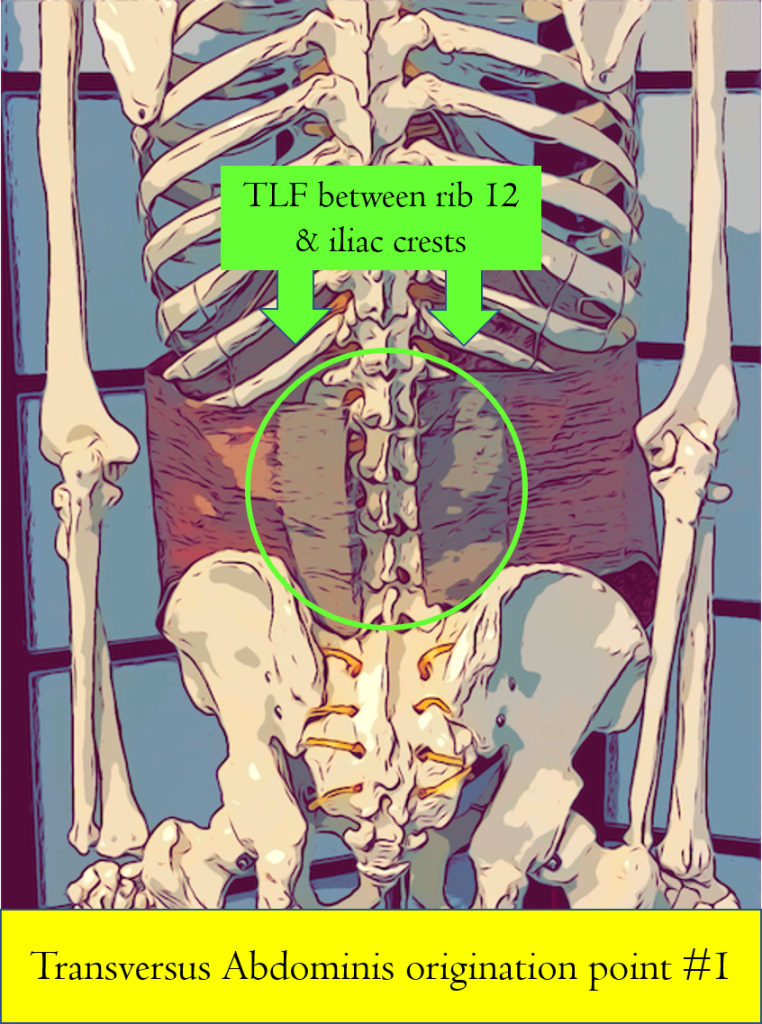


It has three insertion points: (1) the xiphoid process, which is the small bone projection at the bottom of the sternum; (2) the bulk of its muscle fibers form an aponeurosis that forms part of the Rectus sheath and inserts at the thick band of vertical connective tissue called the linea alba, which literally means, “white line”; and (3) the lower muscle fibers that originate from the inguinal ligament become an aponeurosis that joins with the aponeurosis of the Internals to form a tendon, which inserts at the pubic crest. The aponeurosis of the muscle is the center area shown below in gray.

Make note of where the muscle fibers are. When we contract this muscle with necessary muscle effort, insertion bone moves toward origination bone: the xiphoid process, pubic crests, and linea alba move toward the TLF, iliac crests, the cartilages of ribs 7-12, and the inguinal ligaments. Bilateral contraction of the muscle (both sides) stabilizes the lumbar vertebrae and the pelvic barrel. Give it a try.
Take a look at the Geeky Glory ++ section below for a look at unilateral contraction (one side) of this muscle.
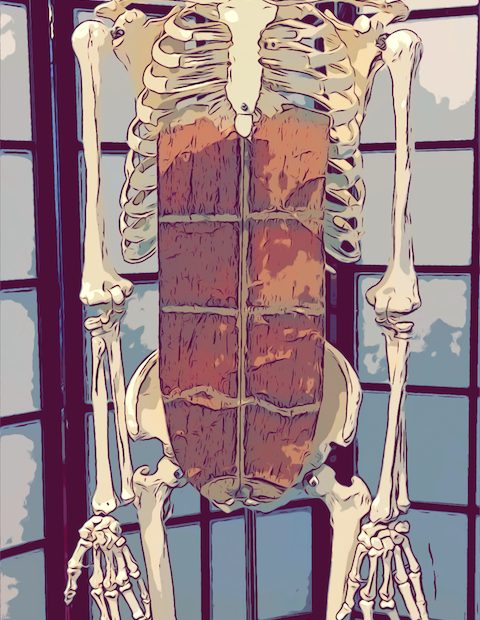
Rectus Ab. The Rectus Ab lies directly on top of the Transversus’ aponeurosis. The Rectus Ab is a pair of superficial muscles that run vertically between the lower rib cage and the pelvis on the sternum side of the body. The pair is separated by the linea alba. There are also three fibrous bands that divide the muscle horizontally, which create the hallmark “six-pack” grid of the muscle.
Each Rectus Ab originates from two places: (1) the pubic crest, and (2) the pubic symphysis of the pelvis.

It has two insertion points: (1) the xiphoid process of the sternum, and (2) the costal cartilage of ribs 5-7.

Make note of where the muscle fibers are. When we contract this muscle with necessary muscle effort, insertion bone moves toward origination bone: the xiphoid process and the cartilages of ribs 5-7 move toward the pubic crests and the pubic symphysis. This stabilizes the lumbar vertebrae and the pelvic barrel. With additional muscle effort, our contraction causes flexion of the vertebrae forward. Give it a try.
Internals. The Internals are a pair of thin abdominal muscles, generally located between the rib cage and the pelvic barrel. They lie on top of the Transversus and the Rectus Ab and underneath the Externals. Each Internal has an aponeurosis at the center of the abdomen that helps form the Rectus sheath (the center area shown below in gray).
The Internals originate from three places: (1) the TLF; (2) the front two-thirds of the iliac crests; and (3) the iliopectineal arch, which is a thickened band of fused iliac and Psoas fascia.
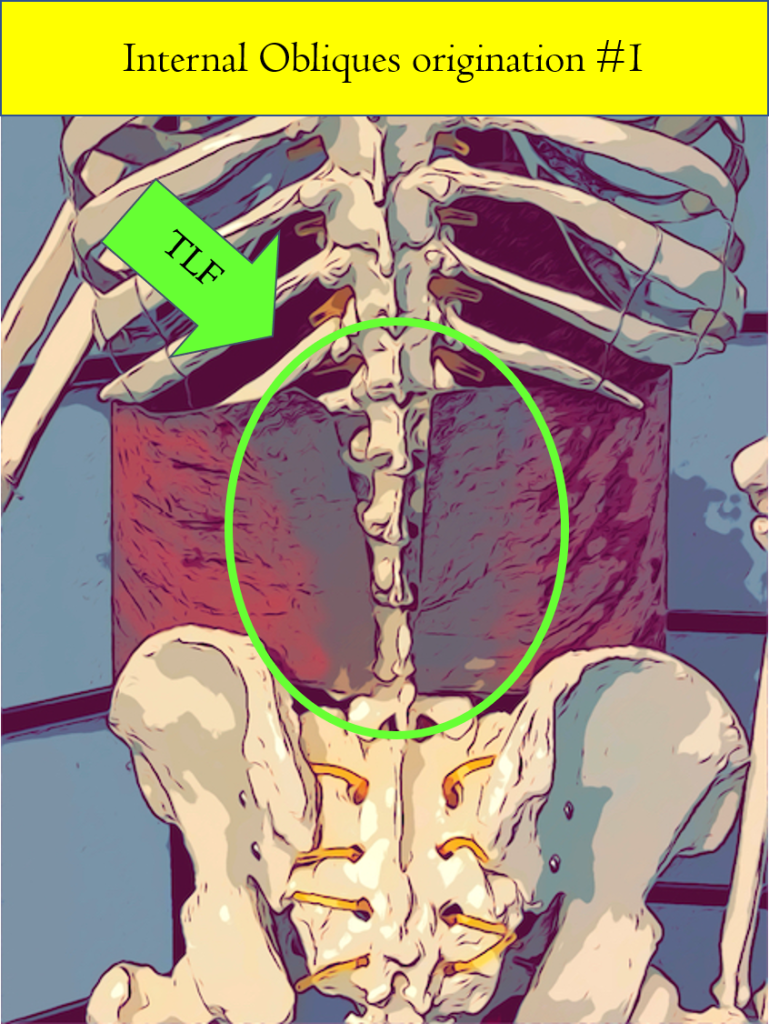


They have three insertion points: (1) the muscle fibers that originate at the TLF insert at the costal cartilages of ribs 10-12; (2) the muscle fibers that originate from the front two-thirds of the iliac crests become an aponeurosis that inserts at the linea alba; (3) the iliopectineal arch merges with the Transversus’ aponeurosis to form a tendon that inserts at the pubic crests.


Make note of where the muscle fibers are. When we contract this muscle with necessary muscle effort, insertion bone moves toward origination bone: the rib cage barrel (ribs 10-12), linea alba, and pubic crests move toward the TLF, iliac crests, and fascia near the pubic bone. Bilateral contraction stabilizes the lumbar vertebrae and pelvic barrel. Give it a try.
Take a look at the Geeky Glory ++ section below for a closer look at unilateral and bilateral contraction of this muscle.
Externals. The Externals are the largest and most superficial abdominal muscle and lie on top of the Internals. Each muscle is located between the lower half of the rib cage and the pelvis, and has an aponeurosis at the center of the abdomen that helps form the Rectus sheath. Because the Externals are the most superficial, their aponeurosis is the layer of the Rectus sheath closest to the skin.
The Externals originate at the surface of ribs 5-12. The attaching fibers interlock with the fibers of the Lats on ribs 9-12 and form a zig-zag line on each side of the rib cage (not shown here).
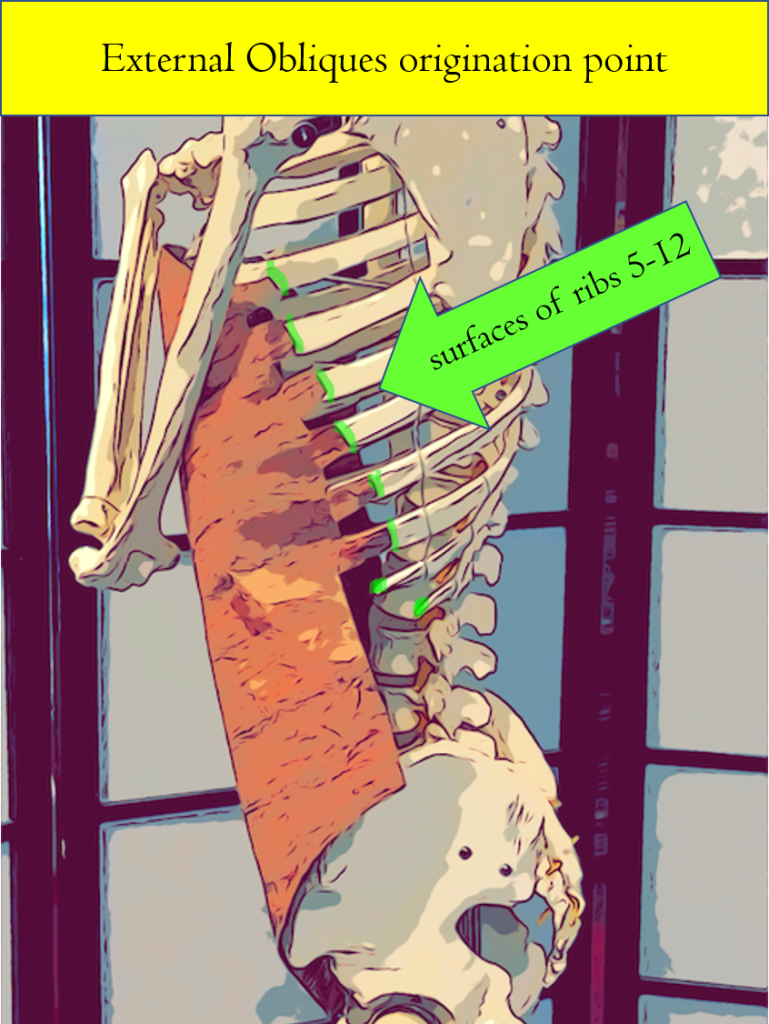

The Externals run toward the center of the sternum side of the body and become an aponeurosis (the center area shown below in gray), which has three insertions points: (1) the linea alba; (2) the pubic tubercle (a bony projection located on the pubic crest); and (3) the iliac crest.

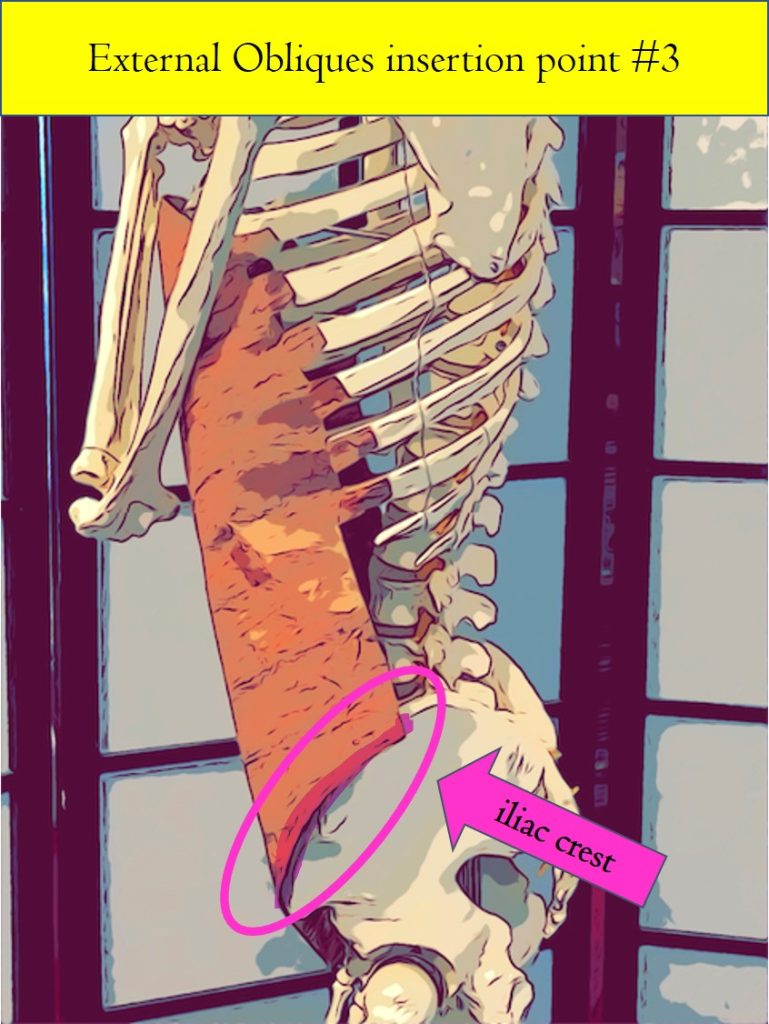
Make note of where the muscle fibers are. When we contract this muscle with necessary muscle effort, insertion bone moves toward origination bone: the linea alba, the pubic tubercles, and the iliac crests move toward ribs 5-12. Bilateral contraction stabilizes the lumbar vertebrae and pelvic barrel. Give it a try.
Take a look at the Geeky Glory ++ section below for a closer look at unilateral and bilateral contraction of this muscle.
Note that, unlike the Transversus and the Internals (the other two lateral flat abdominals), the Externals do not originate at the TLF. Instead, their indirect connection to the vertebrae is through their origination at ribs 5-12 and the interlock of their fibers with those of the Lats. Like the other lateral flat abdominals, however, they insert at the linea alba and the pubic crests.
* * *
Now you have a general idea of where the Four Abdominals are and what they look like. Physical knowledge of the origination and insertion points is the beginning of understanding how to use them.
Geeky Glory +
Like the TLF, the linea alba is a structure for muscle attachment where there is no bone. The linea alba is a vertical, thick, fibrous seam formed by the three interlacing aponeuroses of the Transversus, the Internals, and the Externals, where the two halves of the lateral flat abdominals fuse. The linea alba originates at the xiphoid process and inserts at the pubic symphysis and pubic crests. Thus, this seam runs between the sternum and the pelvic barrel. Take a look again at the insertion points for the Transversus, Internals, or Externals for photos that specifically call out the linea alba.
The TLF and linea alba, then, are one of the origin or insertion “bones” for the abdominals.
Geeky Glory ++
The Obliques can work unilaterally or bilaterally – in other words, one side or both sides of each muscle can contract to move the vertebrae, which moves the rib cage. It is important to remember that, although the lumbar vertebrae can laterally flex to some extent, their ability to rotate is very limited to nil. When I talk about rotation caused by the Obliques, I mean rotation of the thoracic vertebrae.
When we flex the spine right or left, contraction of both the Internals and the Externals on the right (or left) side, together with the Lats and the Erector Spinae, causes flexion of the spinal column on the same side. Contraction of all of these muscles is unilateral and ipsilateral.
When we rotate the spine, simultaneous contraction of the right (or left) side External and the opposite side Internal causes rotation of the spinal column to the opposite side. The opposite side Transversus and Lat are also involved in this rotation. The External’s contraction is contralateral and the Internals, Transversus, and Lat’s contraction is ipsilateral. All are unilateral – one side of each of the muscles is working.
When we flex the spinal column forward, contraction of both sides of both Obliques (bilateral), together with the Rectus Ab and Erector Spinae, causes flexion of the spinal column.
For stabilization of the spinal column, bilateral contraction of both Obliques helps maintain neutrality of the lumbar vertebrae and pelvic barrel (which prevents extension or flexion of the sacrum and tailbone), adding both Obliques’ necessary muscle effort to the Transversus and Rectus Ab’s muscle effort. This is how all of the Four Abdominals stabilize the lumbar vertebrae and pelvic barrel.
Technique Fundamentals
In practical terms, the Four Abdominals are about balance. By and large, every dancer understands that the abdominal muscles provide centrally-located strength that has direct bearing on our balance. I would bet, however, that most dancers think of them (if they understand that there is more than one muscle at work) as located vaguely in the “front” of the body. I would also bet that most dancers do not think of the abdominals as muscles that move bone. What muscle habit do you have when you use the abdominals to balance? Now that you can see what you must contract, is your muscle habit engaging the full capacity of all of the Four Abdominals?
The Four Abdominals can be tricky – they generally work, whether we think about them or not, especially when we are young and strong. But, if we are not properly and actively using them when we dance, are they increasing or decreasing our technical ability?
In Literal Technique, I do not treat the Four Abdominals like an amorphous, monolithic, front-of-the-body, self-operating block of muscle. I called attention to the location of their muscle fibers as a first step in shifting awareness. Because muscle moves bone, I think we must understand which bone is moving and how it moves. We must also understand where movement begins. Ultimately, if we don’t get the big picture of what the abdominals are for – what is their purpose? – we will limit our ability to master technique.
The Four Abdominals are about balance but, more importantly, they are elemental to our technique. They are primary in the muscle chain reaction, just as the spinal column is primary in the bone alignment chain reaction. Both chain reactions are important as we learn to unify the bone alignment and the muscle use of the body, and these must be unified.
Purpose. Let’s break it down and lay it all out. The lumbar vertebrae are at our center of balance. They support most of the weight of the axial skeleton, and that weight is transferred to the legs (the femurs) through the pelvic barrel, specifically through the sacroiliac joints formed by the first two fused sacral vertebrae and the ilia of the hip bones. If we want to learn the technique of moving the dancing body, understanding muscle use at the lumbar vertebrae and pelvic barrel has to be central to our technique.
Our first technique fundamental, then, is that the primary purpose of the Four Abdominals is to stabilize the lumbar vertebrae and to provide them with additional strength necessary to support the weight of the torso as it is transferred to the femurs. Since the transfer of weight happens via the sacroiliac joints, the Four Abdominals’ primary purpose is also to stabilize the 360° pelvic barrel.
Our second technique fundamental is that the Four Abdominals’ primary purpose means that we cannot start moving without using them correctly.
Use. Understanding use of the muscles requires physical knowledge of the muscles. The abdominal muscles are not “somewhere near” the belly button, on the “front” of the body. As described in the Geeky Glory, these abdominals are 360° muscles with 360° origination and insertion points. When we contract the full power of their muscle fiber, insertion bone(s) moves toward origination bone(s). When it comes down to stabilizing the vertebrae and pelvic barrel and finding balance when we dance, actively contracting the muscles’ full capacity actually matters.
It is important to remember that muscle will move bone whether bone is aligned or not. Muscle moves bone, it does not make bone neutral. That is our job. There is, though, an interplay between bone and muscle throughout the body. Sensing this interplay is also our job and, as it turns out, our starting point is the Four Abdominals.
Once we understand how to use the Four Abdominals, we can feel it when we have achieved the central support of the at-rest lumbar vertebrae and pelvic barrel. The corollary to feeling this central support is a change in the necessary muscle effort at the sacrum, which allows the sacrum and tailbone to be at rest – they will not be flexed or extended because the lumbar vertebrae are at rest. Once the sacrum is at rest, so is the pelvic barrel. Once the pelvic barrel is at rest, so is the femur. A similar change happens in the thoracic and cervical vertebrae, which allows the arm bones to find at rest. Necessary muscle effort throughout the body allows the bones to remain at rest while we move.
So, if we contract the full capacity of the Four Abdominals when we start moving, we can feel all the other necessary muscle effort emanate from our center of balance, which will help us find a harmonious interplay between the bones and muscles.
Simultaneity: A Network of Muscle Effort & A Muscle Chain Reaction. These two fundamentals lead us to two more. The Four Abdominals work together to provide strength and stability at our center of balance, but they don’t all do the same thing, and they do not act all by themselves. So, our third technique fundamental is that the abdominals are part of a network of muscle effort that stabilizes and/or moves the vertebrae and the pelvic barrel. We see this in their 360° work with the Erector Spinae, the Lats, and the Pec Majors. The best way to build strength and prevent imbalances in the body is to find this network.
This network uncovers a crucial fourth technique fundamental, which is that muscle use is another sort of chain reaction in the fusion body that starts with the Four Abdominals. Their use is primary. Assuming that we are able to maintain an at-rest skeleton while we dance, their use allows us to feel how our alignment is dynamic – the bones’ relationships change at the very instant we move an arm or a leg or turn our head, which, in turn, impacts our balance. Using the full capacity of the Four Abdominals when we move simultaneously establishes the necessary muscle effort of the other muscles and starts the chain reaction.
We then have the ability to make changes in muscle effort while we dance, changes that will allow us to respond to changes in our alignment and balance. If we do not begin movement with the Four Abdominals, then we have started somewhere else, and the chain reaction is upended. The sensation and nuance of muscle use in the dancing body will be lost.
What muscle habits do you have when you start moving? When do you contract the abdominals? When and how do you use them when you use your legs?
Fusion. If mimicking movement is a big part of our training, we may not be accessing all of our strength and facility. Literal Technique says that use of the muscles requires physical knowledge of the muscles. I believe that physical knowledge will increase our technical ability in a far more lasting way than repetition and trial and error.
The Four Abdominals are about balance but, more importantly, they are elemental to our technique. They are primary in the muscle chain reaction, just as the spinal column is primary in the bone alignment chain reaction. Both chain reactions are important as we learn to unify the bone alignment and the muscle use of the body, and these must be unified. Acknowledging the chain reactions brings them to life so they can improve our technical mastery.
Technique is a means to an artistic end – it should not stymie our talents. Muscle habits that weaken our dancing do not have to be permanent. Technique can be learned, re-learned, and repaired. Literal Technique says that so long as we train the mind to override the reality of the body, unified movement will escape us. Learning to dance with a fusion body requires a shift in understanding. To reach our potential, our goal must be to learn to view and train the body we are in, not a non-existent body we try to access through mental imagery or mimicry. Mark this as our ninth step toward a fusion body.
Next installment: The Femur
Installment No. 6: The Spinal Column
Installment No. 8: The Rib Cage
Installment No. 9: The Erector Spinae
Installment No. 10: Movement of the Arm
Installment No. 11: The Latissimi Dorsi
Installment No. 12: The Pectoralis Majors
Installment No. 13: The Pelvis
Photos credit: Jill Redfern
You can send comments and questions to Jill at info@thirdshiftmovementshop.com. Please subscribe to the Third Shift’s YouTube channel and follow the Third Shift on Facebook.