
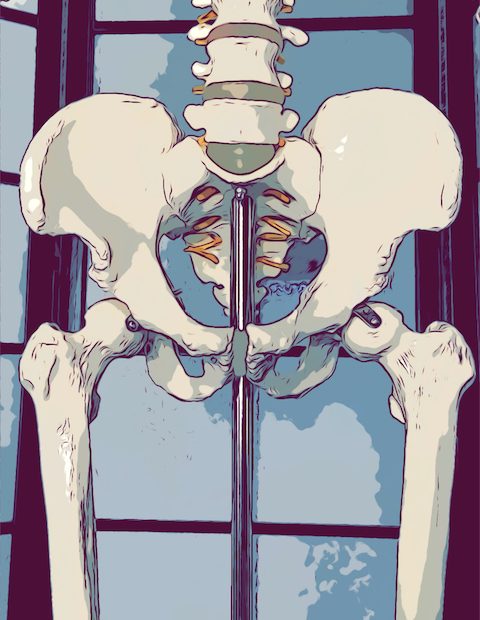
Welcome to the Third Shift Movement Shop, home of Literal Technique, where we work so we can move. And welcome to Installment No. 13 of The Central Geekdom of Dance Technique, “The Pelvis.”
It is very easy to think of the pelvis as the starting point for many of our alignment problems. Dance technique can seem to originate from the pelvis and almost nowhere else. Although it is true that its alignment, stabilization, and movement impact the movement of the entire body, learning about the pelvis teaches us that, once again, the spinal column is where movement begins. This knowledge shifts our understanding of the pelvis and, since the at-rest nature of the pelvis impacts the femur, it also shifts our understanding of the femur.
It is important to understand that, when we dance, a sort of anatomical chain reaction occurs from spinal column to pelvis to femur, which gives us a fantastically geeky way to replace body-parts thinking with physical knowledge of the body we are in. Mark this as our eighth step toward a fusion body.
What Happens Where
Movement of the pelvis happens at its connection to the sacral vertebrae (the sacrum). When we move the sacrum, the pelvis moves.
Remember, the meeting point of L5 and S1 forms the lumbosacral joint, which connects the lumbar vertebrae to the sacrum; here, the anatomical curve of the vertebrae shifts from lordotic (the lumbar vertebrae’s curve) to kyphotic (the sacrum’s curve). When the lumbar vertebrae flex, the sacrum and tailbone extend (curve under). When the lumbar vertebrae extend, the sacrum and tailbone flex (tilt up).
So, when we move the lumbar vertebrae, the pelvis moves.
This means that the at-rest nature of the pelvic barrel is inseparable from the at-rest of the spinal column: the at rest of the pelvic barrel begins with the at rest of the spinal column.
Because its connection to the sacrum is relatively fixed, the pelvic barrel is stabilized or moved by the muscles that stabilize or move the spinal column. In our group of 12, direct muscle effort comes from the Erector Spinae, the Latissimus Dorsi, the Pectoralis Major, the Transversus Abdominis, the Rectus Abdominis, and the Internal and External Obliques.
The pelvic barrel includes the hip joints, which allow movement of the femurs. Thus, the at-rest nature of the pelvic barrel is inseparable from the at-rest of the femurs: the at rest of the pelvic barrel impacts the at rest of the femurs and vice versa.
This means that the five muscles in our group of 12 that stabilize or move the femur – the Psoas, the Glutei Maximi, the Hamstrings, the Adductors, and the Quadriceps Femoris – can impact or are impacted by the at-rest nature of the pelvic barrel.
The pelvic barrel is the juncture of the spinal column and the femurs, revealing a very real and complex fusion that is at the center of our alignment and technique.
Alignment of the pelvic barrel is one of the most fundamental, complex, and critical alignments to find. So, how do we figure it out? Literal Technique says that we figure out alignment by looking at the literal body.
Geeky Glory
Anatomy shows us that the pelvis is made up of three bones: the hip bone, the sacrum, and the tailbone. Since the sacrum and the tailbone are part of the spinal column and the spinal column is part of the axial skeleton, through its connection to the pelvis, the axial skeleton is connected to the femur.
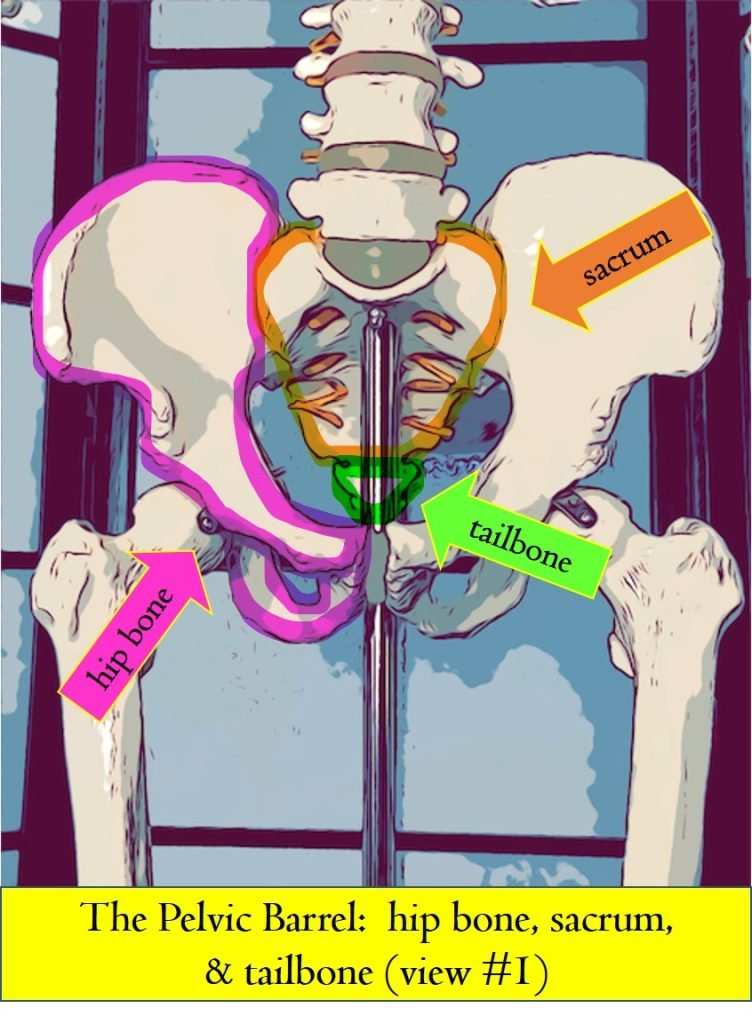
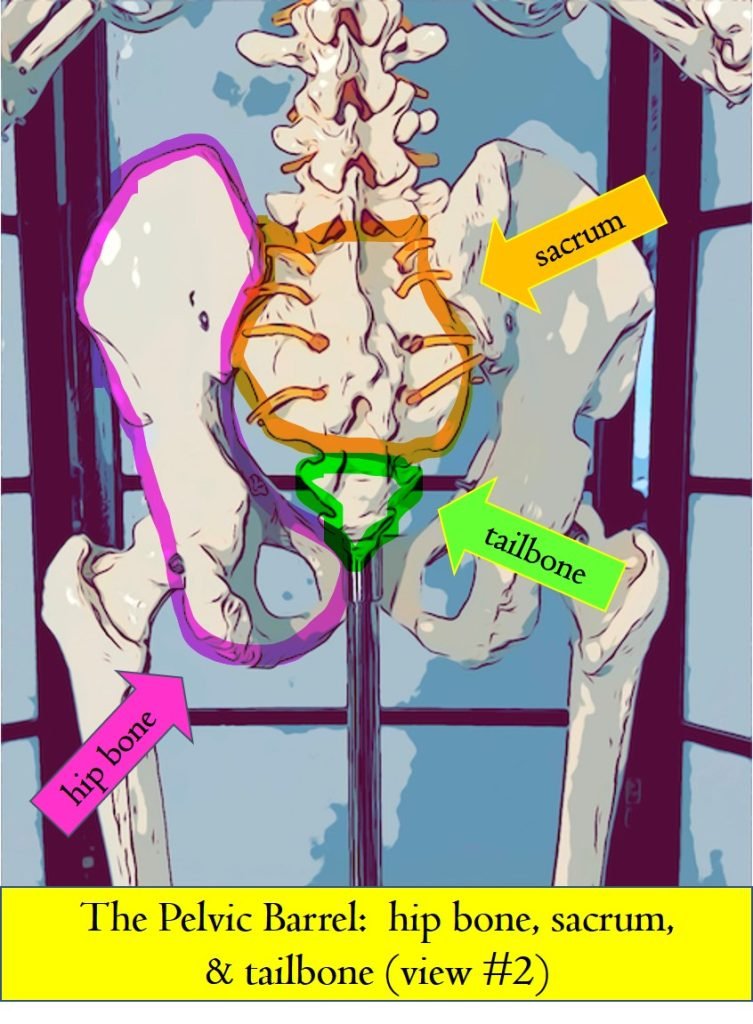
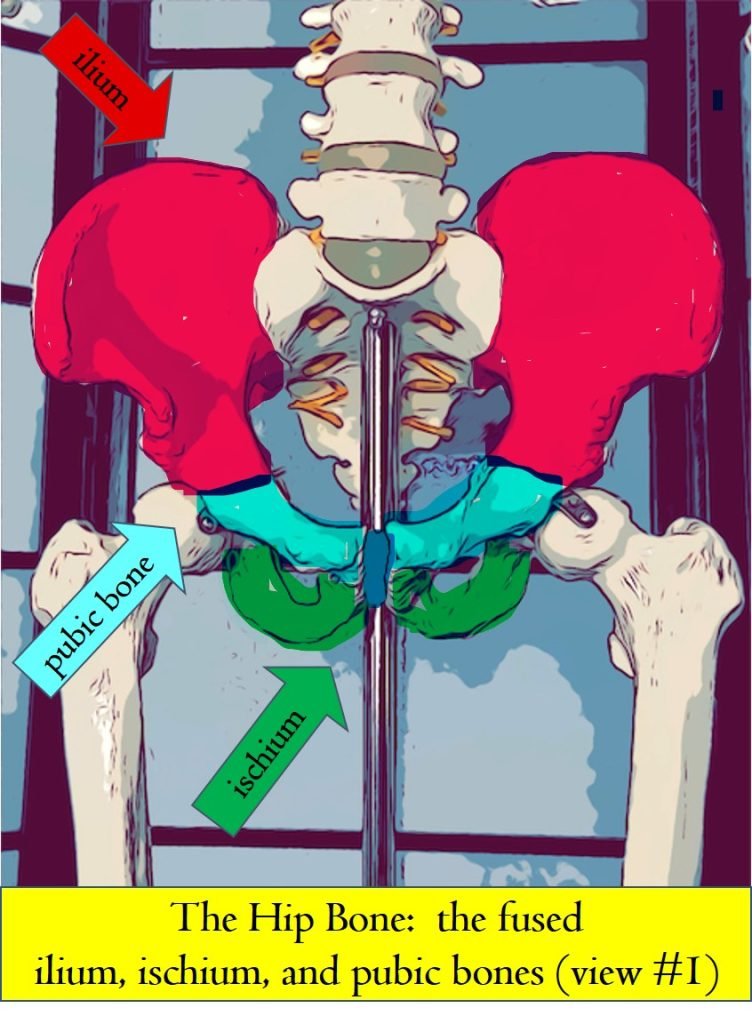
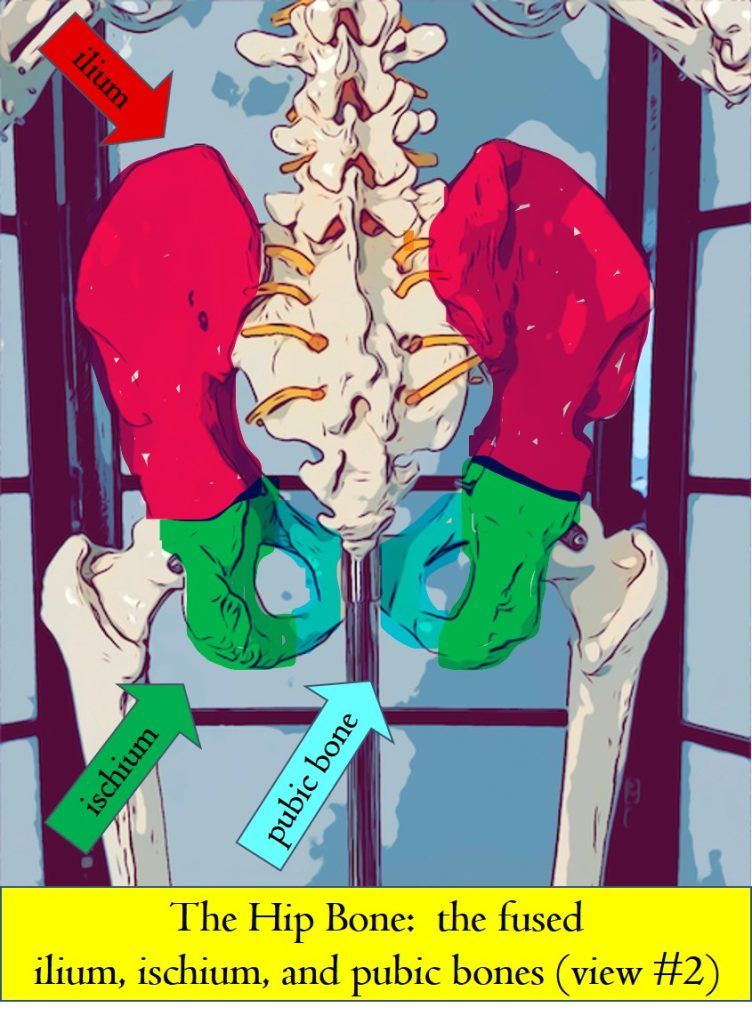
The hip bone is actually three fused bones: the ilium (largest bone of the three and the main bone of the pelvis); the ischium (curved base of the pelvis, also called the “sitz bone”); and the pubic bone. There are two hip bones, one on each side of the sacrum.
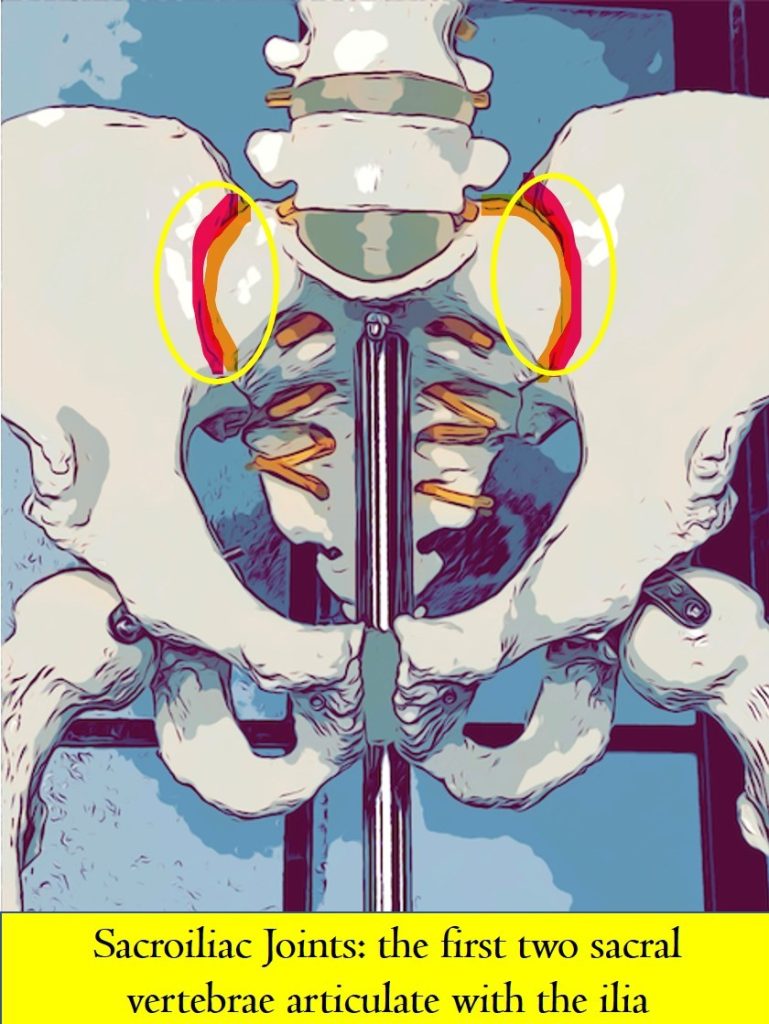
The sacrum, remember, is made up of the five fused vertebrae just below the lumbar vertebrae. The first two fused vertebrae articulate with the ilia of the hip bones to form the sacroiliac joints, one on either side of the sacrum. The sacroiliac joints’ main purpose is to support the weight of the axial skeleton and transfer it to the hip bones; from there it is conveyed to the femurs, if we are standing, or the ischia (the sitz bones), if we are sitting.
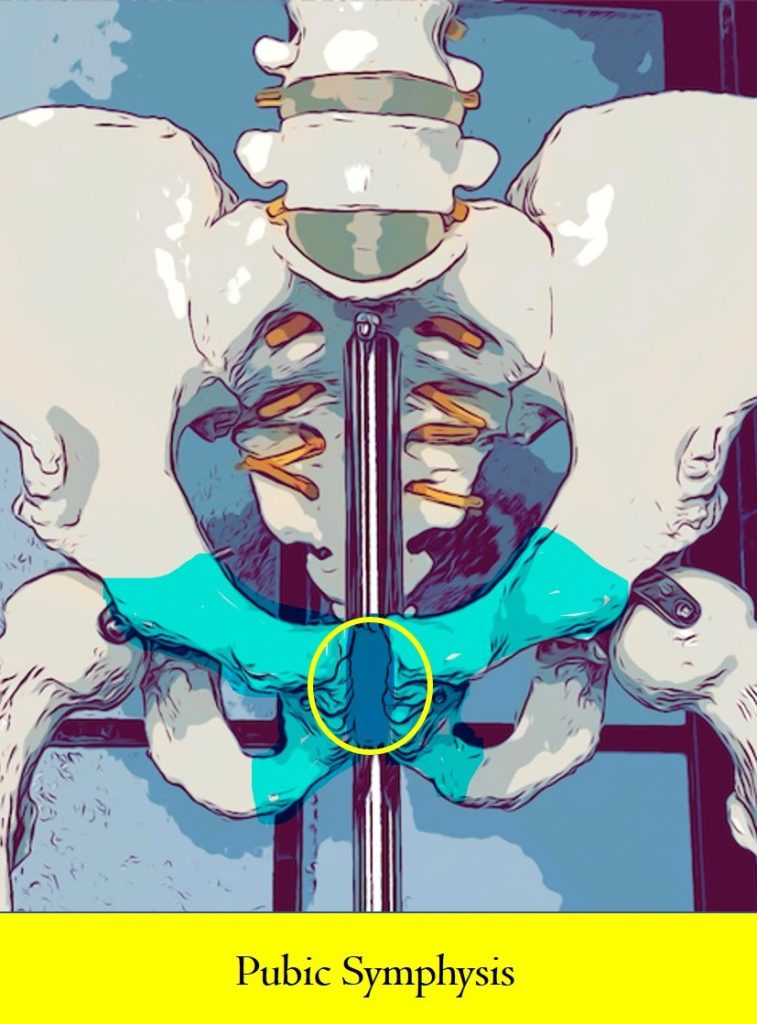
The two pubic bones are joined by what is called the pubic symphysis.
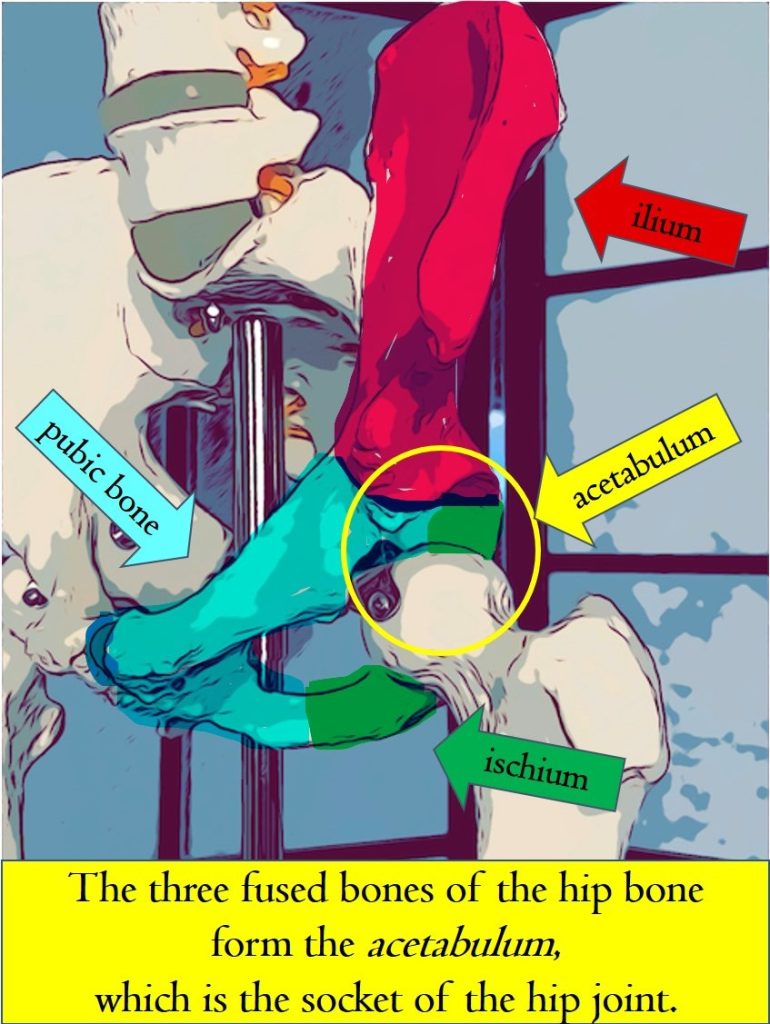
Portions of the three fused bones of the hip bone form the acetabulum, which is the socket of the hip joint. The acetabulum and the head of the femur form the hip joint.
Geeky Glory +
Medical anatomy divides our bones into two skeletons, the axial and the appendicular. The axial skeleton includes the spinal column, the skull, and the rib cage barrel. The arm bones, the pelvic barrel, and the femur are part of what is called the appendicular skeleton (the appendages). The connections between the two skeletons are where weight transfers in the body. For example, in the Geeky Glory of the arm bones, we see that the collar bone braces the shoulder by transferring weight from the arms to the axial skeleton. In the Geeky Glory of the pelvic barrel, we see that the weight of the axial skeleton is borne by the pelvis and transferred to the femurs. Though it is important to know where weight transfers, Literal Technique, through the work of the simultaneously different muscle effort needed to move the torso and the arms and legs of a fusion body, essentially dispenses with the idea of two skeletons.
Physical knowledge provides us with the understanding that the body is not broken into parts. We must learn to feel a 360° torso powered by different muscles doing different things simultaneously. The goal of Literal Technique is to teach dancers how to inhabit the body this way.
Technique Fundamentals
To support our weight and move through space in or out of time, alignment of the pelvic barrel is one of the most fundamental, complex, and critical alignments to find. So, how do we figure it out? Literal Technique says that we figure out alignment by looking at the literal body.
The pelvis is another bone split in half by the front-and-back thinking of existing technique. Literal Technique refers to the pelvis as a “barrel”; pelvic barrel means the sacrum-ilium-ischium-pubic-bone barrel. Like the rib cage, the pelvis is a 360° thing – a barrel – not a front and a back thing, with bone connections to the sacral vertebrae and the femur.
Literal Technique recognizes that vertebrae in the spinal column make up the sacrum, and the sacrum is one of the bones of the pelvic barrel. This is key because it refocuses us on the fact that the pelvic barrel moves because the lumbar and sacral vertebrae move. The pelvic barrel does not move – the lumbar and/or sacral vertebrae move, and the pelvic barrel comes along for the ride. The femur, via the hip joint, also comes along for the ride.
Although it is possible to extend the sacrum and the tailbone without involving the lumbar vertebrae, the misalignment of the pelvic barrel for dancers seems to stem from either (1) flexing the lumbar vertebrae, which curves the sacrum and tailbone under (they extend), or (2) extending the lumbar vertebrae, which tilts the sacrum and tailbone up (they flex). So, incorrect alignment of the spinal column creates misalignment of the pelvic barrel and the femur, either by locking up the hip joint or by locking up the sacral and lumbar vertebrae.
I have never heard a correction to the first problem (if you have, please send me a message), which has led me to believe that it’s not considered a problem. It’s possible that the grip-and-grind-squeeze-your-butt-to-maintain-turn-out teaching results in this misalignment. It could also be created from a general misunderstanding of which muscles to use to stabilize the spinal column and/or how to use them. Whatever the reason, dancers may spend their entire dance lives dancing this way, perhaps believing they have achieved a technical fundamental.
As for the second problem, a common correction focuses on a dancer’s ischia – the sitz bones – through the use of images like, “line up the sitz bones with the heels.” This image is a temporary fix, at best, mostly because it does not get at the root of the problem, which is the alignment of the sacral and lumbar vertebrae. The pelvis moves because the sacral and/or lumbar vertebrae move, so corrections should start there, not at the sitz bones.
This correction also joins the group of corrections that focuses on one “part” of the body (in this case, the sitz bones) and its spatial relationship to another “part” (in this case, the heels). This opens the door, in general, to the fact that, if we are talking about aligning the sitz bones (or the pubic bones), we are really talking about aligning the pelvic barrel, since neither the sitz bones nor the pubic bones can move independently of each other or the pelvic barrel.
In the end, we really have to stop dividing the body into parts, hoping that we will find complex alignment this way. Literal Technique finds technique fundamentals in the literal body instead.
The Pelvic Barrel and the Spinal Column. The anatomy shows us that the alignment of the entire moving body depends on understanding where the spinal column is. For the pelvic barrel, its bone connection to the spinal column means that any misunderstanding of where at rest is for the sacral or lumbar vertebrae will immediately impact the pelvic barrel (as well as the thoracic and cervical vertebrae).

So, our bone starting point for at rest of the pelvic barrel is its connection to the sacrum. Logically, the pelvic barrel cannot be out of alignment. If the pelvis is doing something we don’t want it to do, we must look to the alignment of the spinal column. Ultimately, in Literal Technique, any question about alignment of the pelvic barrel becomes one about stabilization and movement of the spinal column.
The Pelvic Barrel and the Rib Cage Barrel. Movement ofthe pelvic and rib cage barrels happens at the spinal column. They share this basic feature. The rib cage barrel’s connection to the thoracic vertebrae means that its movement happens when these vertebrae flex, extend, or rotate. The pelvic barrel’s connection to the sacrum means that its movement happens when the sacrum and tailbone flex or extend. The relationship between the sacral and lumbar vertebrae makes flexion or extension of the lumbar vertebrae part of the movement picture.
Understanding where movement happens is important when we talk about alignment. As we know, the spinal column is one structure with 33 vertebrae, and the vertebrae are designed to move jointly but differently. This one structure is stabilized/moved with simultaneously different muscle effort. So, alignment and movement of the pelvic and rib cage barrels requires an acute awareness of muscle effort along the spinal column, especially when the vertebrae do not move in the same way (the lumbar flexes and the thoracic vertebrae rotate, for example).

The awareness of the connection between these two barrels is another layer of fusion in Literal Technique. And, again, the common denominator for alignment, stability, and movement is the spinal column.
The Pelvic Barrel and The Femur. A stable pelvic barrel allows a range of movement for the femur, but only when the pelvic barrel is at rest. If it is not, movement of the femur is restricted, and it will not be able to achieve its full range of movement. Moreover, alignment of the femur in the socket directly impacts the alignment and stability of the knee and ankle joints. Thus, not only is the pelvic barrel’s at-rest nature determined by what the spinal column is doing, but so is the femur’s. And, yet again, the common denominator for alignment, stability, and movement is the spinal column.
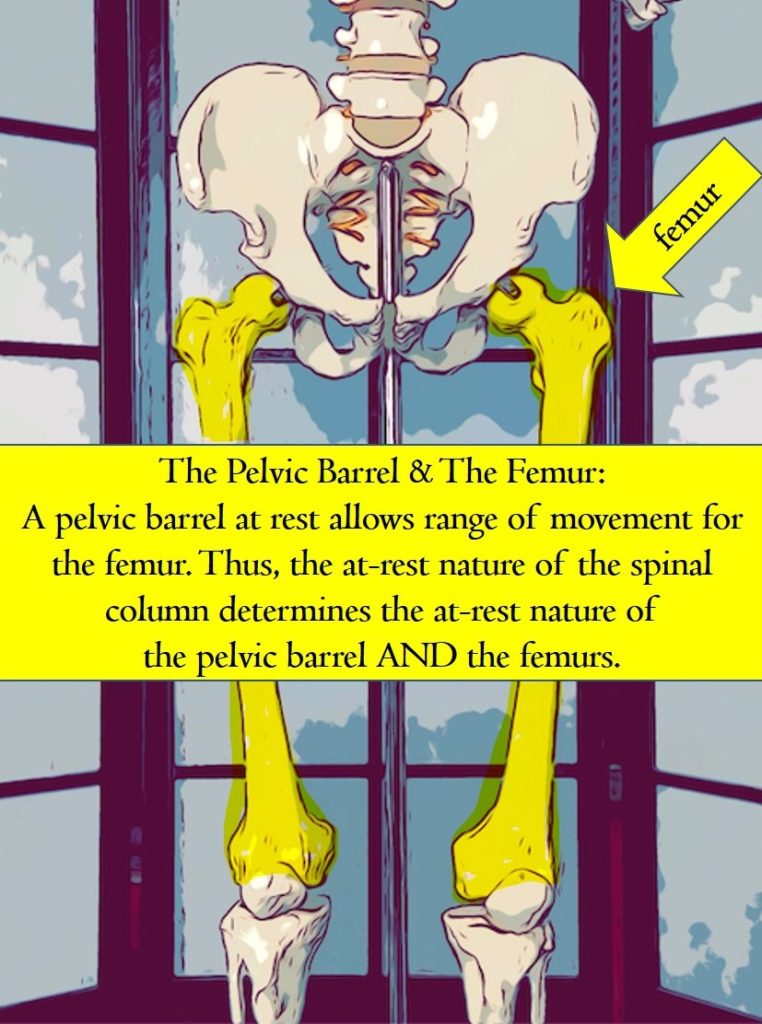
Fusion. Finding at rest and stabilizing the pelvic barrel is complex. The way into understanding what to do lies with understanding the logic of the literal body. When we break it down, we see the centrality of the spinal column in the alignment of the pelvic barrel. If we start with the spinal column, we impact the pelvic barrel and then the femur, in that order.
Physical knowledge provides us with the understanding that the body is not broken into parts. The pelvic barrel is stabilized and moved as a 360° barrel by the spinal column in a 360° torso. We must learn to feel a 360° torso powered by different muscles doing different things simultaneously. The goal of Literal Technique is to teach dancers how to inhabit the body this way.
The four abdominal muscles in our group of 12 will provide muscle effort for the spinal column, the rib cage barrel, the arm bones, and the pelvic barrel and will show us more of the fusion of the 360° torso.
A discussion of the femur and, after that, the five muscles in our group of 12 that move the femur will complete the complex accumulation of all of the 12 muscles. We are well on our way to learning how to view and train the body as a fusion body, in all its geeky glory.
Next installment: The Abdominal Muscles
Installment No. 6: The Spinal Column
Installment No. 7: The Skull
Installment No. 8: The Rib Cage
Installment No. 10: Movement of the Arm: The Humerus, The Collar Bone, The Scapula, & The Sternum
Photos credit: Jill Redfern
You can send comments and questions to Jill at info@thirdshiftmovementshop.com. Please subscribe to the Third Shift’s YouTube channel and follow the Third Shift on Facebook.