Welcome to the Third Shift Movement Shop, home of Literal Technique, where we work so we can move. And welcome to Installment No. 9 of The Central Geekdom of Dance Technique, “The Erector Spinae.”
In Installment No. 5, “Toward A Fusion Body,” I talked about how dance training is the process by which dancers learn the technique of simultaneously stabilizing and moving the body, which is accomplished by using simultaneously different muscle effort. The Erector Spinae muscles give us a straightforward example of what simultaneously different muscle effort means. As the introduction of the first muscle in our group of 12, they also launch the discussion about how to use muscle to stabilize and move bone, which is central to learning Literal Technique.
What Happens Where
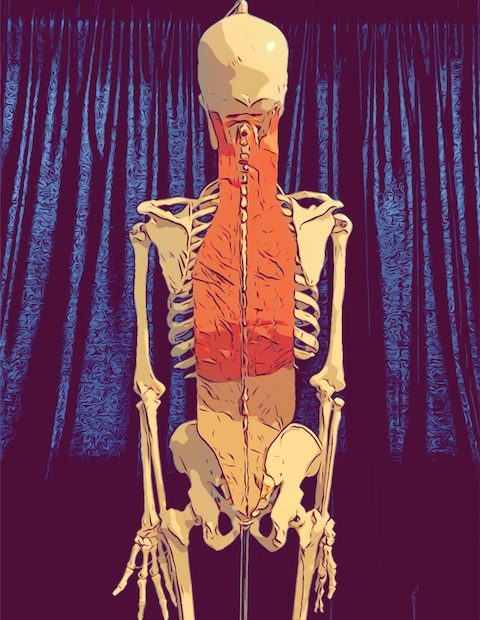
The Erector Spinae (pronounced, “spy-nee” or “spy-nay”) are intrinsic muscles in the back. These muscles are a complex network, a muscle group, and they span the length of the spinal column, from the skull to the sacrum.
The Erector Spinae’s job is both to stabilize and to move the entire vertebral column. They help us stay upright without eliminating the spinal column’s anatomical curves. They extend and laterally flex the spinal column, including the skull. They help rotate the skull (and, depending on the source you read, they also help rotate the spinal column). They can simultaneously stabilize some vertebrae while they move other vertebrae.
The Erector Spinae muscles are just one muscle in our group of 12 that we use to stabilize the at-rest spinal column or to move it in and out of rest. The Erector Spinae are the only muscles in our group of 12 that help us align and move the skull.
In a fusion body, however, keep in mind that the spinal column is stabilized/moved with simultaneously different muscle effort from all of the 12 muscles – the Erector Spinae, the Latissimus Dorsi, the Pectoralis Major, the Transversus Abdominis, the Rectus Abdominis, the Internal and External Obliques, the Psoas, the Glutei Maximi, the Hamstrings, the Adductors, and the Quadriceps Femoris. This is true because the movement of the spinal column impacts the skull, the shoulder bones, the rib cage barrel, the pelvic barrel, and the femur.
The Erector Spinae muscles provide a vivid example of the technique of applying simultaneously different muscle effort to bone.
Geeky Glory
The Erector Spinae muscles are a pair of three vertical muscles on either side of the spinal column, so they are a muscle group. Each of the three muscles are conventionally divided into three groups and organized by location on the spinal column: cervical, thoracic, and lumbar/sacral. This is useful when we are learning the anatomy.
The first of the three, the spinalis muscles, are closest to the spine. They stabilize, extend, and laterally flex the cervical and thoracic vertebrae of the spine. Here are the three groups:
Spinalis capitis, originates at C7-T1 and inserts at the midline of the skull’s occipital bone;
Spinalis cervicis, originates at C7-T1 and the nuchal ligament (a ligament in the nape of the neck) and inserts at C2-C4; and
Spinalis thoracis, originates at T11-L2 and inserts at T2-T8.
The second of the three, the longissimus muscles, are next to the spinalis muscles as we move away from the spine. They span the entire length of the spinal column, from the skull to the sacrum; they stabilize, extend, and laterally flex the spinal column and help rotate the skull. Here are the three groups:
Longissimus capitis, originates at C4-T5 and inserts at the mastoid process of the temporal bone;
Longissimus cervicis, originates at T1-T5 and inserts at C2-C6; and
Longissimus thoracis, has two parts. Part One originates at the middle of the ilium and inserts at L1-L5. Part Two originates at L1-L5, the sacrum, and the iliac crest and inserts at T1-T12 and ribs 5-12.
The last of the three, the iliocostalis muscles, are the farthest from the spine. They span almost the entire length of the spinal column, from C4 to the sacrum; they stabilize, extend, and laterally flex the spinal column. Here are the three groups:
Iliocostalis cervicis, originates at ribs 3-6 and inserts into C4-C6;
Iliocostalis thoracis, originates at ribs 7-12 and inserts at ribs 1-6 and C7; and
Iliocostalis lumborum, has two parts. Part One originates at the crest of sacrum, the iliac crest, and the thoracolumbar fascia (TLF), and inserts at L1-L4 and the adjacent TLF. Part Two also originates at the crest of sacrum, the iliac crest, and the TLF, but in the form of a sheath that covers Part One; it inserts at ribs 5-12.
With a pair of nine muscles, one on each side of the spinal column, we have a total of 18 muscles that work together to stabilize, extend, and laterally flex the spinal column.
Technique Fundamentals
The Erector Spinae stabilize and move the spinal column (and, thus, the rib cage barrel) and the skull. The location and function of these muscles gives us an idea about what we use them to do, but we also have to understand the bone that they move, or we end up damaging bone with muscle.
The central concept here is how to use muscle to stabilize and move bone. But, before we jump in, let’s take two steps back and review a few related, big-picture concepts.
First, when we talk about technique and alignment, we mean bone and muscle. Not bone or muscle. We mean both.
Second, maintaining a neutral skeleton does not mean that alignment is a rigid, static state in the body. Alignment in the body when we dance is dynamic – it continuously shifts when we move, and that requires us to have a nuanced understanding of what it means to simultaneously stabilize and move bone with muscle.
This leads us to muscle effort, which can mean at least three things: expression muscle effort, dictated by choreography, that we apply to movement; grip and grind muscle effort that stabilizes or moves bone in a way that it is not designed to work; and necessary muscle effort that we use to stabilize or move neutral bone. The most harmful muscle effort – and the kind we want to avoid – is grip and grind.
Where we come in, as the dancers who control the muscle that moves the bone, is through muscle effort. We decide how much effort to use to stabilize/move the bone. In Literal Technique, this means that we understand how the body moves, literally, and we direct it. We control the form the body takes so we can say what we want to say.
In Literal Technique, we start with at-rest bone. The spinal column is one structure with 33 vertebrae, and the vertebrae are designed to move jointly but differently. The degrees to which the vertebrae flex, extend, and rotate depend on the particular vertebrae, yes, but the bone cannot move without muscle. How the bone is stabilized or moved will depend on the muscle effort.
Now let’s turn to the Erector Spinae. What I see is a network of muscle designed to jointly stabilize/move bone the way bone is designed to work. Because of the way we move the spinal column, stabilization and movement can happen at the same time. Where they happen depends on the movement we perform. (Good examples are cambré and tendu to the back.) This is how the Erector Spinae move the 33 vertebrae jointly but differently.
Where we come in, as the dancers who control the muscle that moves the bone, is through muscle effort. We decide how much effort to use to stabilize/move the bone. In Literal Technique, this means that we understand how the body moves, literally, and we direct it. We control the form the body takes so we can say what we want to say.
The Erector Spinae muscles provide a vivid example of the technique of applying simultaneously different muscle effort to bone. Look at and see the spinal column, the skull, and the rib cage barrel. Now see the Erector Spinae. Using these muscles, play around with moving the spinal column as one structure and moving the skull and the rib cage barrel from the vertebrae. Dictate the muscle effort. Direct the movement of the bone as it is designed to move.
The bone is neutral, and the muscle is responsive. What this leads us to is sensitive muscle and a breathing, living body. Mark this as our fourth step toward a fusion body.
Next installment: Movement of the Arm: The Humerus, The Collar Bone, The Scapulae, & The Sternum.
Installment No. 6: The Spinal Column
Installment No. 7: The Skull
Installment No. 8: The Rib Cage
Photo credit: Jill Redfern
You can send comments and questions to Jill at info@thirdshiftmovementshop.com. Please subscribe to the Third Shift’s YouTube channel and follow the Third Shift on Facebook.