
This installment is dedicated to the memory of Kathleen Hermesdorf and her handstands. I was a young dancer in San Francisco when I met her. I did not know her well. I didn’t know her at all. I saw her perform and teach. I was fascinated by her movement and her way of being movement.
I took class with Kathleen just once. We were balancing on our hands. She came up to me and touched my back at T12 with one finger, almost imperceptibly, and I felt my alignment involuntarily correct itself. She barely touched my back, and my movement changed, as if by magic. I have never forgotten that. Thank you, Kathleen.
Welcome to the Third Shift Movement Shop, home of Literal Technique, where we work so we can move. And welcome to Installment No. 11 of The Central Geekdom of Dance Technique, “The Latissimi Dorsi.”
In Installment No. 10, we talked about the arm bones and the technique of movement of the arm. The Latissimi Dorsi (also, Lats; singular, Latissimus Dorsi) and the Pectoralis Majors (my next installment), are two muscles in our group of 12 that have a direct impact on the technique of movement of the arm. When we add muscle, we start to fine-tune our understanding of how to move the arm.
The Erector Spinae launched the discussion about the use of simultaneously different muscle effort. The Lats show us this again, but also set the stage for understanding muscle in relation to other muscle. This takes us closer to the shift of understanding we need to view and train the body we are in. Mark this as our sixth step toward a fusion body.
What Happens Where
The Lats adduct, extend, and internally rotate the humerus. So, the Lats lower the arms raised at the side, down and toward the body (adduction); move the arms to behind the body (extension); open the arms raised to the front, out to the side (horizontal abduction (extension)); and rotate the arms toward the imaginary center line of the body (internal rotation). An example of movement that performs three of these actions is moving the arms behind the back and clasping the hands (extension, adduction, and internal rotation). Given the anatomy of the arm bones, this means that the Lats act directly on the shoulder joint and indirectly on the shoulder girdle.
When the humeri are fixed overhead, the Lats also function to lift the body toward the arms (non-dance examples are climbing or chin ups).
Although their main function is movement of the humeri, because the Lats have attachments on both the axial and appendicular skeletons, they also produce movements of the spinal column. They are one of the main stabilizers of the spinal column – they help us stay upright.
When we factor in bone and muscle attachments, we see that the Lats connect the humeri to the spinal column, the rib cage barrel, the pelvis, and the femur, which ultimately requires the Lats to work with all of the other 11 muscles, using simultaneously different muscle effort.
Geeky Glory
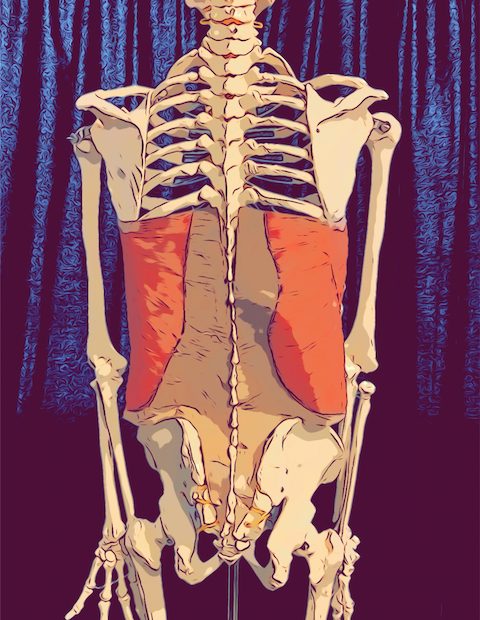
The Lats are one of the superficial extrinsic muscles in the back. They are relatively thin and cover almost all of the other superficial back muscles. The Lats are the widest muscles in the back.
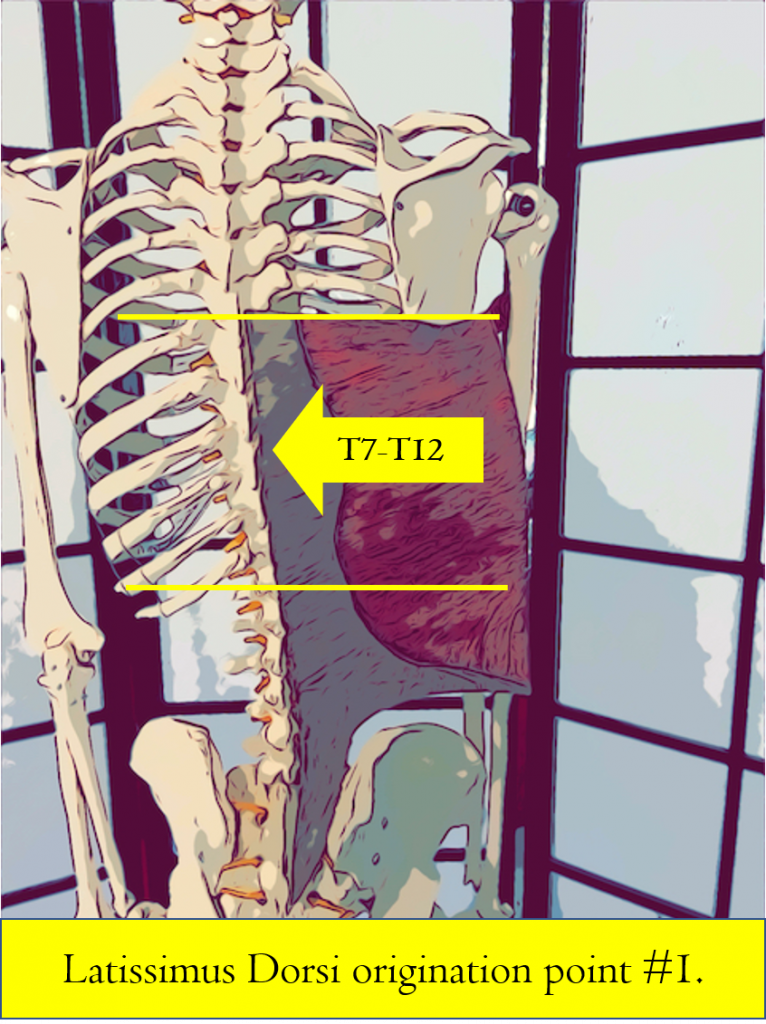
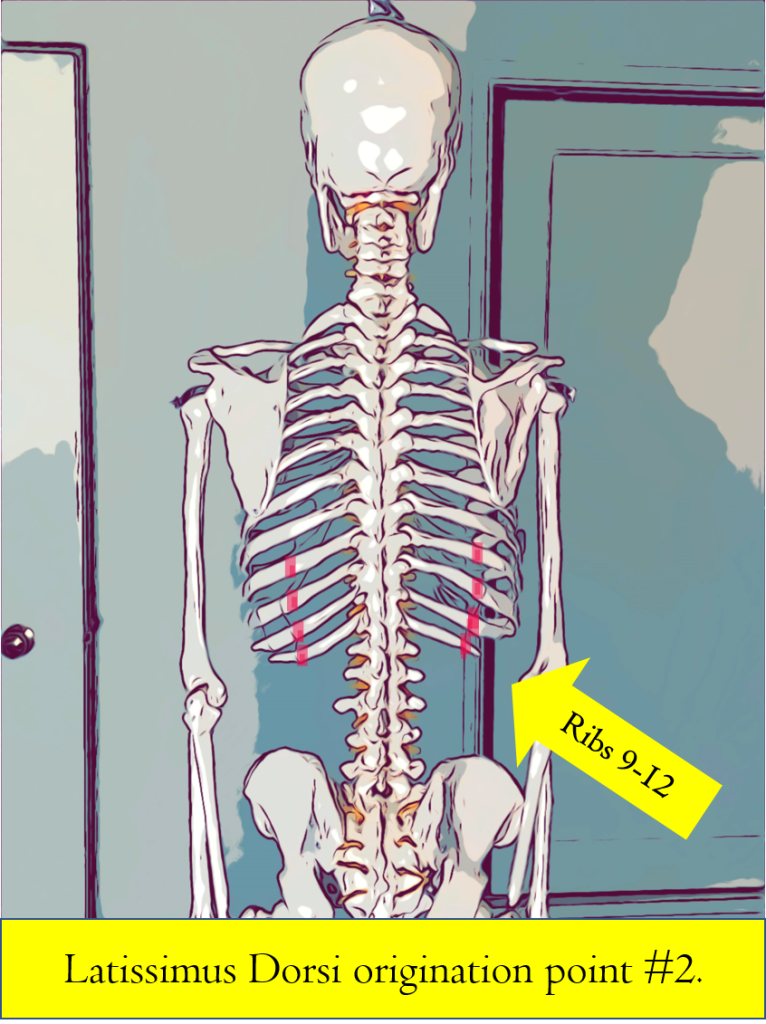
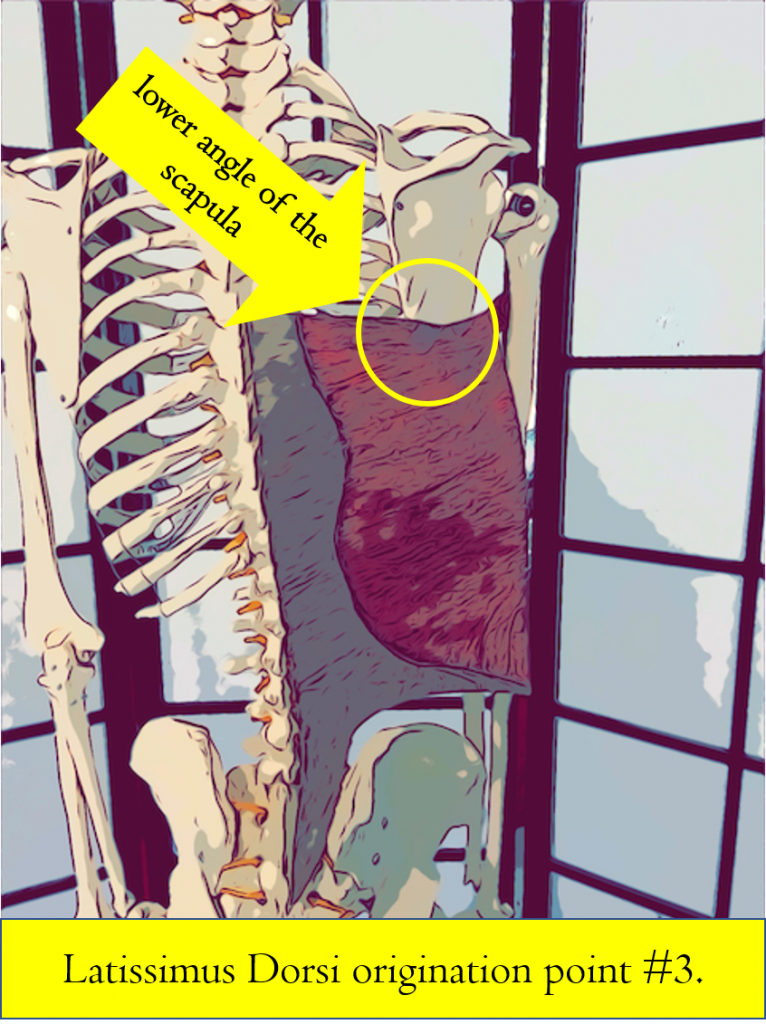
The Lats originate from five places: (1) T7-T12; (2) ribs 9-12 or 10-12; (3) the lower angle of the scapulae; (4) the lumbar and sacral vertebrae via the TLF, which is an attachment site for the Lats; and (5) the iliac crests of the pelvis.
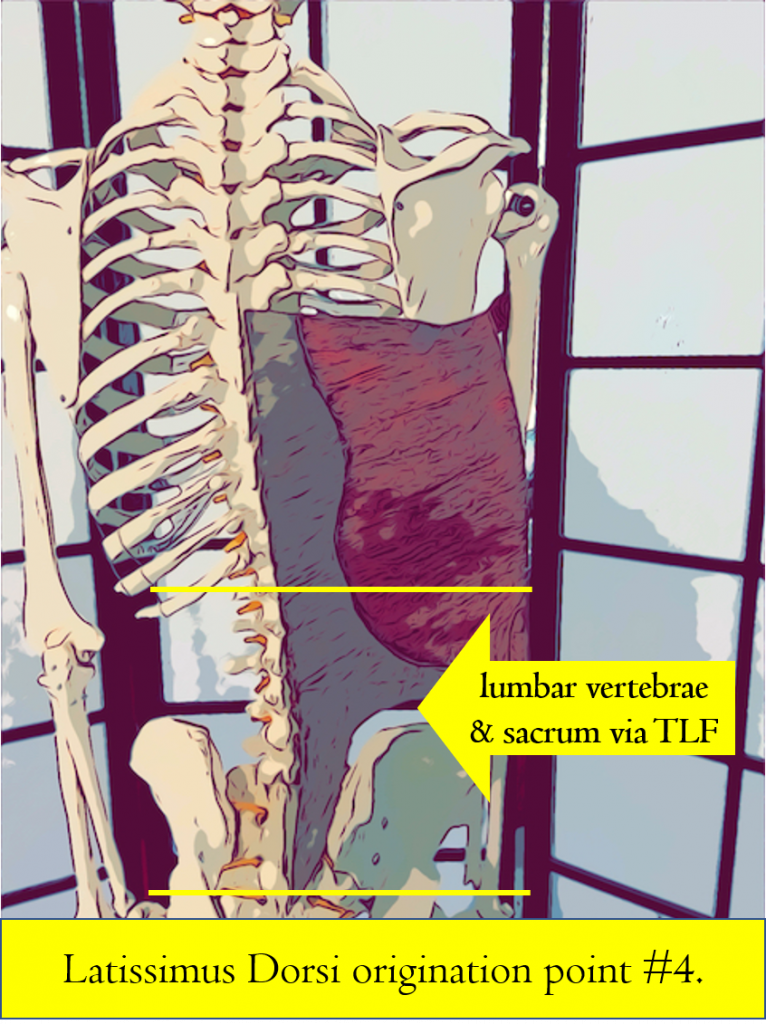
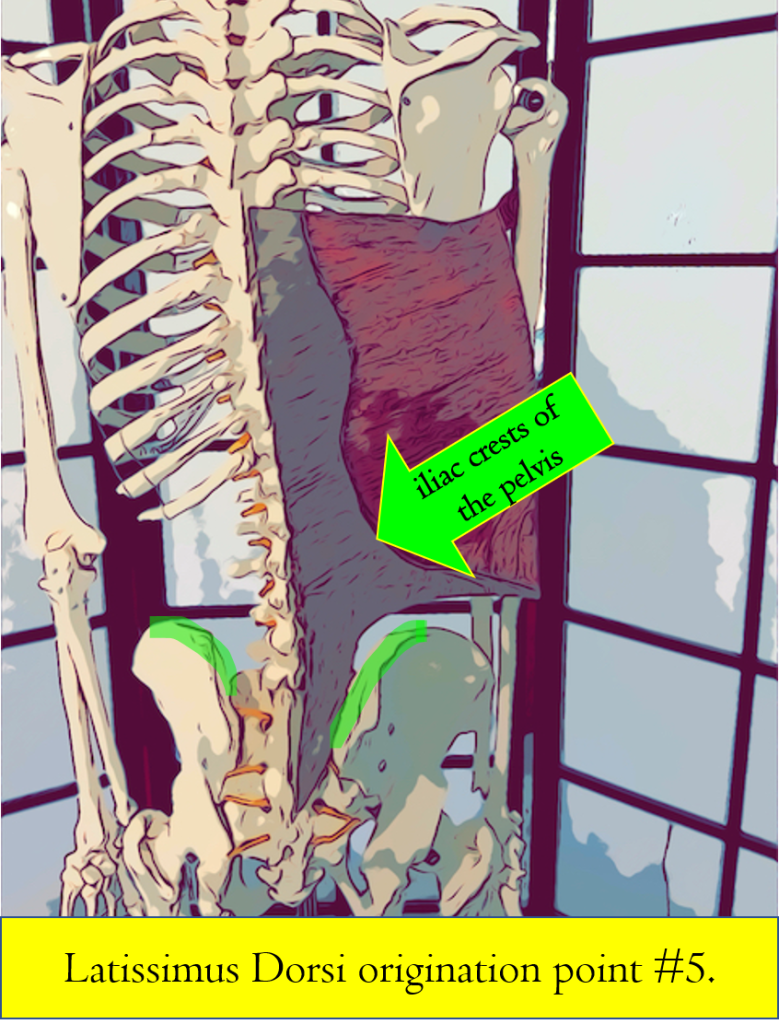
All of the muscle fibers of the Lats sweep up toward the shoulder bones, converge, and then twist, making their way between the rib cage and the humerus,
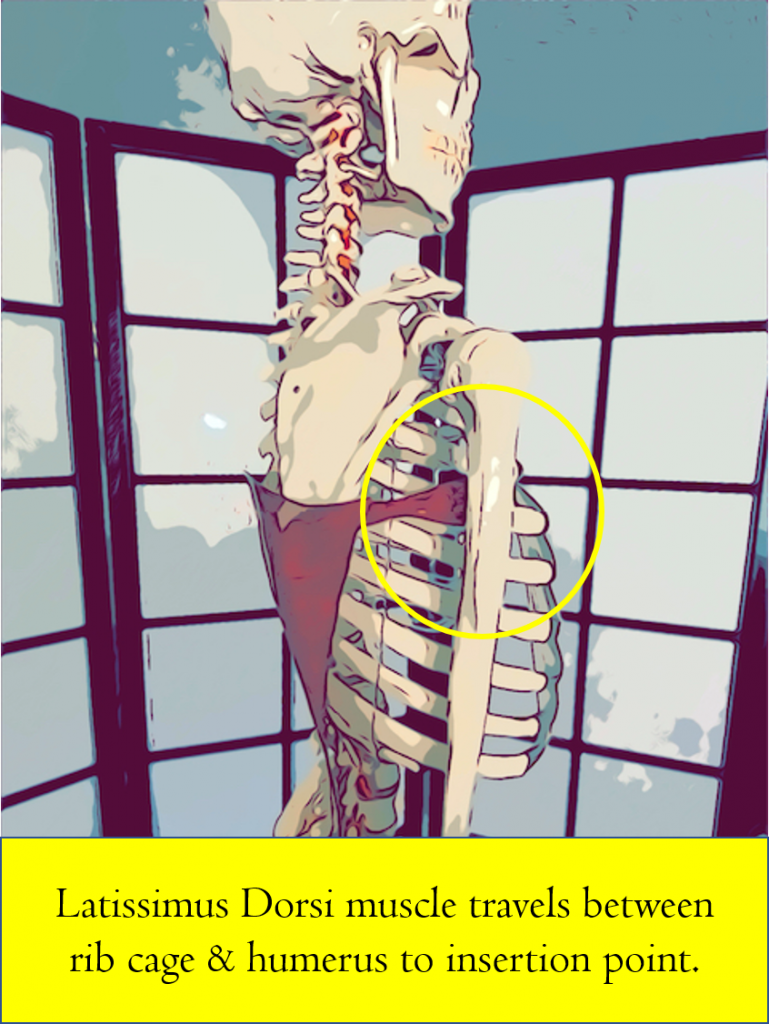
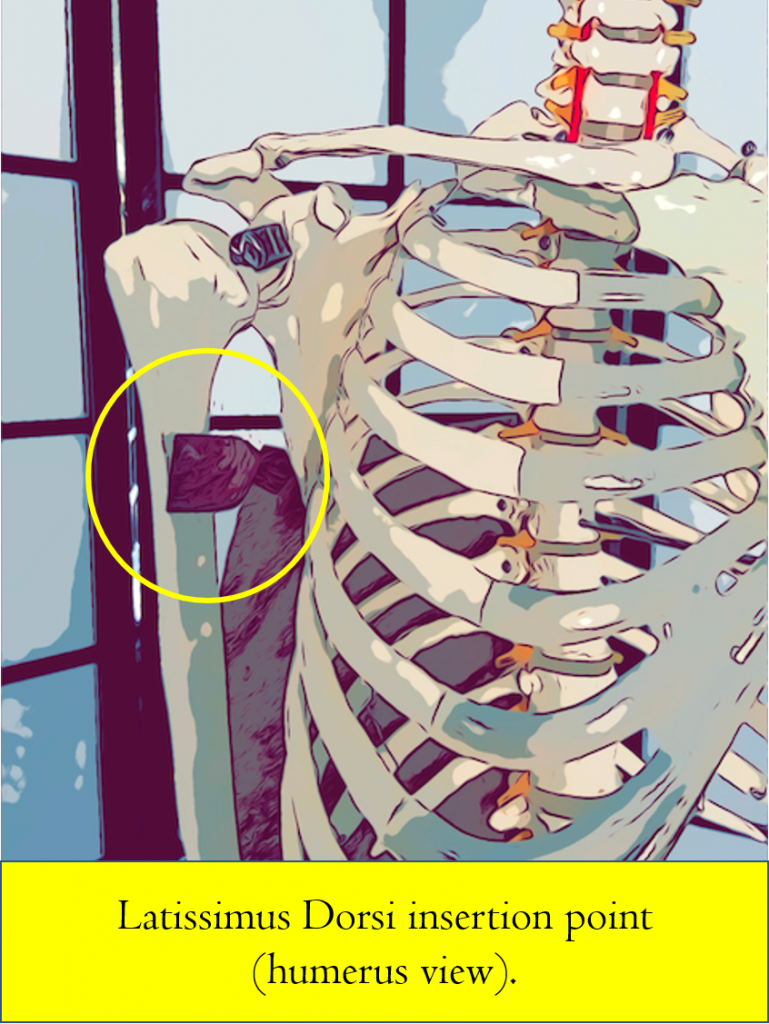
to one insertion point via a tendon at the middle front of the humerus, just below its head.
Geeky Glory +
Every muscle has at least one point of origin on a bone and one point of insertion on another bone (some have more than one point of origin and/or insertion). The point of origin identifies the stationary bone and the point of insertion identifies the bone that will be moved by the muscle. The muscle contracts and creates movement of the bone – the insertion bone moves toward the origin bone. So, by understanding the anatomy of a muscle, we can identify the bone or bones that a muscle moves. This helps us understand from where to move. It also has bearing on how to stabilize and move bone with necessary muscle effort.
Literal Technique says that if we can learn to feel bone and muscle, we can start to shift away from the thinking that imagines the body in parts and toward the physical knowledge that taps into and trains a fusion body.
Technique Fundamentals
I often heard teachers say that the arms move from a point between the shoulder blades, an image intended to stop dancers from moving the arm from the arm. The problem, of course, is that not only does this correction not address that blasted problem of stabilizing the scapula during movement of the arm, but it locates the origin of movement of the humerus from the wrong part the back.
Literal Technique says that the anatomy helps us fine-tune the technique of moving the arm. It is easy to think of the moving bone as the origin of a movement – this is how dancers can end up moving the arm from the arm (or the leg from the leg). The anatomy tells us that movement of the arm happens, in part, from the wide and stable Lats. The Lats contract and the humeri move.
Literal Technique includes the Lats as a one of the 12 foundational muscles. There are certainly other muscles that move the arm bones; it is not my intention to downplay or ignore them (for example, take a look at “Scapulae, movement of” in the Glossary). The complexity of the technique of movement of the arm can leave many dancers confused and with bad habits that disrupt overall alignment. As a foundational muscle, the Lats provide a technical fundamental for arm movement that can help dancers begin to learn, re-learn or repair this technique.
If the alignment of the arm bones happens in relation to the spinal column, and the Lats move the humeri from five origination points, then the movement of the arm is definitely not just about the humeri, and it definitely begins much lower in the body than between the shoulder blades.
The Scapulae. Here come the scapulae again, messing things up. One of the origination points for the Lats is the scapulae, yet the scapulae move when the humeri move. Range of movement in the shoulder joint requires the scapulae to glide on top of the rib cage. So, when the Lats contract and move the humeri, they pull the scapulae in a particular direction based on the particular movement of the humeri – adduction toward the body, extension behind the body, extension away from the body, or internal rotation toward the body. All require the scapulae to move.
When the scapulae are stabilized against the rib cage (by the Lats and other muscles) during movement of the arm, they are essentially simultaneously stationary and mobile. This makes understanding the arms bones and their alignment all the more important.
Movement of the Arm using the Lats. The anatomy shows that movement of the arm happens from T7-T12, from the bottom angle of the scapulae, from ribs 9-12, from the lumbar and sacral vertebrae via the TLF, and from the pelvis.
Take a minute to let it register where this is in the body. Also take note that this does not include almost all of the mass of the scapulae, or the vertebrae or the ribs above T7 (what we typically call the upper body). This has bearing on our awareness of the arm bones during movement of the arm.
The anatomy also shows that the Lats move the humerus at the front of the humerus just below the head, not at the head of the humerus in the shoulder joint socket. Movement of the humerus creates movement in the shoulder joint.
The arm bones, almost entirely independent of the larger skeleton, must be properly aligned for us to find the range of movement of the arm. The Lats’ origination at the bottom angle of the scapulae will facilitate this range, if we can learn how to use this muscle.
Moving the Arms While Upright. When we find the Lats, several things happen that impact the two 360° realities in the upper body: we find necessary muscle effort around the shoulder bones that stabilizes at-rest bones; we find necessary muscle effort around the shoulder girdle joints that stabilizes at-rest bones; we move our focus away from the shoulder bones and the shoulder girdle and toward the lower thoracic vertebrae and rib cage and the lumbar vertebrae and the sacrum/pelvis. All of this changes the way it feels when we move the arms when we are upright.
Moving the Arms While Off Upright or In and Out of the Floor. Moving off upright or in and out of the floor will use the Lats in all the ways we use them when we are upright. You should not feel the scapulae move toward the skull. Instead, you should feel them stabilized against the rib cage where they lie, at ~T2-T7. You should feel two stable, wide 360° realities in the upper body. You should feel stabilized lower thoracic vertebrae, rib cage, and lumbar vertebrae, and a stabilized sacrum and pelvis. Remember, “stable” and “stabilize” mean that the muscle is using the amount of effort necessary to maintain at-rest bone. It is not a license to grip and grind the bone in place.
Fusion. Movement of the arm is more complicated than we would like it to be, in large part because of the anatomy of the arm bones. Adding the Lats to the picture begins to clear up where movement begins, but it also requires us to be able to discern between the scapulae and the humeri when we move the arm. If we cannot do this, we end up with all manner of alignment problems that prevent us from feeling a freedom of movement when we dance. This only leads to frustration and discouragement.
Moving from the Lats increases the expressive potential of the arms by allowing us to use only necessary muscle effort around the arm bones; this lets us find a suppleness and responsiveness in the upper body. Coupling this with an ability to find the overlapping alignment of the arm bones and the rib cage barrel will eventually eliminate the problem of moving the arm from the arm.
Literal Technique says that if we can learn to feel bone and muscle, we can start to shift away from the thinking that imagines the body in parts and toward the physical knowledge that taps into and trains a fusion body. This is the goal of Literal Technique.
Next installment: The Pectoralis Majors
Installment No. 10: Movement of the Arm: The Humerus, The Collar Bone, The Scapula, & The Sternum
Photos credit: Jill Redfern
You can send comments and questions to Jill at info@thirdshiftmovementshop.com. Please subscribe to the Third Shift’s YouTube channel and follow the Third Shift on Facebook.