
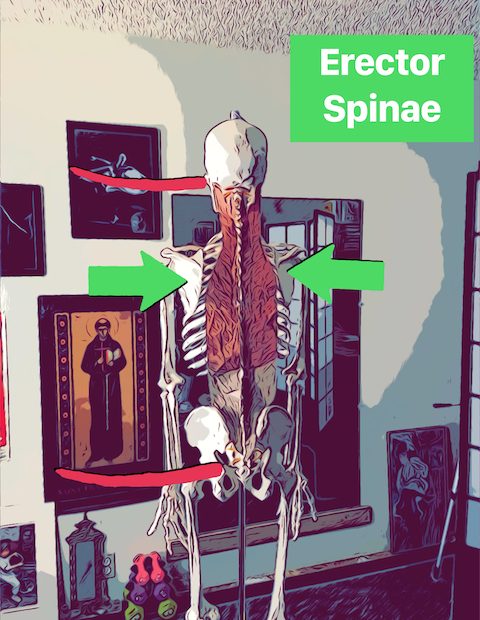
I want to give a thank you and shout out to Allison Denney at Rebel Massage for her unique insight into these muscles and her willingness to answer my questions. Check out her video on the Erector Spinae, where she paints the muscles onto the back. I don’t know how many of you do bodywork or massage therapy, but I highly recommend this video as a way for dancers to understand the extent of these muscles.
Welcome to the Third Shift Movement Shop, home of Literal Technique, where we work so we can move. And welcome to Installment No. 18 of The Central Geekdom of Dance Technique, “The Erector Spinae Revisited.”
My first installment about the Erector Spinae, Installment No. 9, was published on August 14, 2022. It was my first installment about one of the 12 muscles, and I introduced this muscle group as a straightforward example of simultaneously different muscle effort. I have described dance training as the process by which dancers learn the technique of simultaneously stabilizing and moving the body, which is accomplished by using simultaneously different muscle effort. The Erector Spinae are all about simultaneity.
When I wrote Installment No. 9, however, I had not yet begun to talk about muscle origination and insertion, and the Erector Spinae need to be looked at this way. So, this installment includes photos of these muscles’ origination and insertion points, which are located at the vertebrae, the skull, the rib cage barrel, and the pelvic barrel. Knowledge about exactly where these muscles are located will improve our technique.
What Happens Where
Let’s start with a review of the what happens where of the Erector Spinae (pronounced, “spy-nee” or “spy-nay”). The Erector Spinae are a pair of three vertical muscles on either side of the spinal column, so they are a muscle group. The Erector Spinae muscles count as one muscle in our group of 12.
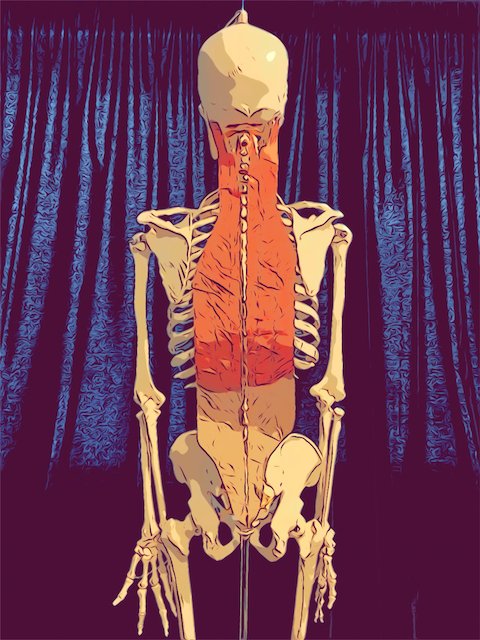
These muscles are intrinsic muscles in the back; they span the length of the spinal column, from the skull to the sacrum. Their job is both to stabilize and to move the entire vertebral column. Take a look at this photo to get an idea of the expanse of these muscles:
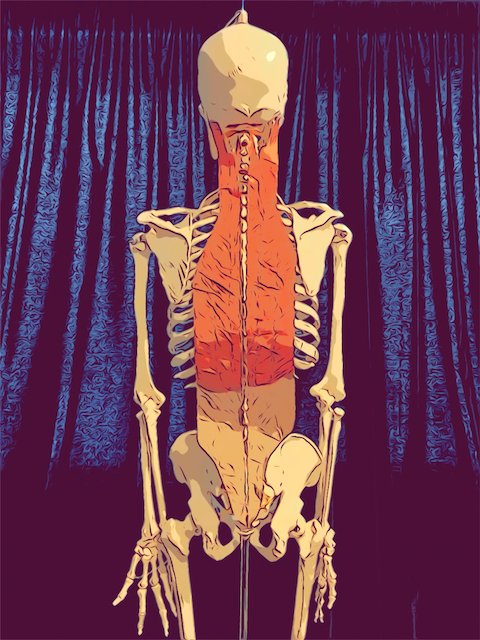
This muscle group:
- helps us stay upright without eliminating the spinal column’s anatomical curves;
- extends and laterally flexes the vertebrae, including the skull;
- helps rotate the skull; and
- depending on the source you read, also helps rotate the vertebrae.
The Erector Spinae muscles are just one of the muscles in our group of 12 we use to stabilize the at-rest spinal column or to move it in and out of rest. The Erector Spinae are the only muscles in our group of 12 that help us align and move the skull. The Erector Spinae unto themselves are an important building block for understanding the fusion body.
Geeky Glory
Before we dig into the Geeky Glory, I want to give you some notes about a couple of things. First, remember that the spinal column is one structure with 33 vertebrae: seven cervical, 12 thoracic, five lumbar, five sacral, and four tailbone. The sacral and tailbone vertebrae are fused, so we cannot see the individual vertebra, and they have no individual movement. The cervical, thoracic, and lumbar vertebrae are anatomically different but they all have spinous processes and transverse processes, which are the aspects of the vertebrae we will talk about when we talk about the Erector Spinae. Anatomy labels other aspects of the vertebrae, but our focus will be on these two.
Secondly, remember that a “process” is a projection or a bony outgrowth of a larger bone. When we look at the side of the spinal column closest to the skin – the side we can actually feel with our fingertips – the spinous process is located at the center of the vertebrae and projects out from the vertebrae, away from the body. The transverse processes are located on each side of the vertebrae; they project to the side, and some are in line with the ribs. Quite a few of the Erector Spinae muscles originate and insert directly on these processes:

So here we go.
Each of the three Erector Spinae muscles is conventionally divided into three groups and further organized by location. They originate or insert at the vertebrae, the skull, the rib cage barrel, and the pelvic barrel. Keep in mind that the origination and insertion points are for pairs of muscles. These points will show us where movement happens, which is how we will improve our technique; the photos that follow will show these points without the muscle.
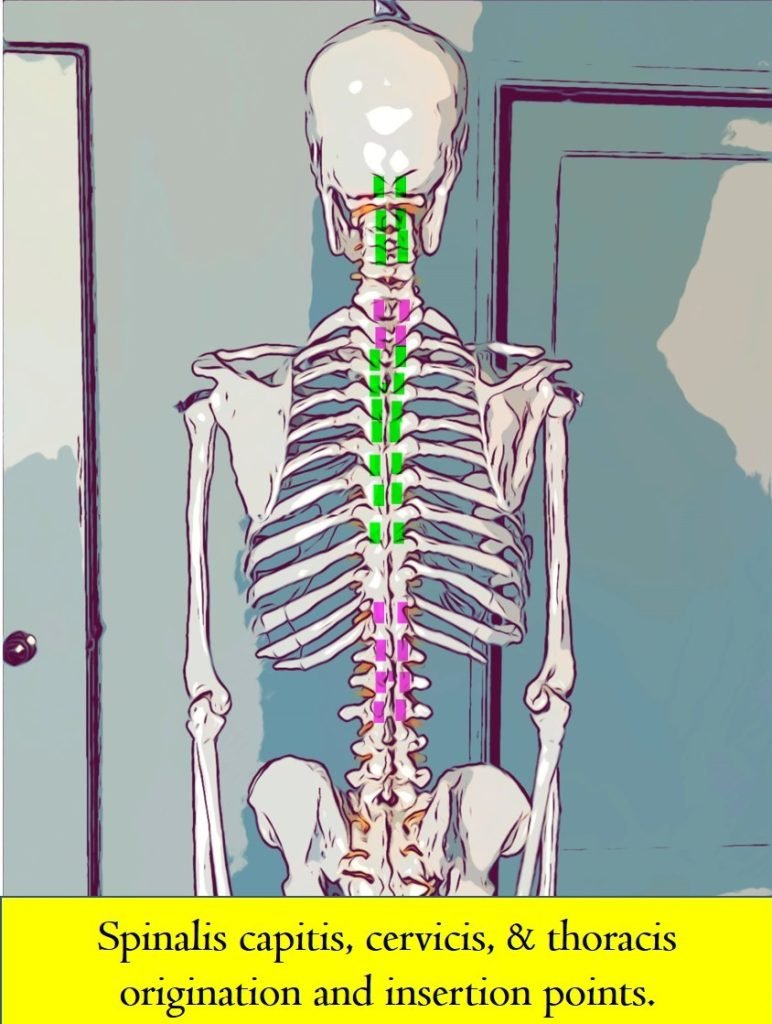
The spinalis muscles, the first of the three, are connected to the skull, the cervical and thoracic vertebrae, and L1 and L2. They stabilize, extend, and laterally flex the cervical and thoracic vertebrae of the spine.

Here are the three groups of the spinalis muscles:
Spinalis capitis originates at the spinous processes of C7-T1 and inserts at the midline of the skull’s occipital bone:

Spinalis cervicis originates at the spinous processes of C7-T1 (just like capitis) and the nuchal ligament (a ligament in the nape of the neck, not shown in the photo) and inserts at the spinous processes of C2-C4:

Spinalis thoracis originates at the spinous processes of T11-L2 and inserts at the spinous processes of T2-T8:

Take another look at the origination and insertion points of all three spinalis muscles together:
* * *
The longissimus muscles, the second of the three, are connected to the skull, the cervical, thoracic, and lumbar vertebrae, the rib cage barrel, and the sacrum and the pelvic barrel. They stabilize, extend, and laterally flex the spinal column and help rotate the skull.

Here are the three groups:
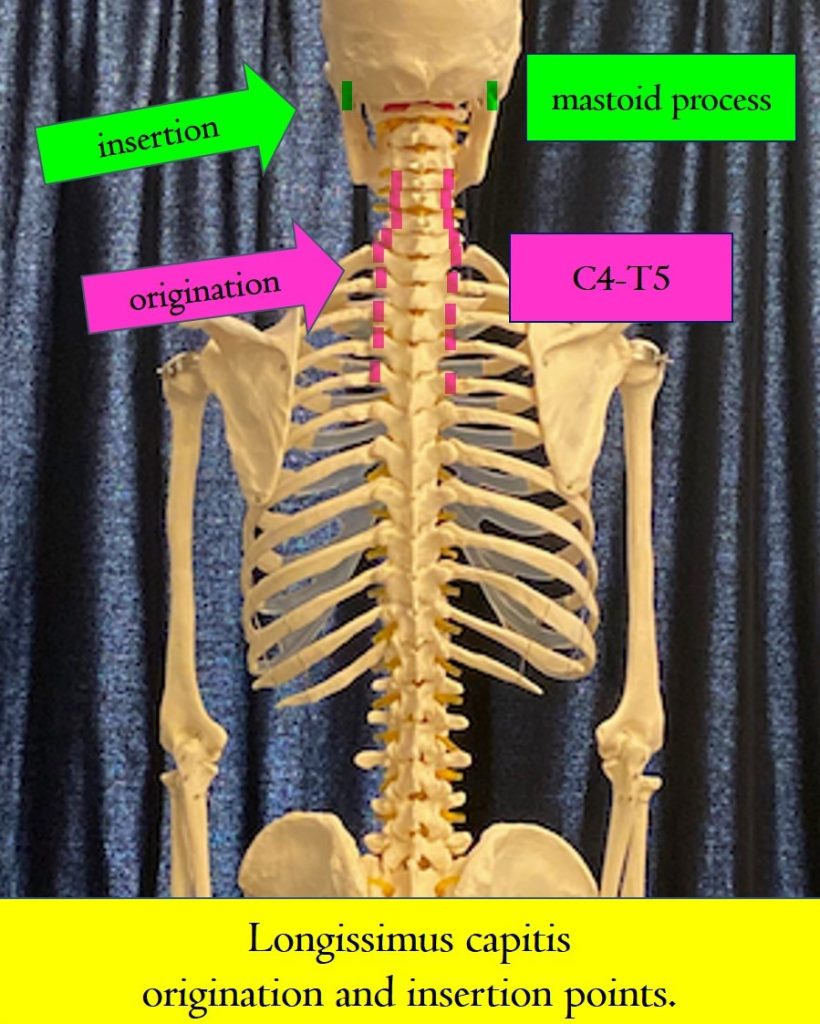
Longissimus capitis originates at the transverse processes of C4-T5 and inserts at the bottom edge of the mastoid process of the temporal bone:
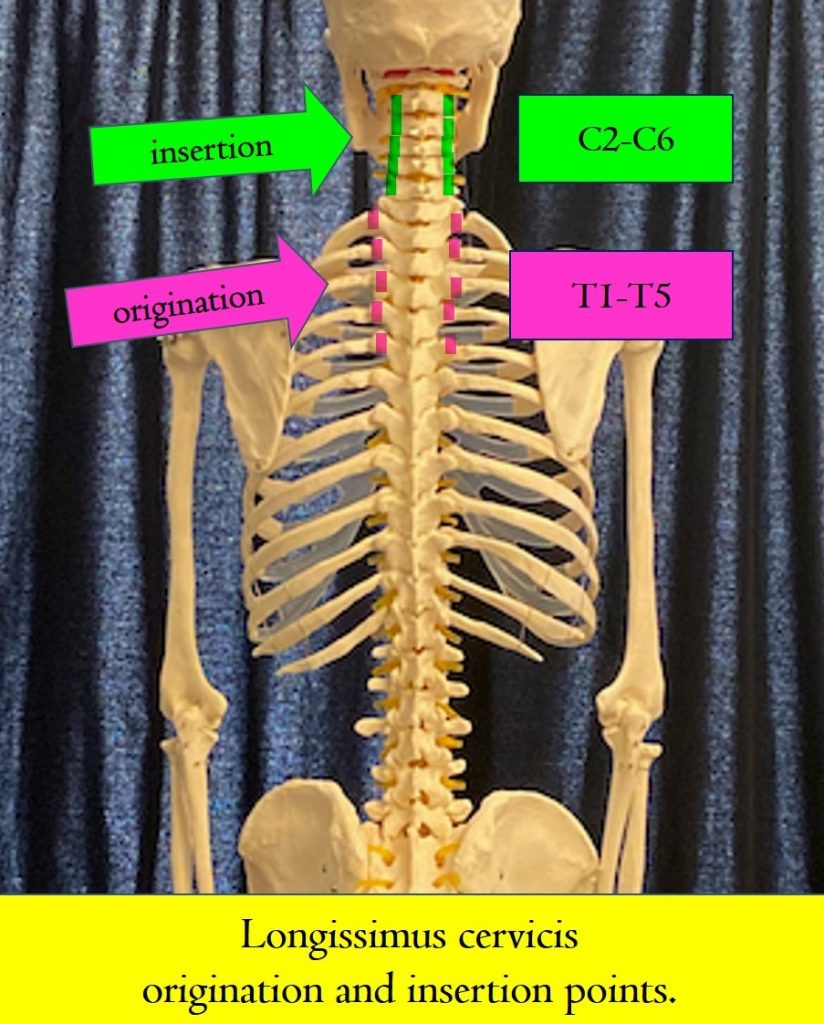
Longissimus cervicis originates at the transverse processes of T1-T5 and inserts at the transverse processes of C2-C6:
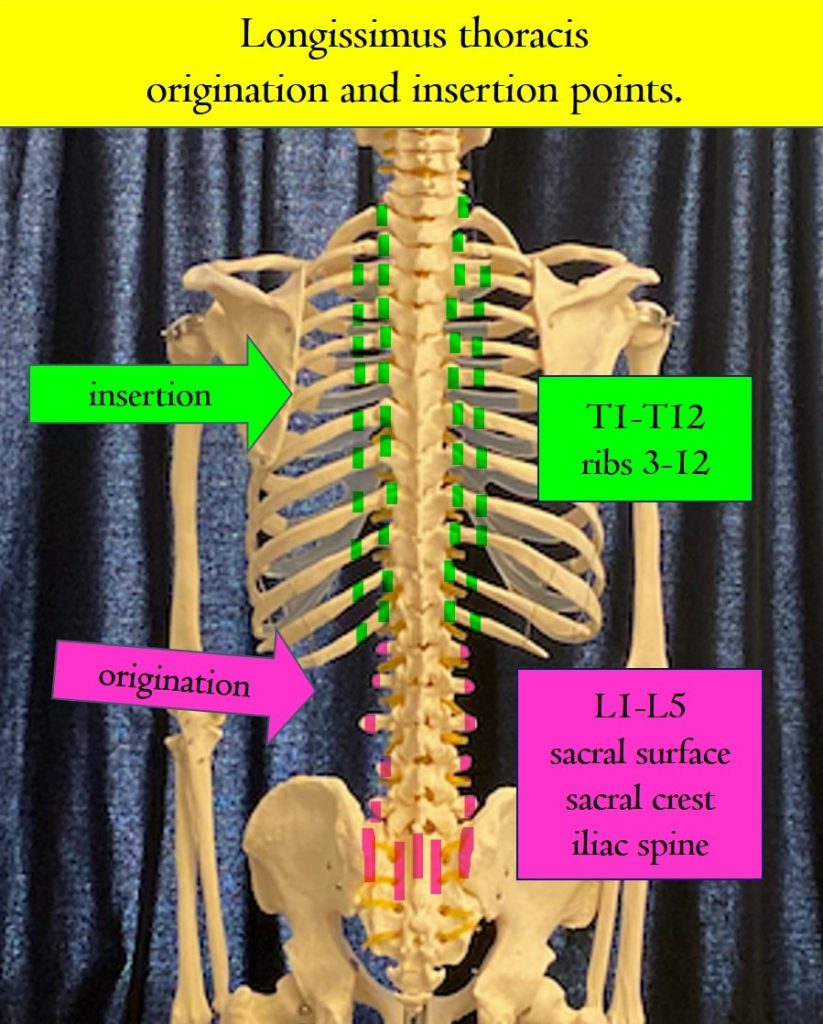
Longissimus thoracis originates at (1) the dorsal surface of the sacrum, (2) the median sacral crest, (3) the medial surface of the posterior superior iliac spine, and (4) the transverse processes of L1-L5, and inserts at (1) the transverse processes of T1-T12, and (2) between the tubercles and angles of ribs 3-12:
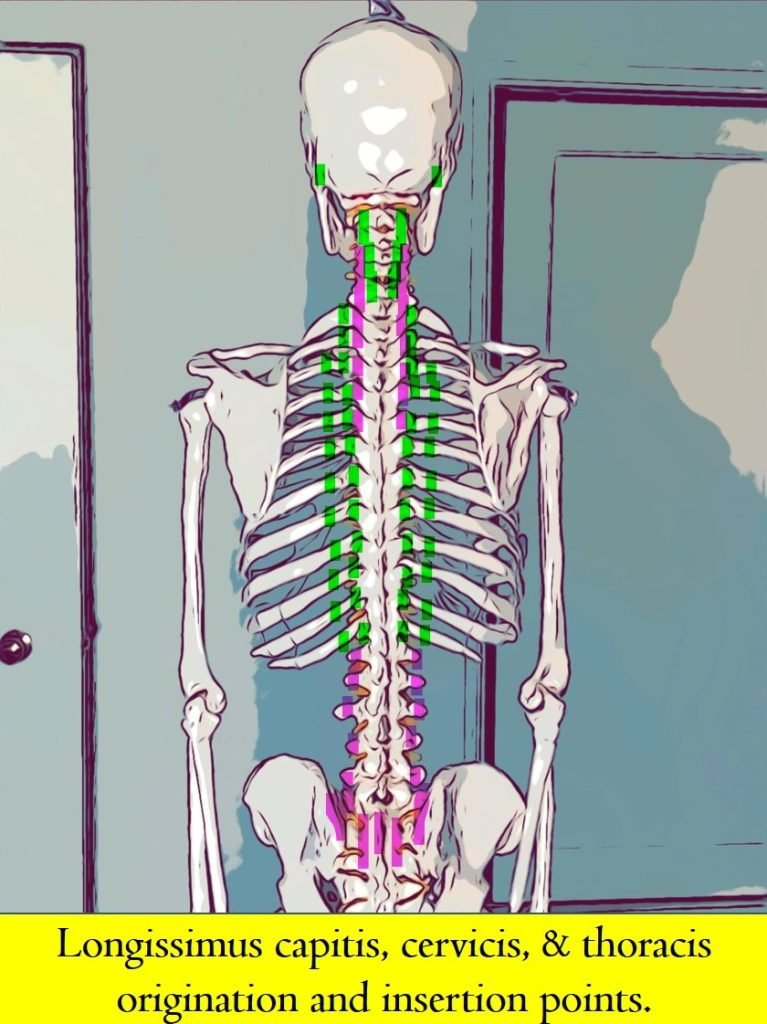
Take another look at the origination and insertion points of all three longissimus muscles together:
* * *
The iliocostalis muscles, the last of the three, are connected to the cervical and lumbar vertebrae, the rib cage barrel, the sacrum and pelvic barrel, and the TLF. They stabilize, extend, and laterally flex the spinal column.
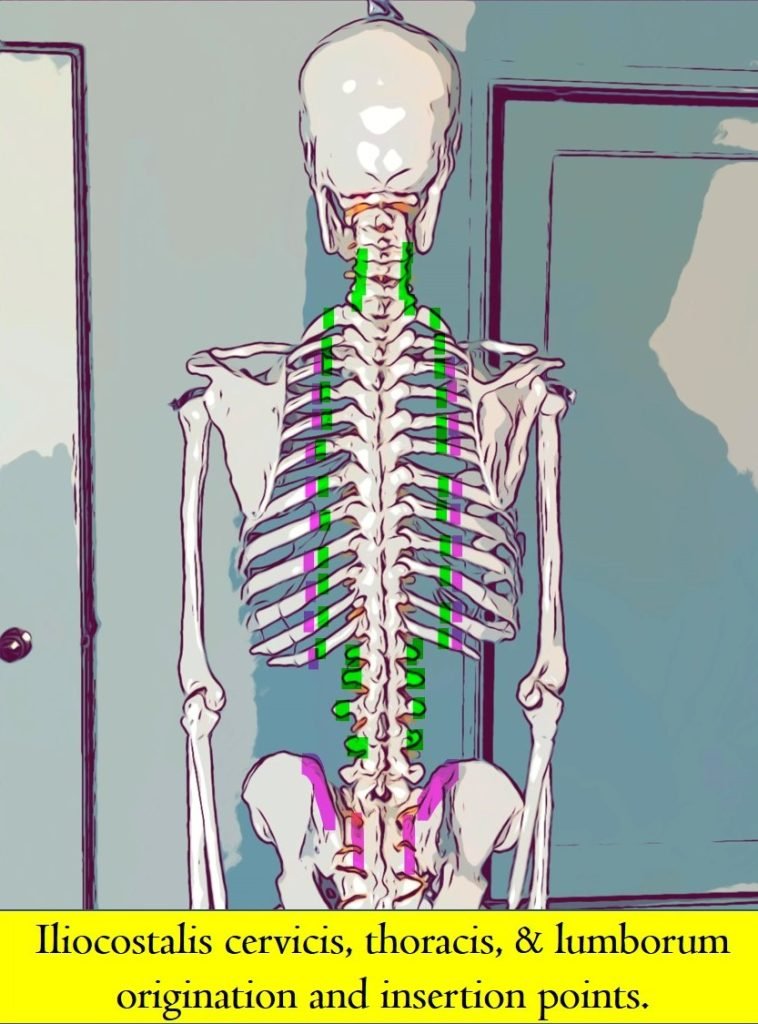
Here are the three groups:
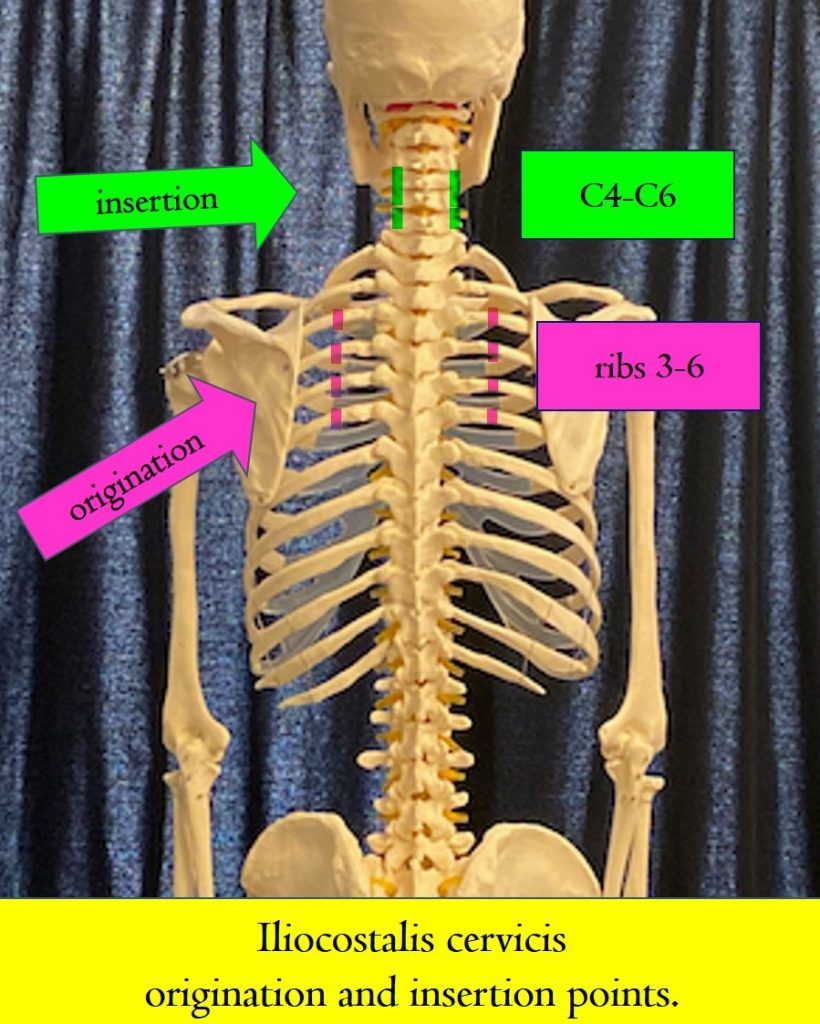
Iliocostalis cervicis originates at the angles of ribs 3-6 and inserts at the transverse processes of C4-C6:
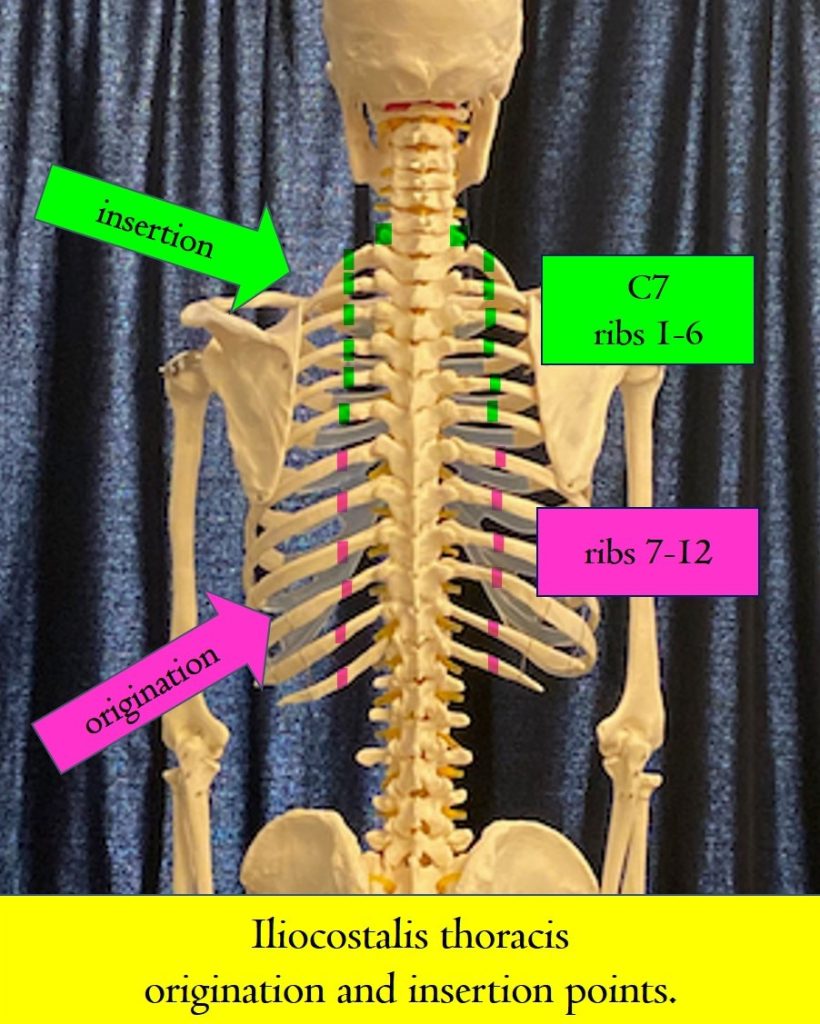
Iliocostalis thoracis originates at the angles of ribs 7-12 and inserts at the transverse process of C7 and the angles of ribs 1-6:
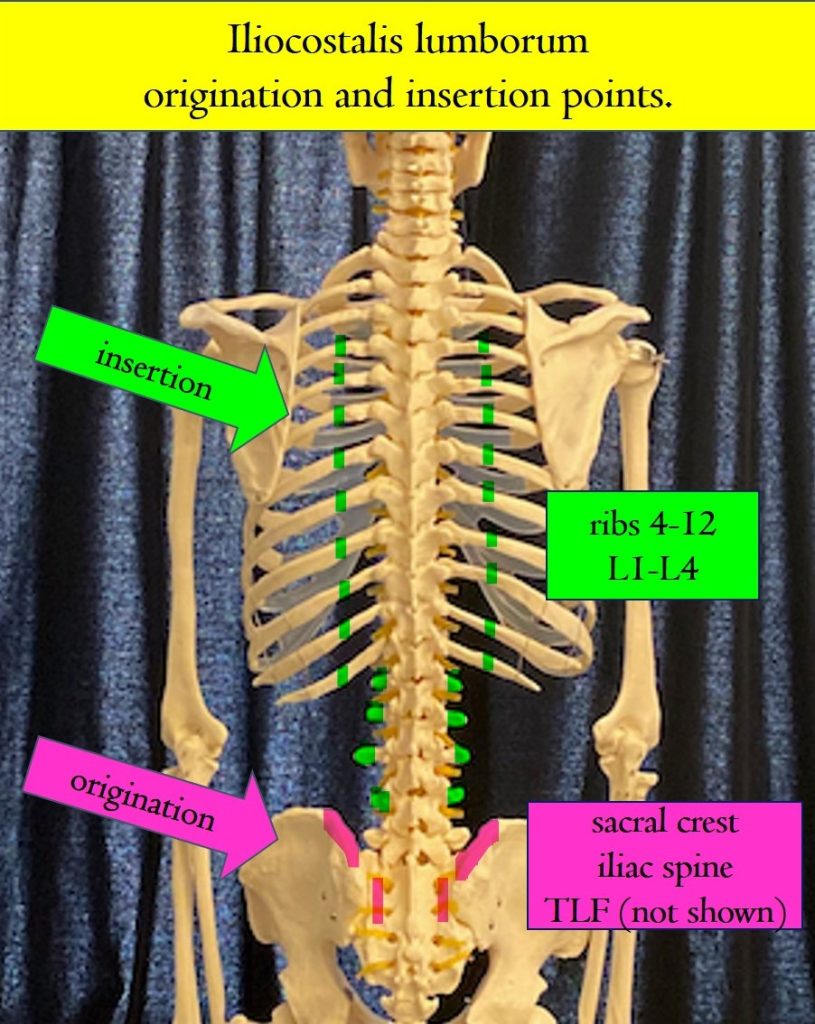
Iliocostalis lumborum originates at the medial end of the iliac spine, the lateral crest of the sacrum, and the TLF (not shown in the photo), and inserts at the transverse processes of L1-L4 and the angles of ribs 4-12:
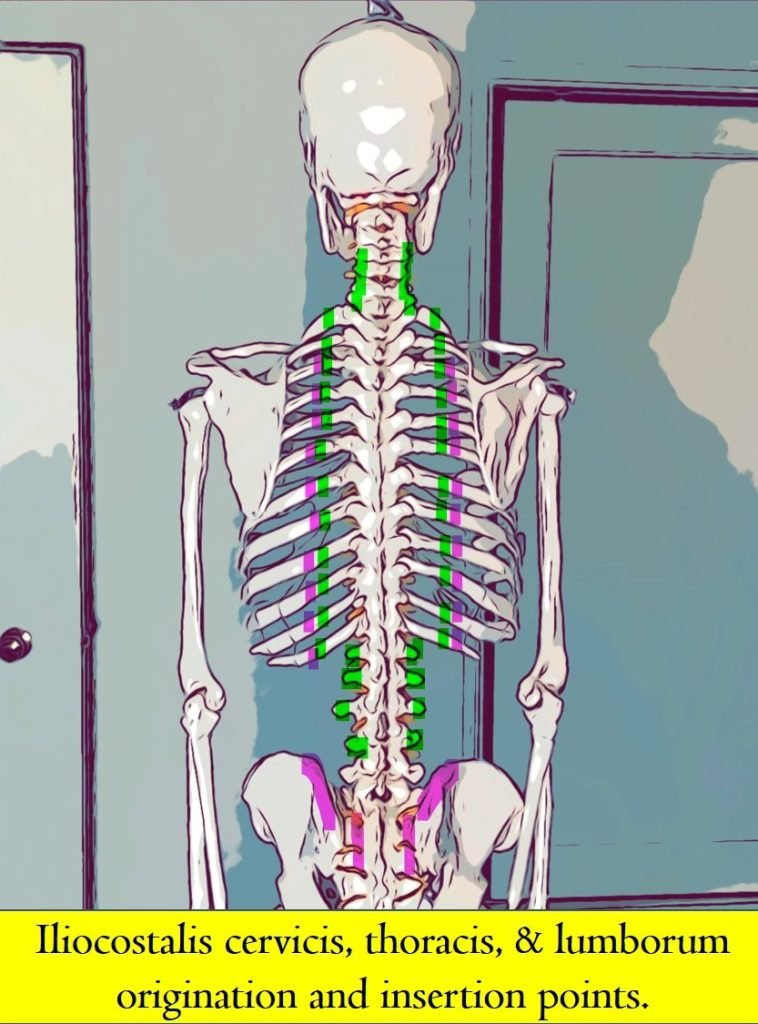
Take another look at the origination and insertion points of all three iliocostalis muscles together:
* * *
Now, check this out. This photo shows all three muscles’ origination and insertion together side by side with the photo of the muscles. This gives us a nice view of the expanse of the Erector Spinae:

* * *
Technique Fundamentals
The anatomy shows us from where the Erector Spinae flex and extend the vertebrae. I would guess that you can already suggest a few movements that use these muscles. But how are we going to use all of this knowledge in our technique? There seems to be a lot going on here.
Taken as a whole, from the standpoint of technique, there are two things of note about the Erector Spinae. The first is that it is not possible to use one of the Erector Spinae muscles without using the other two. There may be a pair of three muscles made of up three muscles, all with their own origination and insertion points, but from a movement standpoint, there is no way to isolate any of these muscles. So, our technique will not involve figuring out how to isolate and move 18 muscles. Instead, our technique begins at the bone and, primarily, at the vertebrae. Remember, the skull moves at its C1 and C2 connection; the rib cage barrel moves because the thoracic vertebrae move; and the pelvic barrel moves because the sacrum moves.
The second is that, at the same time that we cannot isolate these muscles, we also may not be able to feel all of them (I’m especially thinking about those on the rib cage barrel and at the lumbar vertebrae, sacrum, pelvic barrel, and TLF). Sometimes we can’t completely feel a muscle in our technique (a good example is the Psoas Major). Our technique, then, will require us to know where at the bone the Erector Spinae muscles are located and what they do.
So, our first technique fundamental is that, because the Erector Spinae muscles cannot be isolated, they move the spinal column as one structure with 33 vertebrae that move jointly but differently. To master the movement of 33 vertebrae, we must have physical knowledge of the vertebrae. Where are the anatomical curves of the spinal column? How much does each vertebra flex, extend, and rotate? This knowledge will let us fine tune movement. Most importantly, grasping the spinal column as one structure will unify our movement.
If a pair of three muscles made of up three muscles do not all function in the same way when we dance; if we may not be able to feel them the way we do other muscles, but we know that these muscle pairs do not work independently (they cannot be isolated from each other); if they work toward the same goal, which is to stabilize and/or move the vertebrae, from the skull to the sacrum . . . then that sounds like an ensemble to me. So, our second technique fundamental is that the Erector Spinae muscles are an ensemble. They work together to stabilize or move the vertebrae. Grasping this will also unify our movement.
FUSION. As you know by now, all roads in Literal Technique lead to fusion, which is where the third technique fundamental takes us. As it turns out, the Erector Spinae are a member of a larger ensemble of seven muscles that includes the Four Abdominals, the Lats, and the Pec Majors.
It is likely that you’ve been taught to think of the body as parts in a larger pool of body parts that have to be pushed and tweaked independently of one another in order to find alignment of the skull, the rib cage and the pelvis. It’s possible that the vertebrae are missing from your understanding of alignment. In a body-parts scenario, the muscles, too, are broken into parts with no relationship to each other.
In my previous installments about the bones and the 12 muscles, the Geeky Glory, time and time again, shows us that the common denominator for alignment, stability, and movement is the spinal column. As you become more accustomed to using the entire spinal column when you dance, you will begin to understand that the purpose of the Erector Spinae, the Four Abdominals, the Lats, and the Pec Majors is to align the 33 vertebrae.
This is a huge shift in our understanding of dance technique. These muscles do not independently align body parts, or sections of the body, or the front or back of the body.
These seven muscles align the 33 vertebrae.
This is key to our technique. Literal Technique says that, once you find this, you will have found the way into the alignment, stability, and movement of a fusion body.
Installment No. 6: The Spinal Column
Installment No. 7: The Skull
Installment No. 8: The Rib Cage Barrel
Installment No. 13: The Pelvic Barrel
Photo credits: Jill Redfern
You can send comments and questions to Jill at info@thirdshiftmovementshop.com. To stay up to date, please follow the Third Shift on Facebook and subscribe to my Substack newsletter.