
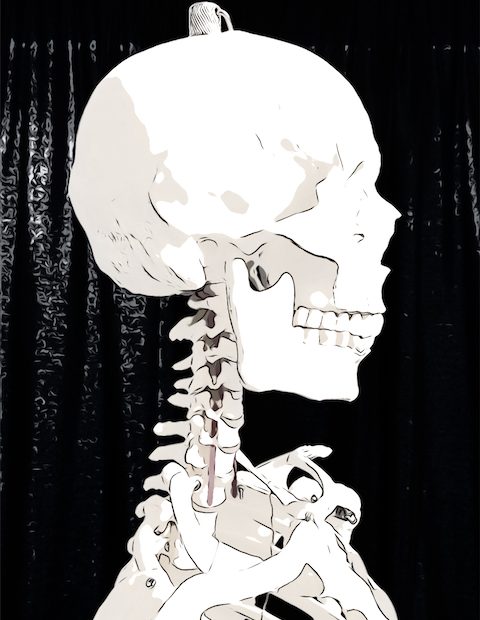
Welcome to the Third Shift Movement Shop, home of Literal Technique, where we work so we can move. And welcome to Installment No. 7 of The Central Geekdom of Dance Technique, “The Skull.”
In Installment No. 6, I talked about the spinal column. As you will see in this installment, it is impossible to separate the alignment of the skull from the alignment of the spinal column. Literal Technique provides a clear picture of this relationship. Mark this as our first step toward a fusion body.
What Happens Where
Movement of the skull happens at its spinal column connection. When we nod up and down, we are moving the skull from its bone-to-bone attachment to cervical vertebrae, C1. When we turn the head side to side, the skull rotates by a joint formed between C1 and C2.
Because of this relationship, alignment of the skull, correct or not, will have an impact on the alignment of the cervical vertebrae and, since the spinal column is one structure, it will impact alignment of the spinal column as a whole. The reverse is also true: the alignment of the spinal column will impact the skull’s alignment.
The skull moves in concert with a moving spinal column (an example is spinal extension with the skull at rest) or independently of a stabilized or moving spinal column (such as looking left when standing).
The only muscle in our group of 12 that directly stabilizes or moves the skull is the Erector Spinae, a group of muscles that spans the full length of the spinal column and has attachments to the skull. Since the spinal column’s alignment also impacts the shoulder bones, the rib cage barrel, the pelvic barrel, and the femur, we can infer that the other 11 muscles also impact the stabilization/movement of the skull.
Geeky Glory
The skull is anatomically connected to the spinal column by the atlanto-occipital joint. This joint is formed by the occipital bone of the skull and the first cervical vertebra, C1 (also called the “atlas”). This joint allows flexion and extension of the skull, for example, when we move the head up and down to say yes.
A second joint, called the atlanto-axial joint, is formed by C1 and the second cervical vertebra, C2 (also called the “axis”). This joint allows rotation of the skull, for example, when we move the head to the left or to the right.
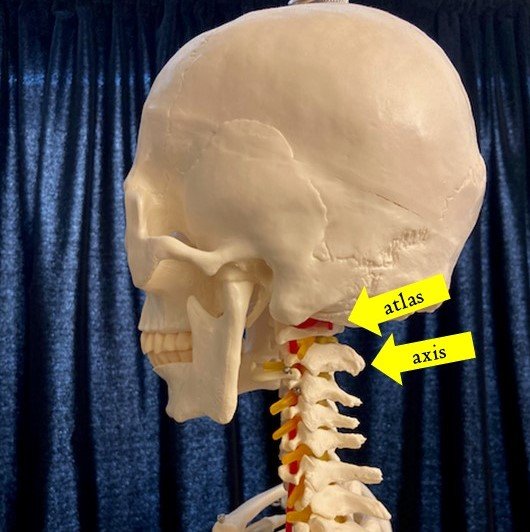
These joints allow forward flexion (~5-10°), lateral flexion (~5-10°), extension (~10°), and rotation (~45°) of the skull.
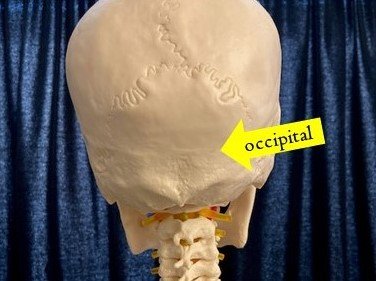
Literal Technique calls out two bones at the back of the skull: the occipital and the temporal bones. These bones are important because they are attachment sites for muscles that move the skull:
The occipital bone is at base of the skull. It is the only bone in the skull that articulates with the cervical vertebrae.
The temporal bones are a pair of bones on either side and at the base of the skull.
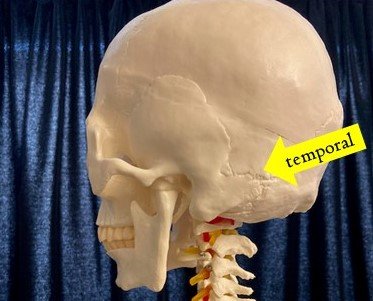
The mastoid process of the temporal bone is behind the ear.

Learning to move a fusion body means moving the skull as part of the spinal column. Learning to feel when the skull is at rest is about learning to feel the vertebrae. Moving the skull means learning to move it from C1 and C2.
Technique Fundamentals
Carriage and alignment of the head is a regular concern in technique, and focus is usually on a dancer’s chin. There is some value in this. A chronically lifted chin has the potential to create a forward head posture, which wreaks havoc with the cervical vertebrae; if the chin is too low, the cervical vertebrae lose their anatomical curve, plus a dancer’s eyes are not level. In either case, alignment is thrown off when we dance.
Trying to achieve proper alignment of the skull by focusing on other parts of the head, however, seriously misunderstands the anatomy. In practice, vague corrections like “drop your chin” or “imagine energy out through the top of your head” tend to create more alignment issues, largely because they are too open to interpretation. The lasting result is that we do not learn to feel where the alignment and movement of the skull actually happens.
In general, dance training treats the skull as a type of appendage with a separate set of rules. If the 33 vertebrae are designed to act jointly but differently, the skull’s connection to C1 and C2, and the range of movement they give the skull, is part of this design.
So, from the standpoint of proper technique, the skull connects to the top of the spinal column and its movement happens by joints formed by the skull and C1, and by C1 and C2. Literal Technique’s starting point for alignment of the skull is its at-rest spinal connection. Finding neutral means finding an alignment of C1 and C2 that does not compress any of the cervical vertebrae or move them out of their anatomical curve. We will talk about the muscles that stabilize and move the skull in the installments that follow, but this is our bone starting point.
Learning to move a fusion body means moving the skull as part of the spinal column. Learning to feel when the skull is at rest is about learning to feel the vertebrae. Moving the skull means learning to move it from C1 and C2.
If the spinal column is one structure with 33 vertebrae and the skull’s movement happens at C1 and C2, play around with feeling how the skull moves as part of the spinal column. Where is your starting point and to where do you return?
Next installment: The Rib Cage.
Photo credit: Jill Redfern
You can send comments and questions to Jill at info@thirdshiftmovementshop.com. Please subscribe to the Third Shift’s YouTube channel and follow the Third Shift on Facebook.