

Welcome to the Third Shift Movement Shop, home of Literal Technique, where we work so we can move. And welcome to Installment No. 12 of The Central Geekdom of Dance Technique, “The Pectoralis Majors.”
As we continue to introduce the 12 muscles of Literal Technique, the concepts of simultaneously different muscle effort and using muscle in relation to other muscle should become easier to understand. And, adding more muscle should further illuminate the reality of our 360° body. More muscle lays out the wonderful complexity of our technique – things are getting geekier.
The Pectoralis Majors (also, Pec Majors; singular, Pectoralis Major) are one of the two muscles in our group of 12 that have a direct impact on the technique of movement of the arm. The other muscle is the Lats (take a look at Installment No. 11).
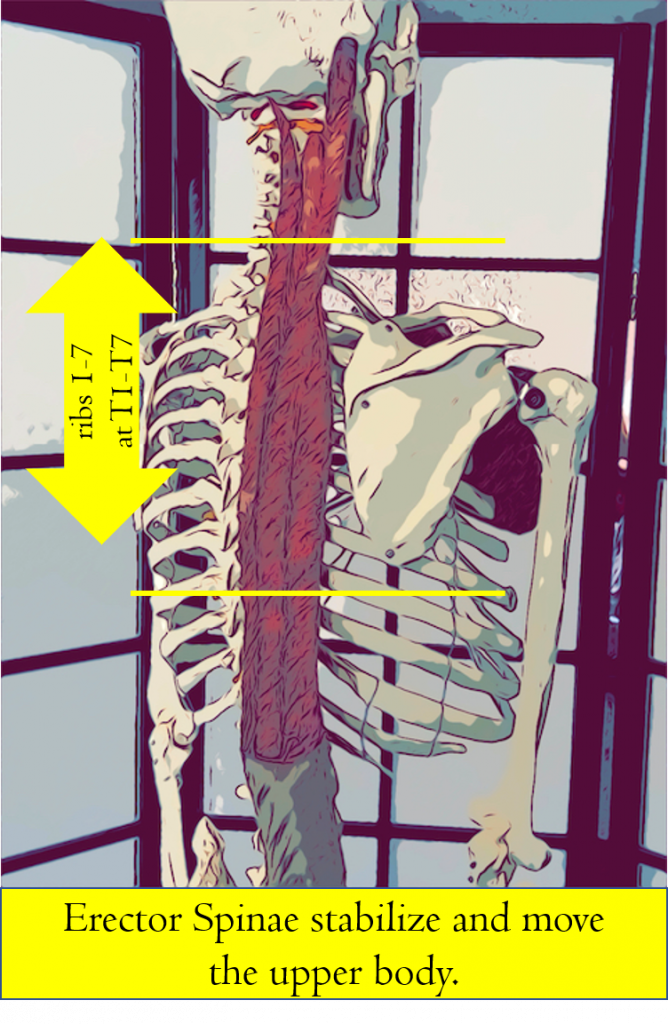
The Pec Majors and the Erector Spinae, another muscle in our group of 12, both stabilize and move the upper body. Anatomically and functionally, these two muscles have no overlap. Literal Technique, however, identifies them as two muscles responsible for the what happens where in the upper body when we dance. You can find the Erector Spinae at Installment No. 9.
The geekier part is that, ultimately, these three muscles not only give us a 360° view of movement of the humeri and the upper body, they also show us that movement of the arm happens from a 360° torso.
I began introducing the 12 muscles, first, with the Erector Spinae and then, with the Lats. When we add the Pec Majors, we not only add to the technique of movement of the arm, but we start to see the Erector Spinae, the Lats, and the Pec Majors’ relationship to the abdominal muscles. This further connects the arms to the rib cage but now concretely connects them to the pelvis. The 360° muscle stabilizes and moves the spinal column, the rib cage, the arm bones, and the pelvis.
We are now entering the exciting part of Literal Technique, when we finally begin to see that the body is a fusion body. Literal Technique says that there is no trick to learn – the fusion body exists because the body is fusion. It does this all by itself. If you allow it to move this way, there is nothing you have to do to make it work this way. But it will not move as a fusion body if you do not understand it. It will not move as a fusion body if your mind teaches it to move in parts. A shift in understanding is required to view and train the body we are in. This is the goal of Literal Technique.
What Happens Where
The Pec Majors adduct, extend, flex, and internally rotate the humerus. So, these muscles:
- lower the arms raised at the side, down and toward the body (adduction);
- move the arms across the body toward the opposite shoulder (horizontal adduction);
- move the arms across the body toward the opposite hip (diagonal adduction);
- move the at-rest arms straight up (flexion);
- return the flexed arms to at rest (extension);
- rotate the arms toward the imaginary center line of the body (internal rotation).
The Pec Majors and the Lats are synergist for adduction of the arms raised at the side, down and toward the body, and for internal rotation.
The Pec Majors and the Lats are synergist for lifting the body toward the arms when the humeri are fixed overhead (think of those non-dance movements, climbing and chin ups).
When we factor in bone and muscle attachments, we see that the Pec Majors connect the humeri to the collar bone; the sternum; the rib cage barrel; and the abdominals, which ultimately requires the Pec Majors to work with all of the other 11 muscles, using simultaneously different muscle effort.
Geeky Glory
The Pec Majors are a pair of superficial muscles on the sternum side of the rib cage barrel.
Each Pec Major has two sections, which are called heads: the clavicular head and the sternocostal head. Each head is a section within the larger Pec Major that can act separately. The sternocostal head makes up 80% of each Pec Major’s size.

Each Pec Major muscle originates from four places: (1) the half of the collar bone closest to the sternum (clavicular head); (2) the manubrium and body of the sternum (sternocostal head); (3) the costal cartilage of ribs 1-6 (sternocostal head); and (4) the aponeurosis of the External Oblique (the Rectus sheath) (sternocostal head).


All of the muscle fiber of these two heads are horizontal and converge to one insertion point on the outside of the humerus, just below its head, and on the outer side of the insertion point of the Lats.

Both heads are involved in adduction and internal rotation of the humerus.
The clavicular head is responsible for flexing the arm (raising the at-rest arm forward and up).
The sternocostal head is responsible for extending the flexed arm (bringing the arm back to at rest).
Technique Fundamentals
The goal of Literal Technique is to morph a “parts” body into a fusion body, so that when we move, we move from the body we are in, not from mental images derived from non-existent anatomy. Literal Technique looks to the literal body to analyze movement. It says that we can use the logic of the body to correct patterns and bad habits that may have roots in conventional teaching images that separate the body from itself, divide it into front and back halves, or identify isolated parts or points from which movement happens.
To teach dancers how to move the arms of a fusion body, Literal Technique begins with the Pec Majors and the Lats. As I said in my installment about the Lats, there are certainly more than two muscles that move the arm bones, and it bears repeating here. But these two muscles are foundational muscles in Literal Technique; they provide a starting point for understanding where movement of the arm happens when we dance.
The upper body cannot be left out of the technique of movement of the arm (take a look at Installment No. 10 for a discussion of the arm bones, the rib cage barrel, and the upper body). Literal Technique identifies the Pec Majors and the Erector Spinae as muscles that unify the upper body and the arm; as a result, the introduction of the Pec Majors here helps us start the morph into fusion.
Movement of the Arm Using the Pec Majors. The anatomy shows that movement of the arm happens from the collar bone near the sternum, from the manubrium and body of the sternum, from the costal cartilage of ribs 1-6, and from the aponeurosis of the External Obliques.
The anatomy also shows that the Pec Majors move the humerus at the front of the humerus just below the head, not at the head of the humerus in the shoulder joint socket. Movement of the humerus creates movement in the shoulder joint.
The Pec Majors’ origination at the collar bone and manubrium of the sternum requires us to be aware of the muscle effort needed for an at-rest shoulder girdle. (Remember, the shoulder girdle is made up of the manubrium bone of the sternum, the collar bones, and the scapulae.) Overzealous and chronic contraction (grip and grind muscle effort) of the Pec Majors can cause persistent internal rotation of the humeri in the joint, which would impact the stabilization and alignment of the collar bones, the scapulae, and the rib cage barrel.
The arm bones, almost entirely independent of the larger skeleton, must be properly aligned for us to find the range of movement of the arm. When the Lats act properly on the scapulae, they facilitate this range. The Pec Majors’ necessary muscle effort on the collar bone, sternum, and ribs 1-6 contributes to proper alignment of shoulder girdle and the rib cage barrel, which facilitates range of movement of the arm as well. If we can learn how to use this muscle, we will increase our ability to find the entire range of movement of the arm.
The Conversation Between the Pec Majors and the Lats. We can see that the Pec Majors and the Lats have no origination points in common. The only thing they have in common is that, when they contract, they both move the humeri. Understanding their origination is important – our ability to differentiate between the Pec Majors and the Lats has bearing on our awareness of the arm bones during movement of the arm.
There is some commonality in the function of the Pec Majors and the Lats – they are synergist for adduction and internal rotation of the humeri. Otherwise, they move the humeri to different places around a 360° torso. Between the two muscles, they move the humeri into the space behind us, to the side, and across, up, and down in the space in front of us. Sounds like most port de bras to me.
If you let the anatomy and function register for a minute, hopefully, you can see that the Pec Majors and the Lats are in a continuous harmony or trade off – I like to think of it as a conversation – between which muscle is moving the humeri, and when one or both muscles are providing stabilization of the other arm bones while movement happens.
If all we did was stand with our arms in one place, this might not matter. But choreography will ask us to move the arms, sometimes quickly, in all sorts of ways, so learning to feel and hear this conversation is crucial. It is a perfect example, not only of simultaneously different muscle effort, but also of muscle working in relation to other muscle.
[T]he technique of movement of the arm is complex. It involves alignment of the 360° arm bones and the rib cage barrel, a conversation between the Pec Majors and the Lats, and the inclusion of the upper body via a conversation between the Pec Majors and the Erector Spinae. There is no movement of the arms from a point between the shoulder blades. There is no arbitrary and amorphous “keeping the shoulders down.” There are no front and back halves of the body.
The 360° Upper Body and Movement of the Arm: Three Muscles and Two Conversations. The Pec Majors’ origination directly impacts stabilization and movement of the upper body. Since we cannot sever the upper body from movement of the arm, let’s take a look at the Pec Majors and the 360° upper body.
The bones of the upper body are the 360° arm bones plus the 360° ribs 1-7 at T1-T7:
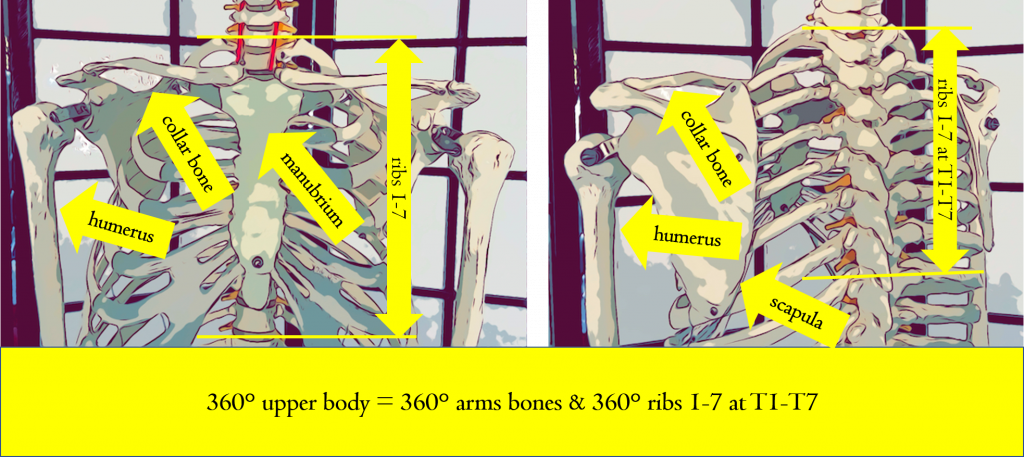
Remembering that when a muscle contracts, the insertion bone moves toward the origin bone, the anatomy shows that the Pec Majors’ muscle effort contributes to stability in the shoulder girdle and the rib cage barrel. This means that using these muscles is about learning how to stabilize and move bone with necessary muscle effort. The Pec Majors’ over-contraction (the grip and grind muscle effort we talked about earlier) can destabilize both the shoulder girdle and the rib cage barrel; with the destabilization of the rib cage barrel, they destabilize the vertebrae, which destabilizes the upper body.

Enter the Erector Spinae, which originate and/or insert at the vertebrae from whence movement of the rib cage barrel happens and provide stability and movement in the upper body.
To prevent grip and grind muscle effort and maintain stabilization of the spinal column (and thus, the rib cage barrel), we must harmonize the muscle efforts of the Erector Spinae and the Pec Majors. We need balance. Here we have a second conversation, this time in the upper body, between the Pec Majors and the Erector Spinae.
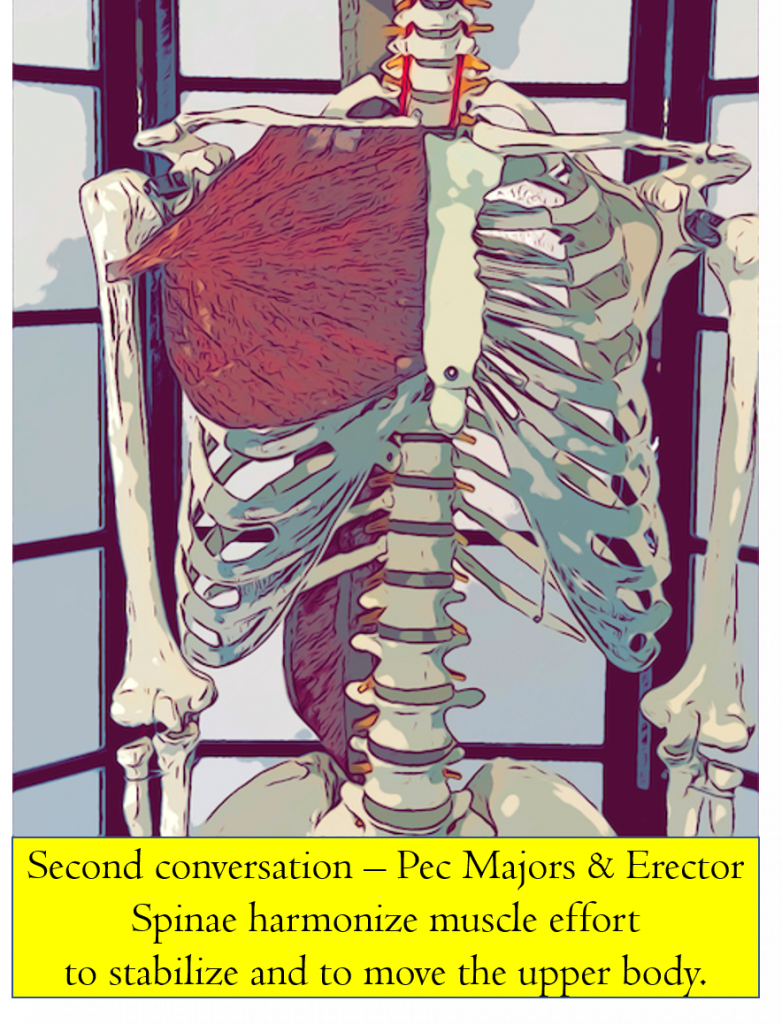
Together, the Pec Majors and the Erector Spinae muscles give us 360° muscle effort in the upper body; finding a muscle effort balance between these two muscles will have bearing on the alignment of the spinal column and, thus, the rib cage barrel and the arm bones.
So, the Pec Majors serve as a bridge that unifies three muscles and two conversations, to give us a solid starting point for stability and movement of the arm and a 360° upper body.
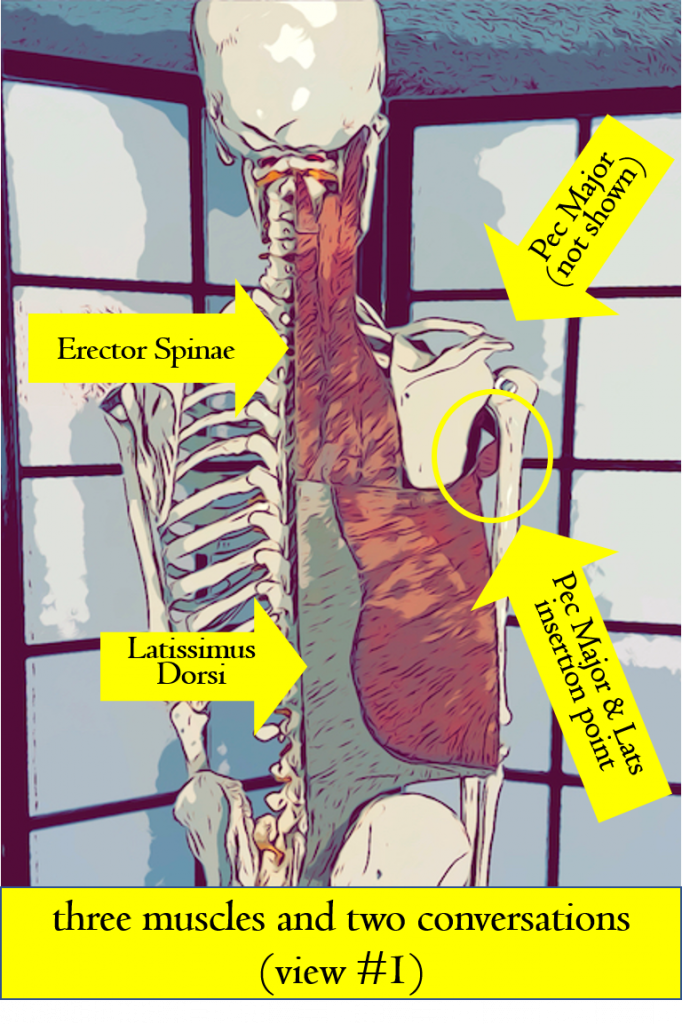
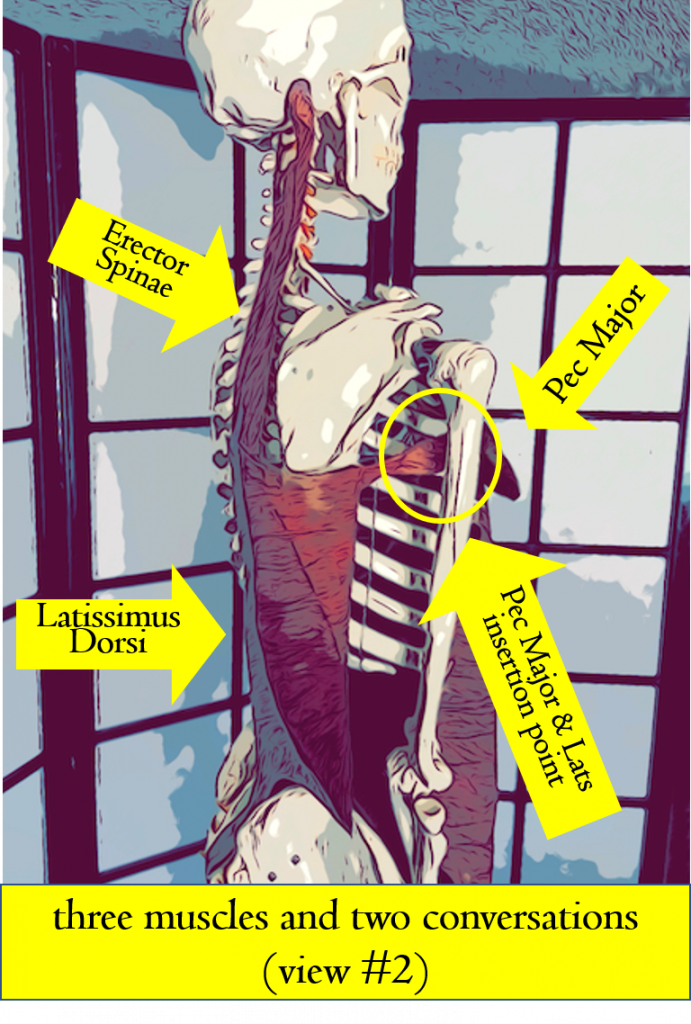
The 360° Torso. All told, then, we can see from the anatomy that the humerus moves from the collar bone, the sternum, and the lower angle of the scapulae (all of these bones are components of the shoulder girdle); the rib cage barrel; the External Obliques; the thoracic, lumbar, and sacral vertebrae (spinal column); and the pelvic barrel. With the Pec Majors, the Lats, and the Erector Spinae, we add muscle to the bones.
The bones and muscles show us more than a 360° upper body – that’s a 360° torso!

Fusion. Whether we like it or not, the technique of movement of the arm is complex. It involves alignment of the 360° arm bones and the rib cage barrel, a conversation between the Pec Majors and the Lats, and the inclusion of the upper body via a conversation between the Pec Majors and the Erector Spinae. There is no movement of the arms from a point between the shoulder blades. There is no arbitrary and amorphous “keeping the shoulders down.” There are no front and back halves of the body.
The addition of the Pec Majors shows us that, in the end, movement of the arm and the upper body happens in a 360° torso. With this understanding, we are building on the physical knowledge we need to learn how to inhabit the body we are in. Mark this as a pretty exciting seventh step toward a fusion body.
Try this: use your physical knowledge of the anatomy of the arm bones, the rib cage barrel, the Pec Majors, the Lats, and the Erector Spinae to slowly move your arms around an upright body. Then try slowly moving your arms around a flexed or rotated spinal column. Then use your arms to help you move in and out of the floor. What happens in the 360° torso? What do you have to do to feel and hear the conversations between the muscles?
Next installment: The Pelvis
Installment No. 9: The Erector Spinae
Installment No. 10: Movement of the Arm: The Humerus, The Collar Bone, The Scapula, & The Sternum
Installment No. 11: The Latissimi Dorsi
Photos credit: Jill Redfern
You can send comments and questions to Jill at info@thirdshiftmovementshop.com. Please subscribe to the Third Shift’s YouTube channel and follow the Third Shift on Facebook.