
The technique of moving the leg in Literal Technique is about learning to dance the femur. If you haven’t already read Installment No. 15, “The Femur,” I strongly recommend that you read it before or alongside this installment. Together, these two installments help me lay out what I mean when I talk about dancing the entire femur and not just the head of the femur in the hip joint.
Welcome to the Third Shift Movement Shop, home of Literal Technique, where we work so we can move. And welcome to Installment No. 16 of The Central Geekdom of Dance Technique, “The Five Leg Muscles.”
In the last installment, we looked at the femur without the muscle, which allowed us to see from where the Five Leg Muscles stabilize or move the femur. In this installment, we put the muscle back on.
When you think about it, when we dance, all leg movement essentially boils down to flexing, extending, rotating, adducting, and abducting the femur. There are five muscles in our group of 12 that do this: the Psoas Major (I will shorten this to Psoas); the Glutei Maximi (shortened to Glutes Max); the Hamstrings; the Adductors; and the Quadriceps Femoris (Quads). Understanding these five muscles lays an important technical foundation for movement of the femur and the lower leg.
Each of the Five Leg Muscles have their own job, however, in the context of Literal Technique and a fusion body, we will never think about these five muscles separately. They work together, like an ensemble, to dance the femur.
As we shall see, all of the Five Leg Muscles either originate from or insert at the femur. Except for the Psoas, all of them have origination points at the pelvic barrel. The femur is directly connected to the lumbar vertebrae by the Psoas and to the sacral vertebrae and tailbone by the Glutes Max. The femur is indirectly connected to the vertebrae via the pelvic barrel by the Hamstrings, the Adductors, and one muscle in the Quads. So, the Five Leg Muscles intertwine the femur with the pelvic barrel and the vertebrae and, thus, the rest of the body.
Each of the Five Leg Muscles have their own job, and you should understand each muscle. In the context of Literal Technique and a fusion body, however, we will never think about these five muscles separately. They work together, like an ensemble, to dance the femur. So, first we will learn about each of them, and then we will integrate them into the muscle network they create.
Because we exist in a fusion body, the Five Leg Muscles are part of Literal Technique’s larger 12-muscle network. So, I am overjoyed to say that this installment marks our completion of the complex accumulation of all of Literal Technique’s bones and 12 muscles. Mark this as a jumping and leaping eleventh step toward a fusion body.
My warning about this installment: this is some intricate, super-geeky stuff. If your head starts to spin, stop and find your balance. Don’t try to memorize anything – look at it, work it out; come back to it, work it out; and let it sink in over time.
What Happens Where
Before we get into it, I want to make a quick note about the use of the word extension in anatomy versus dance class. When we dancers talk about leg extensions, we mean lengthening the leg in front, side, and back positions, such as moving from fifth position through coupé and passé to an 90° extension to the side. When anatomy talks about leg extensions, it means an angle between two points created by movement in a joint. If the angle gets bigger, it’s an extension of the joint. If the angle gets smaller, it’s a flexion of the joint. Translation: extension of the femur in anatomy means movement of the leg behind the body; movement of the leg to the front or the side is femur flexion. Keep this in mind as you learn about the Five Leg Muscles.
The Psoas (pronounced, “so-as”) flexes and externally rotates the femur. It also flexes the torso at the femur (for example, moving from lying down to sitting up).
The Glutes Max extend the femur (their primary function); they also externally rotate and abduct the femur.
The Hamstrings extend the femur and, when it is extended, they externally rotate the femur. They flex the knee joint (bend the knee) and rotate the lower leg. They stabilize the pelvic barrel.
The Adductors adduct, flex, extend, and rotate the femur. They help stabilize the hip joint by keeping the femur at rest, and they help stabilize the pelvic barrel when we stand, walk, or run.
The Quads flex the femur and extend the knee joint (which lengthens the lower leg). They are the most powerful extensor of the knee and can simultaneously flex the femur and extend the lower leg. They also stabilize the knee joint.
Geeky Glory
As you look at the Geeky Glory, a reminder that, when we contract muscle, it creates movement of bone – the insertion bone moves toward the origination bone. So, by understanding the anatomy of a muscle, we can identify the bone(s) that a muscle(s) moves.
When we contract the Five Leg Muscles, it is not always possible to feel contraction of the muscle at its origination. Thus, for proper use of the muscles, it will be important for us to know the location of the origination and insertion points.
For the sake of simplicity, the below photos of the muscles and their origination and insertion points show only one side of the body. Remember that these muscles come in pairs, so, although the photos may not show both sides, the images and markings apply to both sides.
Lastly, don’t forget that you can check the Glossary for words you don’t know or that are not defined here.
***
Psoas. The Psoas is a deep muscle that extends from each side of the last thoracic vertebrae and all five of the lumbar vertebrae to the inside of the same-side femur. It extends diagonally and downward through the pelvis. It flexes and externally rotates the femur.
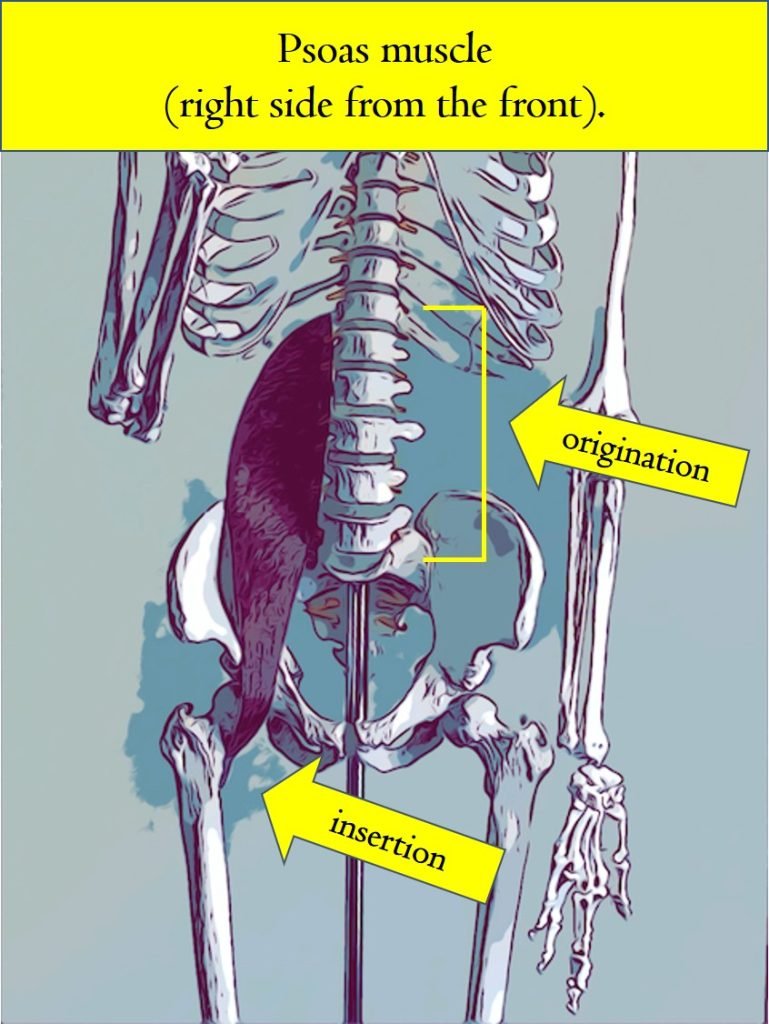
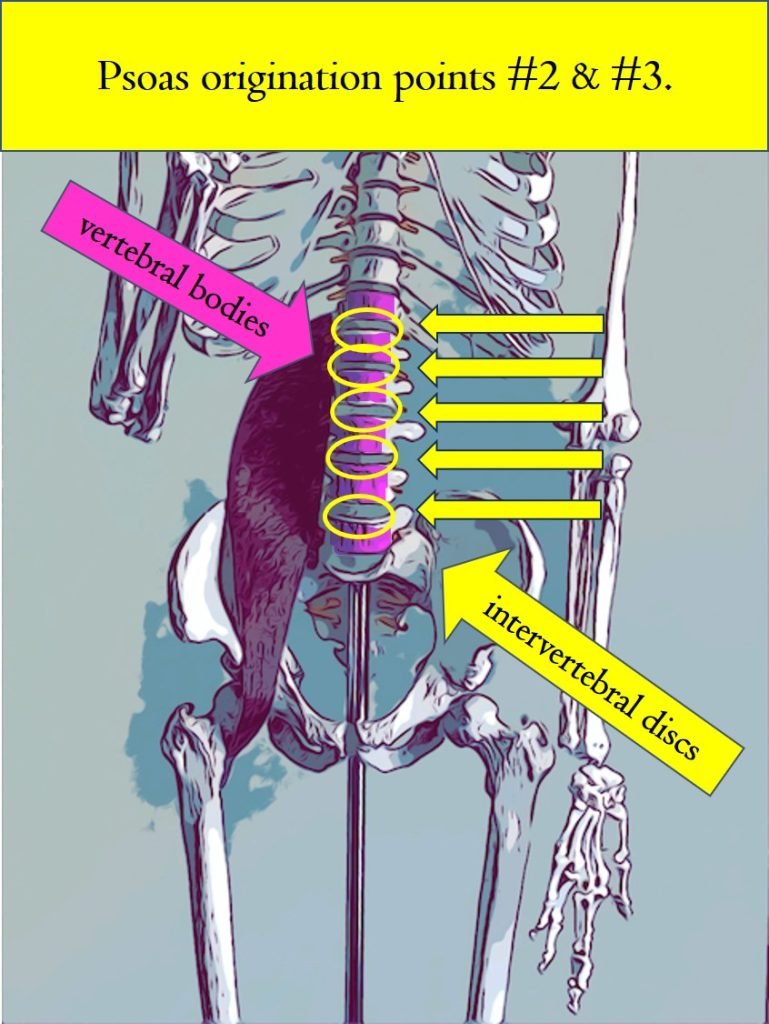
It originates at (1) the transverse processes of L1-L5; (2) the vertebral bodies of T12-L5 (shown in dark pink below); and (3) the intervertebral discs between T12-L4 (shown inside the yellow circles below).
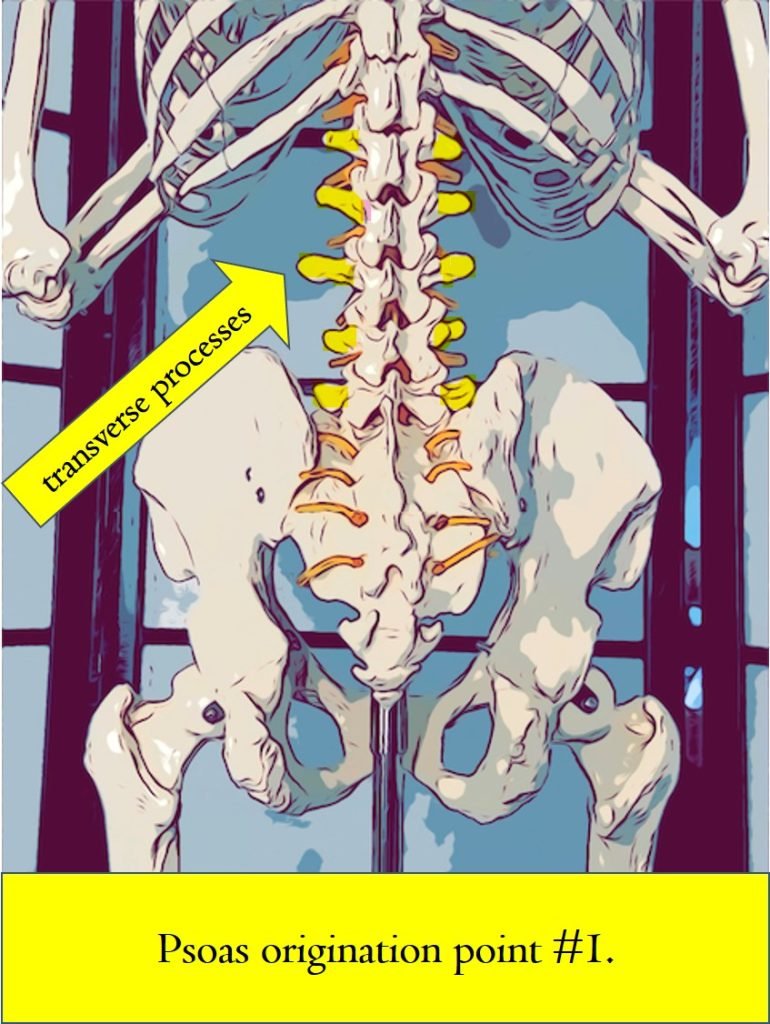
It inserts at the lesser trochanter, which is located at the proximal end of the femur.
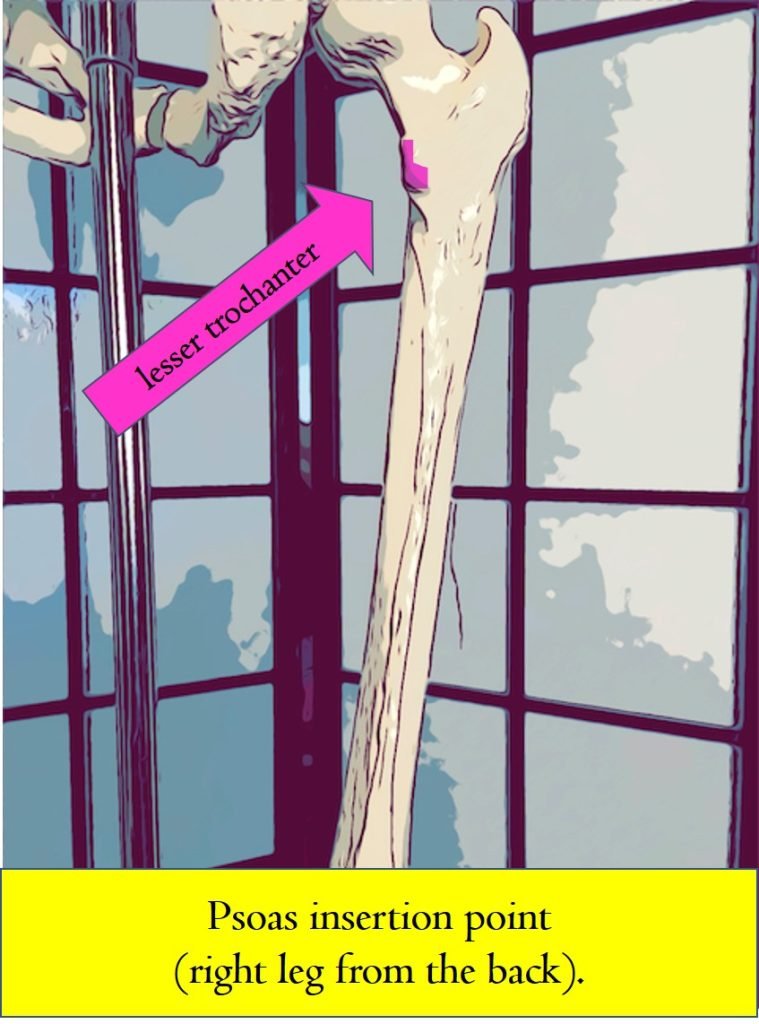
Because the Psoas is a deep muscle, it is difficult to feel it contract. Most of us are probably aware of the Psoas closer to the femur; it may register as a sore hip flexor. It is still the case, however, that when this muscle contracts, insertion bone moves toward origination bone: the femur is moved at the lesser trochanter toward T12 and the lumbar vertebrae. Because we know where it originates, we know that movement of the femur toward the vertebrae is not the beginning of movement, rather, it is the end result of contraction.
Take note that the origination bones are at our center of balance. Also note that neither the origination nor the insertion points are inside the hip joint. Psoas contraction moves the femur from a point on the femur itself.
When we are standing with two neutral femurs, necessary muscle effort in each Psoas muscle stabilizes the lumbar vertebrae by maintaining the natural curve of the vertebrae (lordosis). This has bearing on the bone alignment chain reaction that begins with the vertebrae, a chain reaction that includes the femur.
Reorienting ourselves to where movement begins will strengthen our technique. Close your eyes and put the fingertips of both hands on either side of the curve of the lumbar vertebrae. Engage the Four Abdominals. Visualize the Psoas’ origination and insertion points, engage the Psoas, and then slowly flex each femur, one at a time. Next, externally rotate each flexed femur, one at a time.
***
Glutes Max. The Glutes Max are a pair of superficial muscles that form the bulk of the mass of our bum cheeks. Theyextend, externally rotate and abduct the femur.
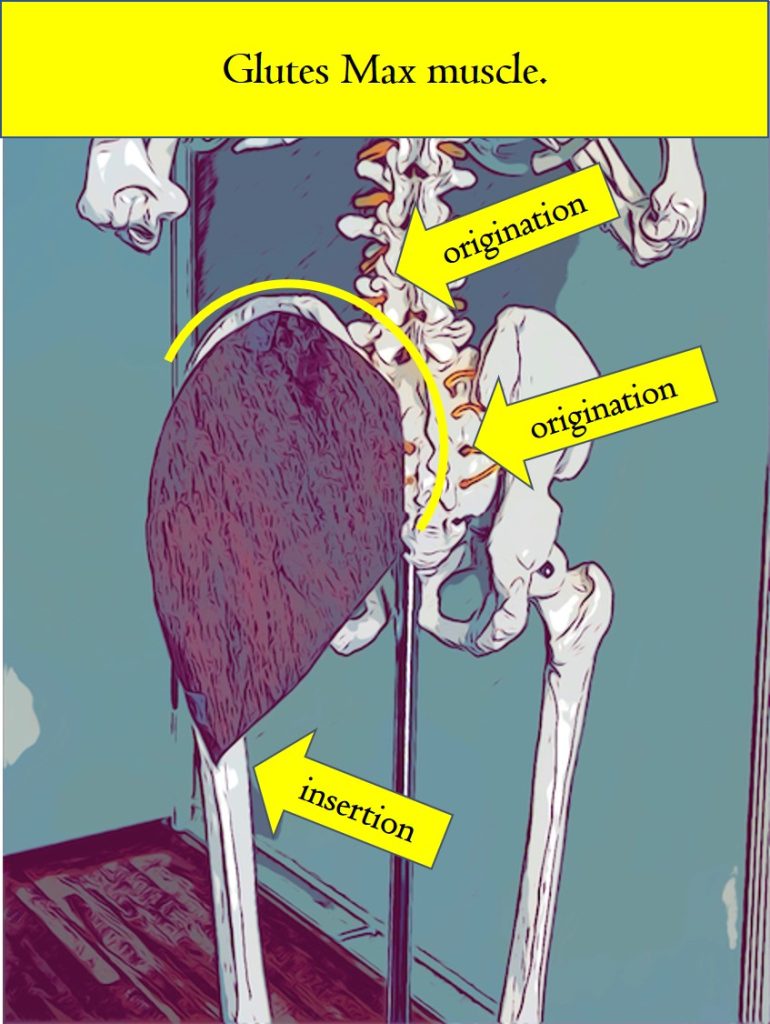
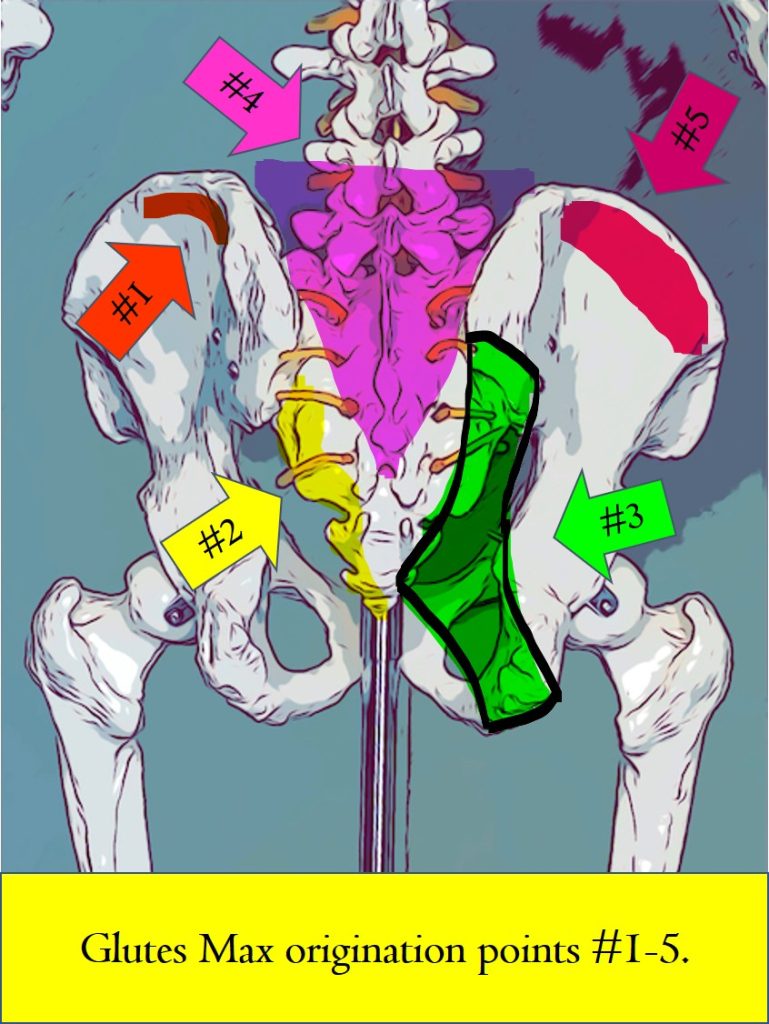
Each Glute Max originates from: (1) the gluteal surface of the ilium, behind or at the posterior gluteal line; (2) the side surfaces of the sacrum and the tailbone; (3) the sacrotuberous ligament; (4) the thoracolumbar fascia (TLF) (partial TLF shown here); and (5) the gluteal aponeurosis, a membrane that covers the gluteus medius muscle, which lies partially underneath the Glute Max.
The Glutes Max insert at (1) the gluteal tuberosity and (2) the iliotibial tract (also called the IT band), helping to form the top of the IT band.
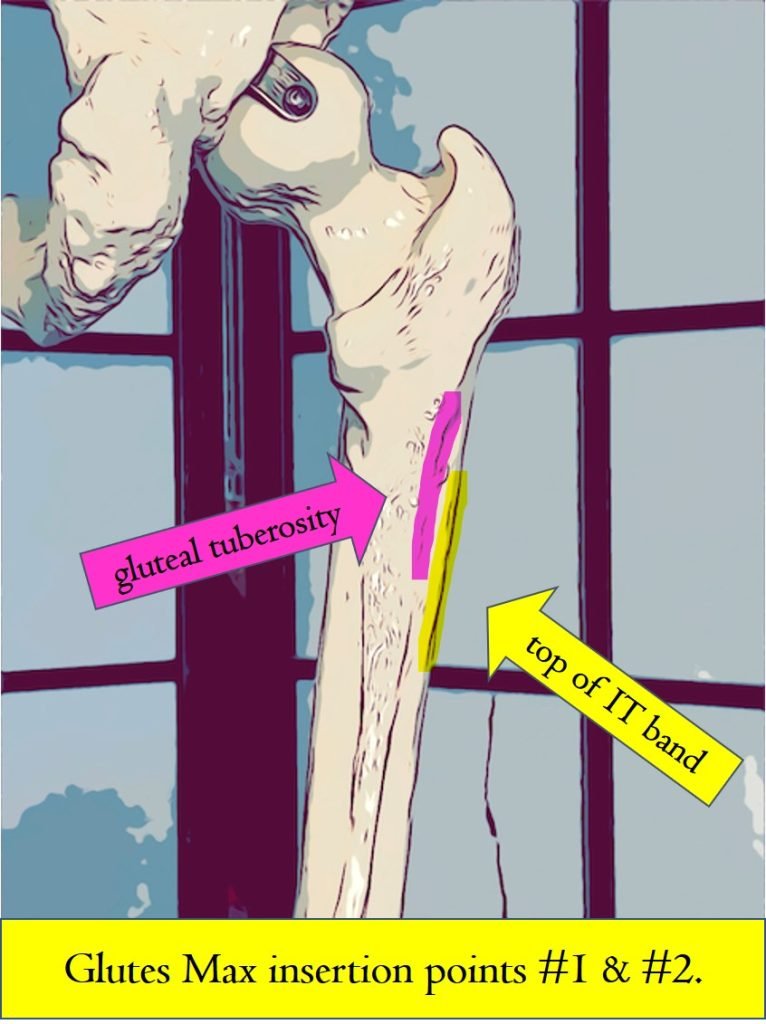
Contraction of the Glutes Max has to be one of the easier contractions to feel. No doubt you are absolutely aware when you are contracting these muscles, but did you know that they move the femur? Note that neither the origination nor the insertion points are inside the hip joint. Also note how close all of the origination points are to our center of balance.
Because we know where the Glutes Max originate, we know that the movements of the femur are not the beginning of our movement, rather, they are the end result of contraction. Glutes Max contraction moves the femur from a point on the femur itself and the IT band.
In addition to movement of the femur, the Glutes Max help us stay upright when the vertebrae, pelvic barrel, and femur are simultaneously at rest. Rotation of the femur using the Glutes Max can happen when the femur is at rest or in combination with femur extension and abduction.
Close your eyes and place the palms and fingertips of both hands on as much of the origination of each Glute Max as you can. Engage the Four Abdominals. Visualize the origination and insertion points, engage the right or left Glute Max, and then slowly extend each femur, one at a time, behind the body. Next, externally rotate the extended femur, one at a time.
***
Hamstrings. The Hamstrings are located at the back of the thigh, and are a muscle group with three muscles: Semimembranosus, Semitendinosus, and Biceps Femoris. Let’s look at them separately:
The Semimembranosus is the largest of the three muscles and lies at the inside of the back of the thigh. The Semimembranosus extends the femur, flexes the knee, internally rotates the tibia when the knee is flexed, and stabilizes the pelvic barrel.
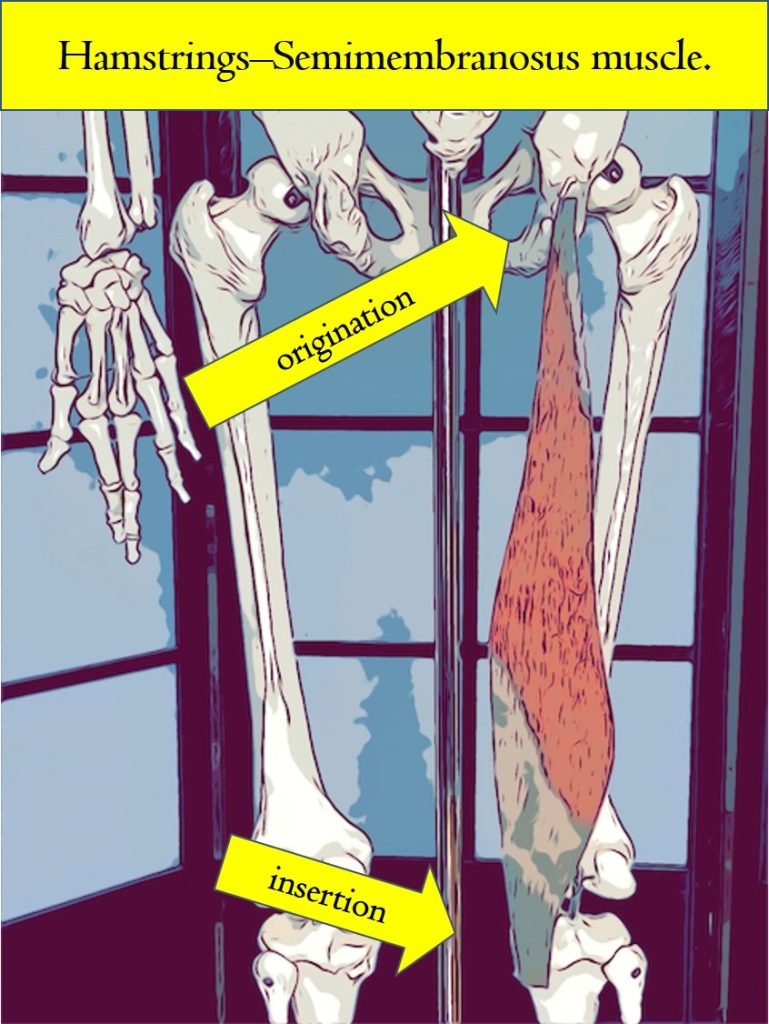
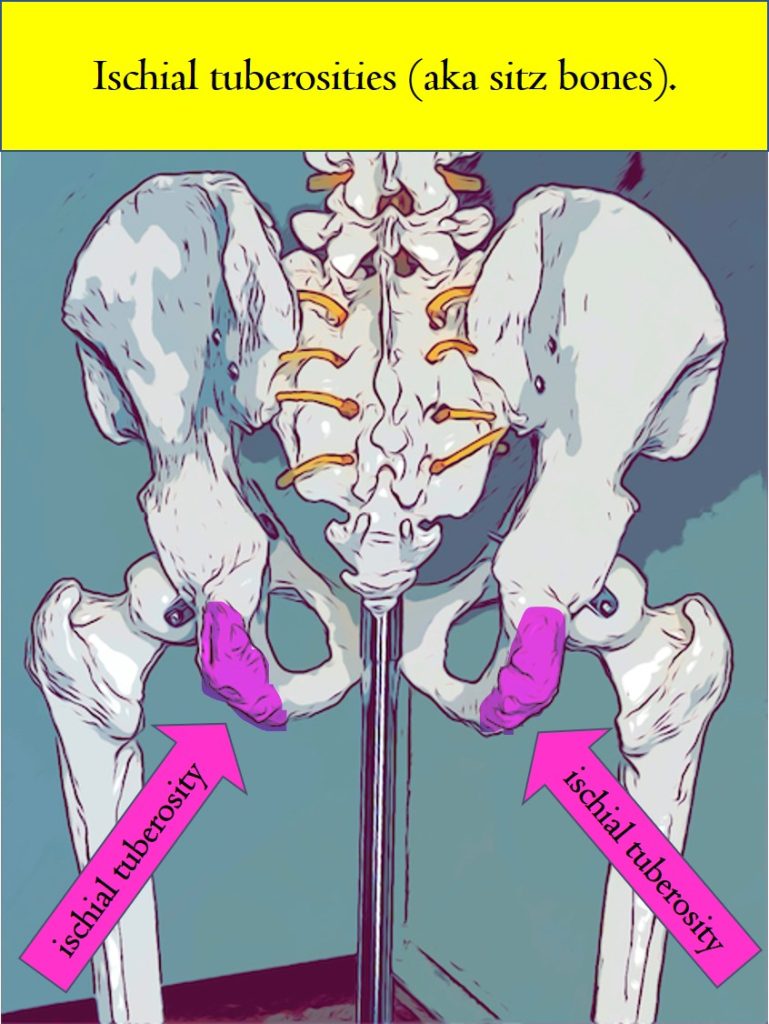
It originates at the ischial tuberosity (the sitz bone) of the ischium of the hip bone. Since all of the Hamstrings originate at some point on this bone, here’s a photo of the ischial tuberosities.
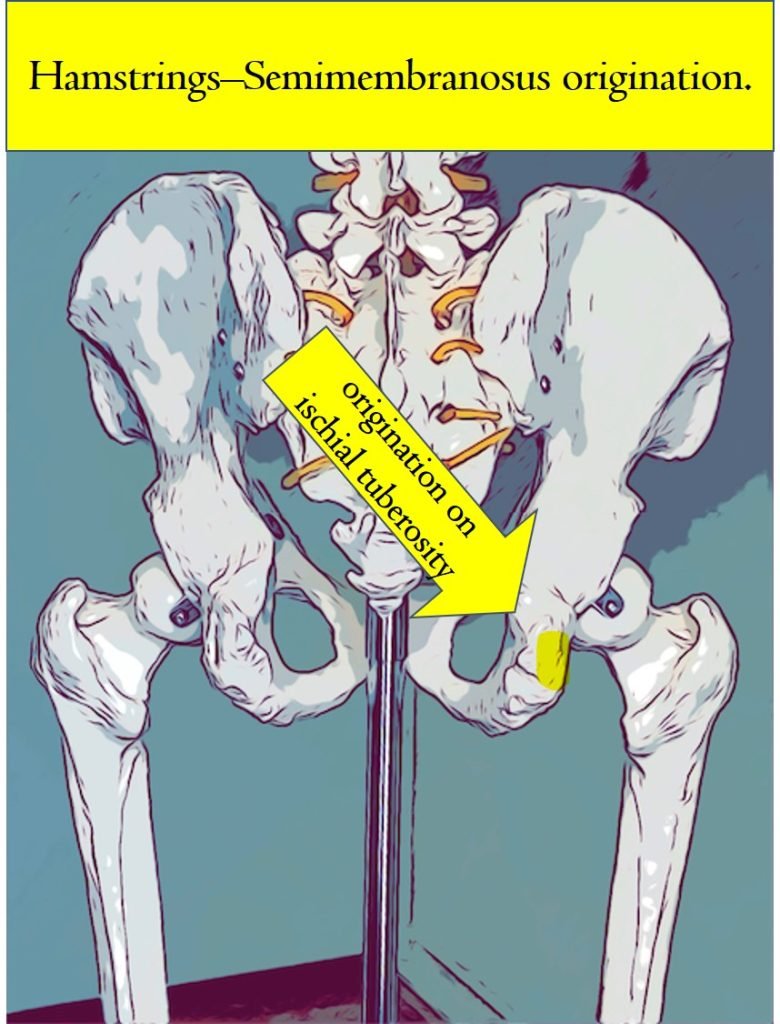
Here is the location of Semimembranosus’ origination. Note that it does not originate on the entire area of the ischial tuberosity.
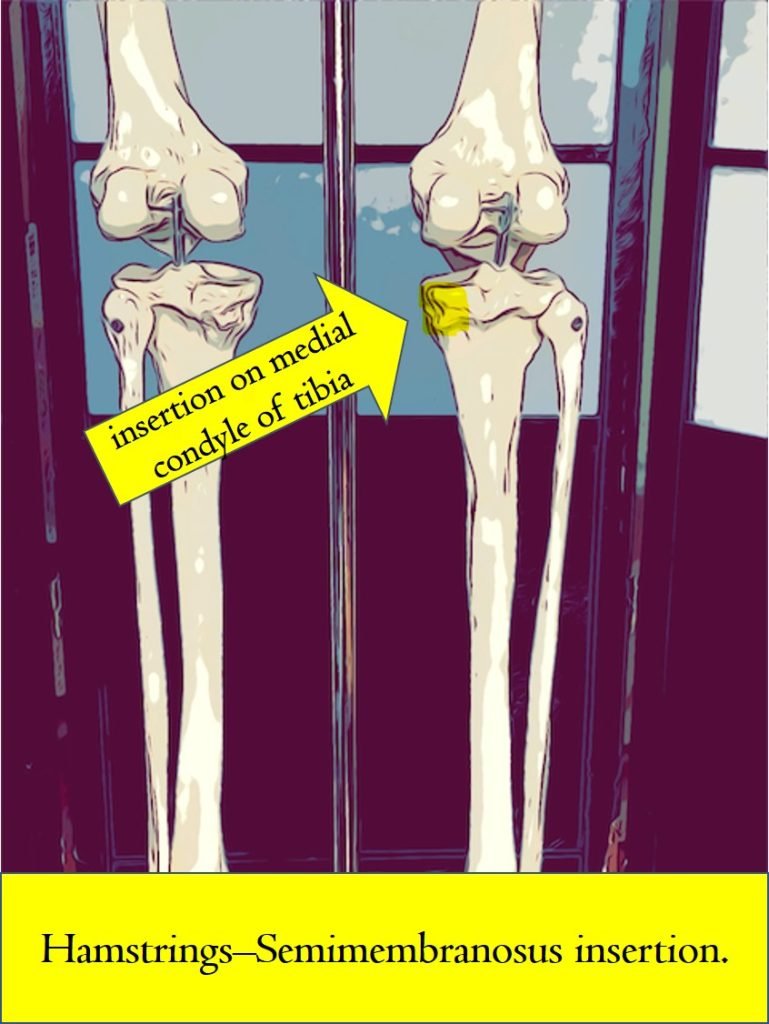
Semimembranosus inserts at the inside and back of the medial condyle of the tibia.
The Semitendinosus is the longest of the three muscles; it lies in the middle of the back of the thigh. The Semitendinosus extends the femur, flexes the knee, internally rotates the tibia when the knee is flexed, and stabilizes the pelvic barrel.
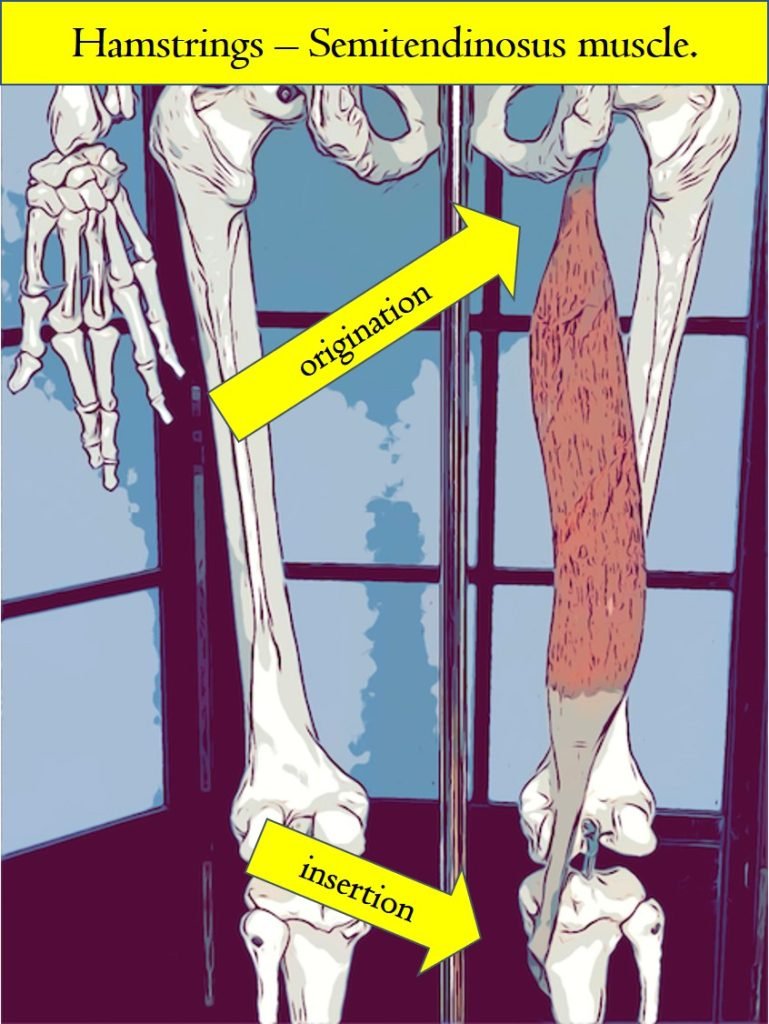
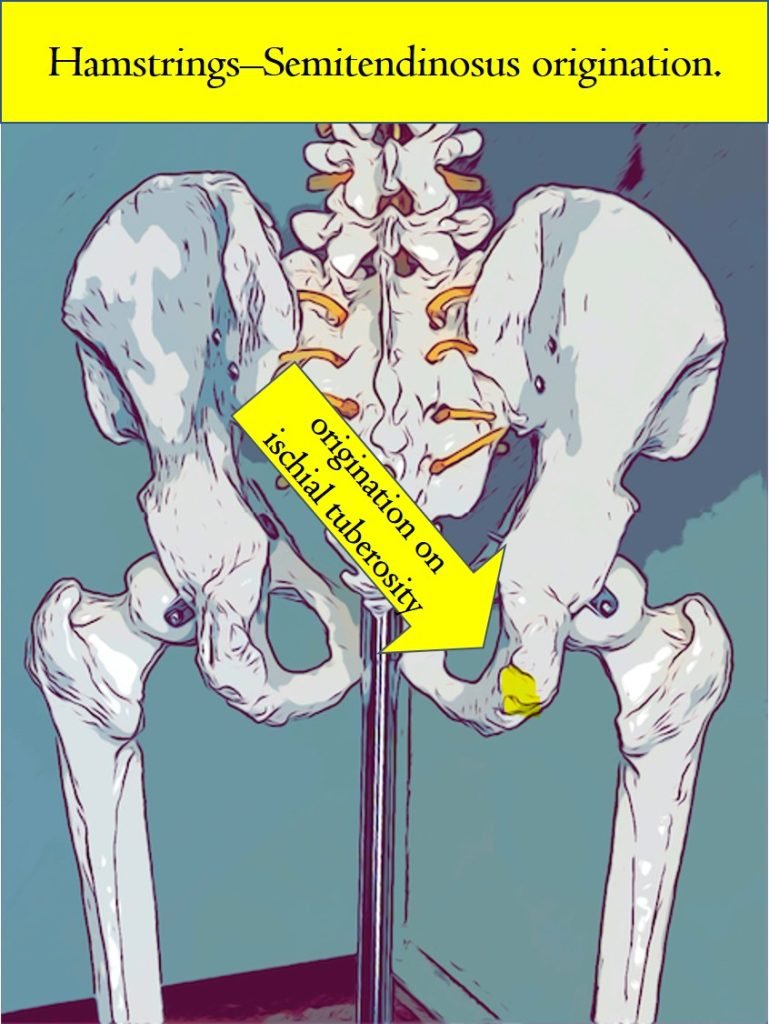
It originates at the ischial tuberosity (the sitz bone) of the ischium of the hip bone; it shares its origin with the long head of the Biceps Femoris (discussed below) via a common tendon. Note that it does not originate on the entire area of the ischial tuberosity.
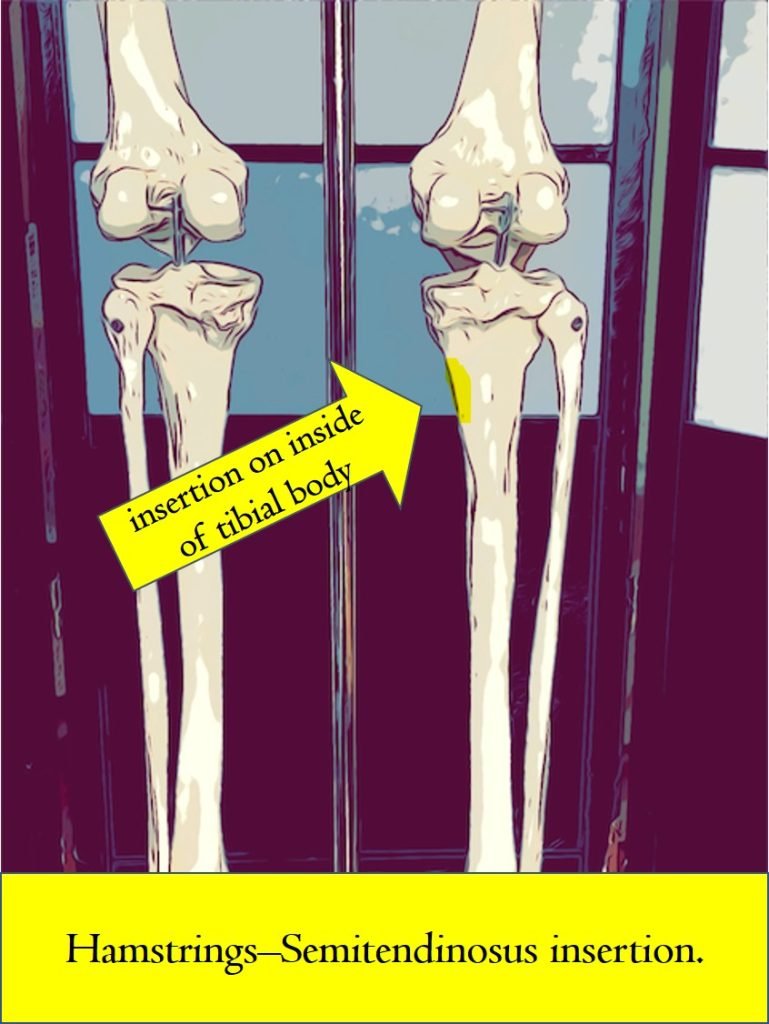
It inserts at the inside of the body of the tibia.
The Biceps Femoris is the most superficial of the three Hamstring muscles; it lies next to Semitendinosus toward the outside of the thigh. The word “biceps” in its name tells us that it has two attachment points on one end. Thus, unlike the other two Hamstring muscles, this muscle has two “heads” at its insertion point: a long head and a short head. They are shown separately below, but they are two heads on the same muscle.
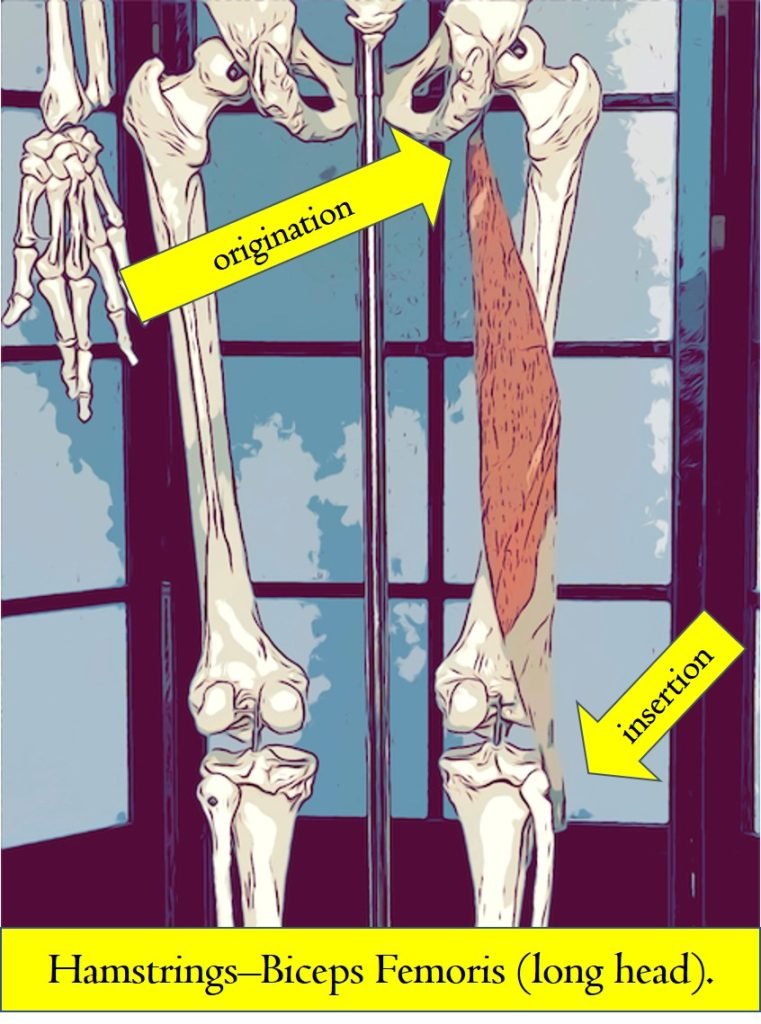
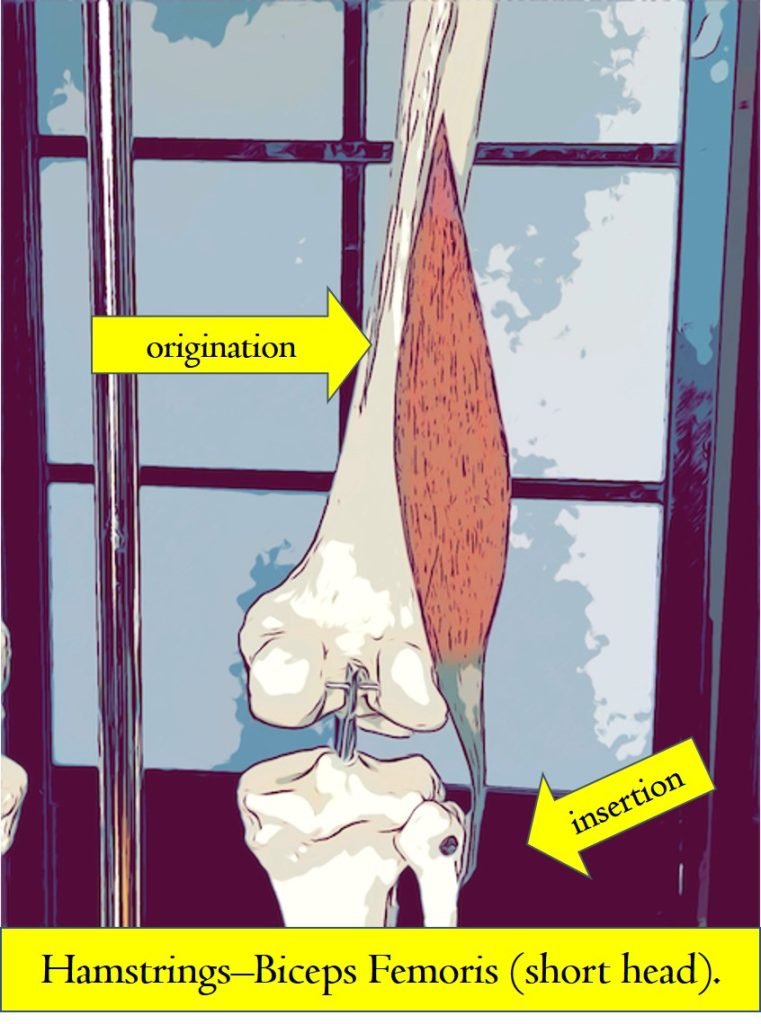
The long head extends the femur, externally rotates the femur when it is extended, flexes the knee joint, and stabilizes the pelvic barrel.
The long head originates at (1) the ischial tuberosity (it shares its origin with Semitendinosus via a common tendon) and (2) the sacrotuberous ligament (origination point shown at the pink circle below). The origination points are shown separately because they overlap.
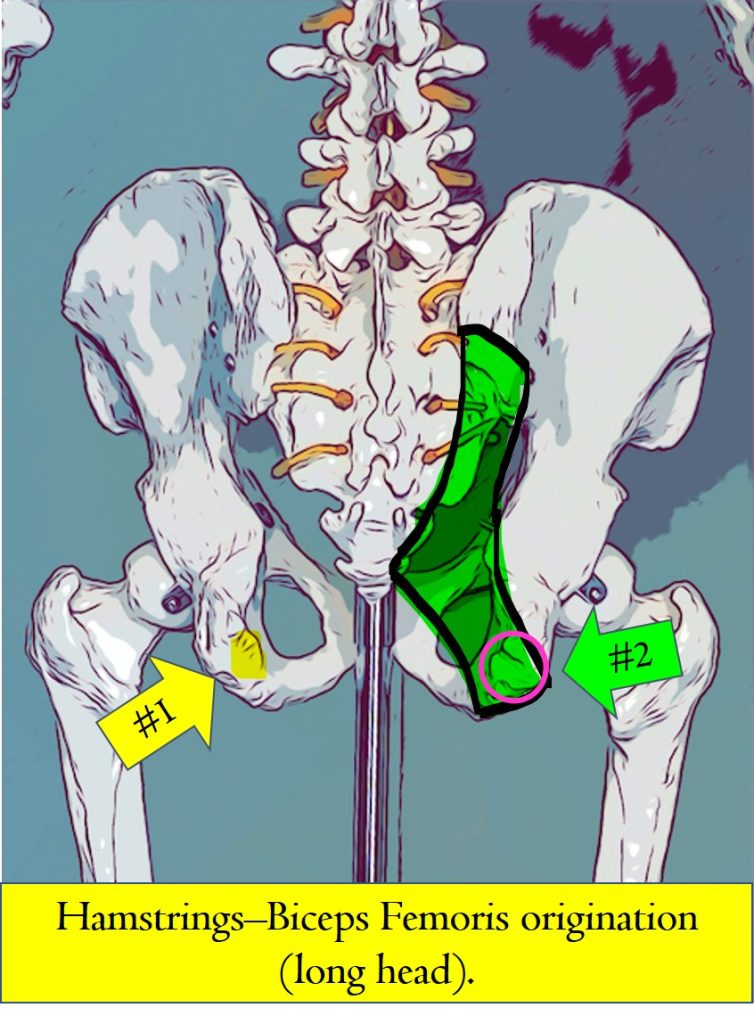
It converges into one tendon with the short head and inserts at the outside of and below the knee joint, at the head of the fibula.
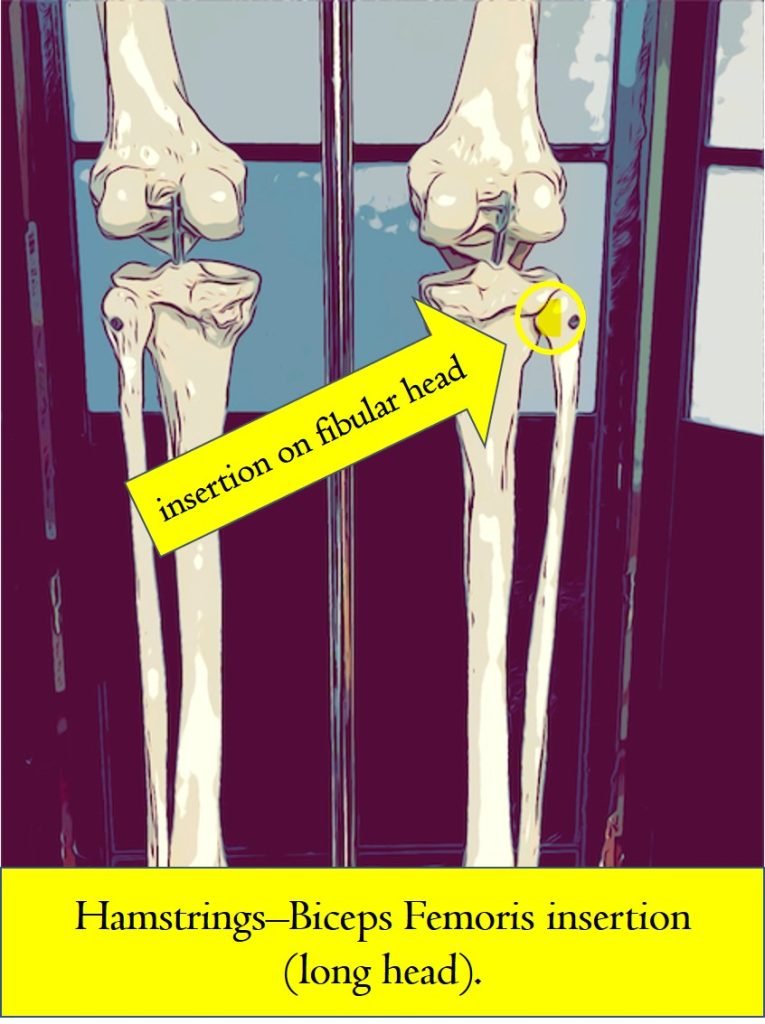
The short head flexes the knee joint and externally rotates the tibia when the knee is flexed.
The short head originates at (1) the linea aspera and (2) the lateral supracondylar line of the body of the femur.
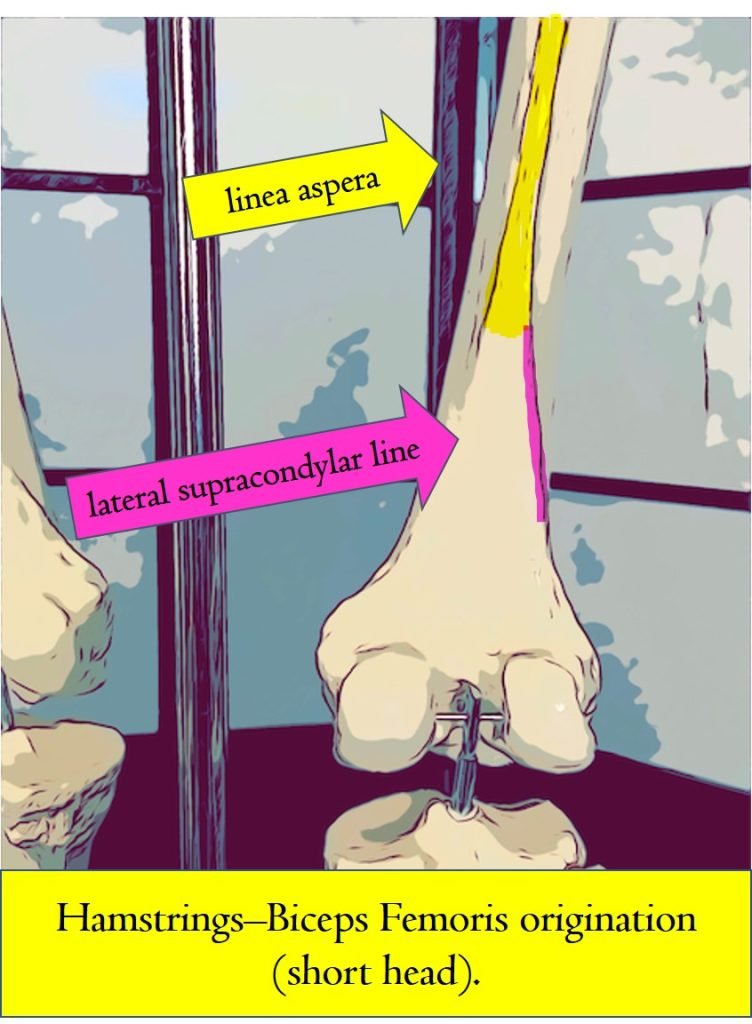
It converges into one tendon with the long head and inserts at the outside of and below the knee joint, at the head of the fibula.
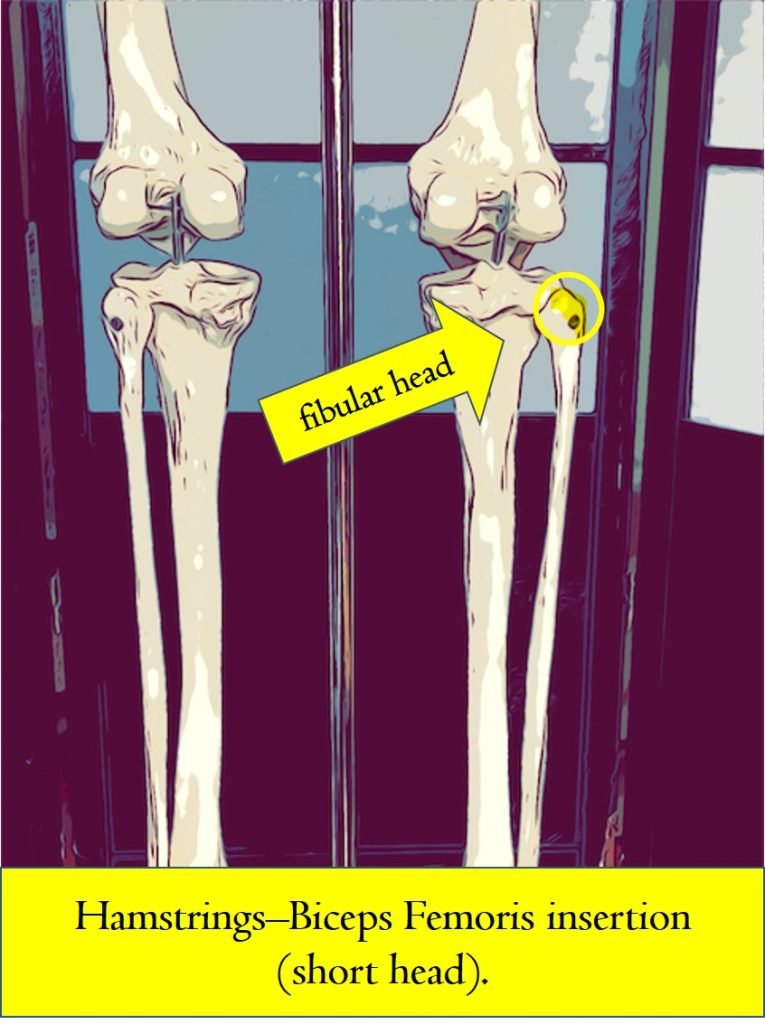
Contraction of the Hamstrings is one of the easier contractions to see – when we contract these muscles, they change shape – but I’m not sure we can always feel them work. I think the biggest difficulty with the Hamstrings is grasping how their contraction moves the femur when they neither originate nor insert on the femur itself.
Consider this: the femur is, de facto, part of the pelvic barrel by virtue of the hip joint. When we contract the Hamstrings, which originate on the pelvic barrel, the femur moves because it goes spatially where the hip joint goes spatially. Plus, the femur is one large bone that does not move in parts, and the Hamstrings insert below the knee; thus, the entire femur moves.
I think the beauty of the Hamstrings is that they require us to delve into the logic of a body that it not divided into parts. Reorienting ourselves to the Hamstrings will help us use them in our technique.
Contraction of the Hamstrings at the pelvic barrel creates quite a bit of movement, so I think it’s worth breaking it down. Please notice that neither the origination nor the insertion points of the Hamstrings are inside the hip joint:
All of the Hamstrings extend the femur from points below the knee.
All of the Hamstrings flex the knee from points below the knee.
The long head of Biceps Femoris externally rotates the femur when the femur is extended from a point below the knee.
The short head of Biceps Femoris externally rotates the tibia when the knee is flexed from a point below the knee.
Semimembranosus and Semitendinosus internally rotate the tibia when the knee is flexed from points below the knee.
Because we know where the Hamstrings originate, we know that extension and flexion are not the beginning of movement, rather, they are the end result of contraction. Also note how close the origination bones are to our center of balance.
Close your eyes and place your fingertips on the Hamstrings’ sitz bones originations. Engage the Four Abdominals. Visualize the origination and insertion points, engage the right or left Hamstrings, and extend the femur, one leg at a time. Flex the knee joint, one knee at a time.
***
Adductors. The Adductors are located on the inside of the thigh and are a muscle group with three muscles: Adductor Brevis, Adductor Longus, and Adductor Magnus. Let’s look at them separately.
Adductor Brevis is the shortest adductor muscle. Its main function is adduction of the femur, however, it also flexes, extends, and externally rotates the femur.
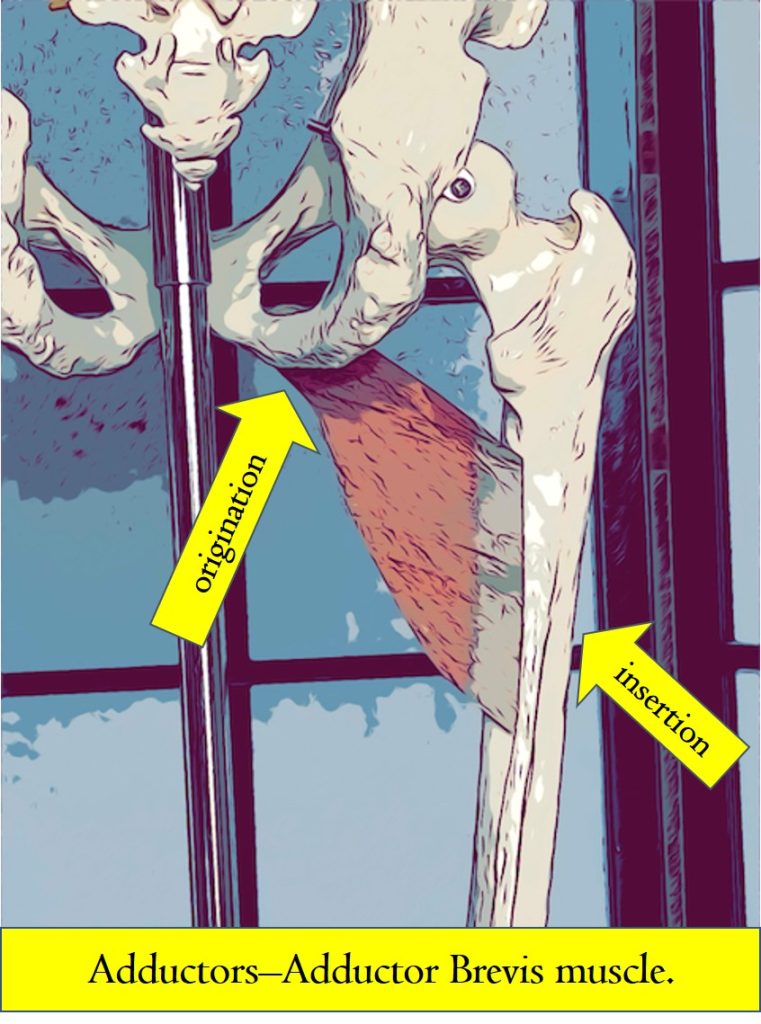
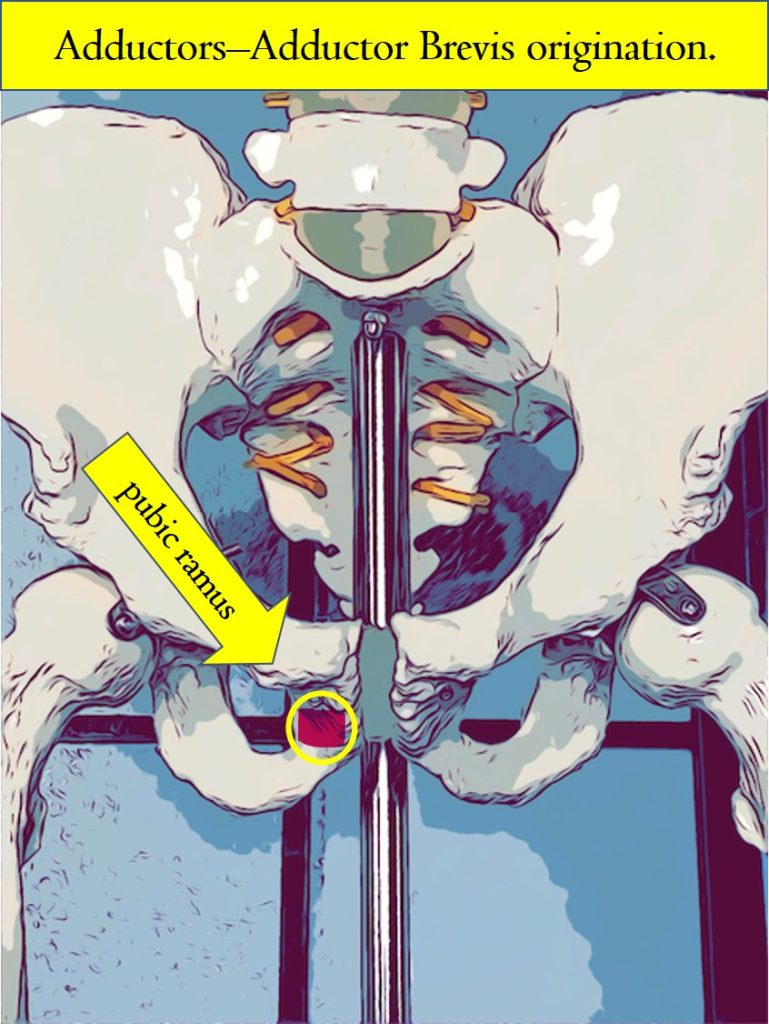
Its origination is at the surface of the pubic ramus.
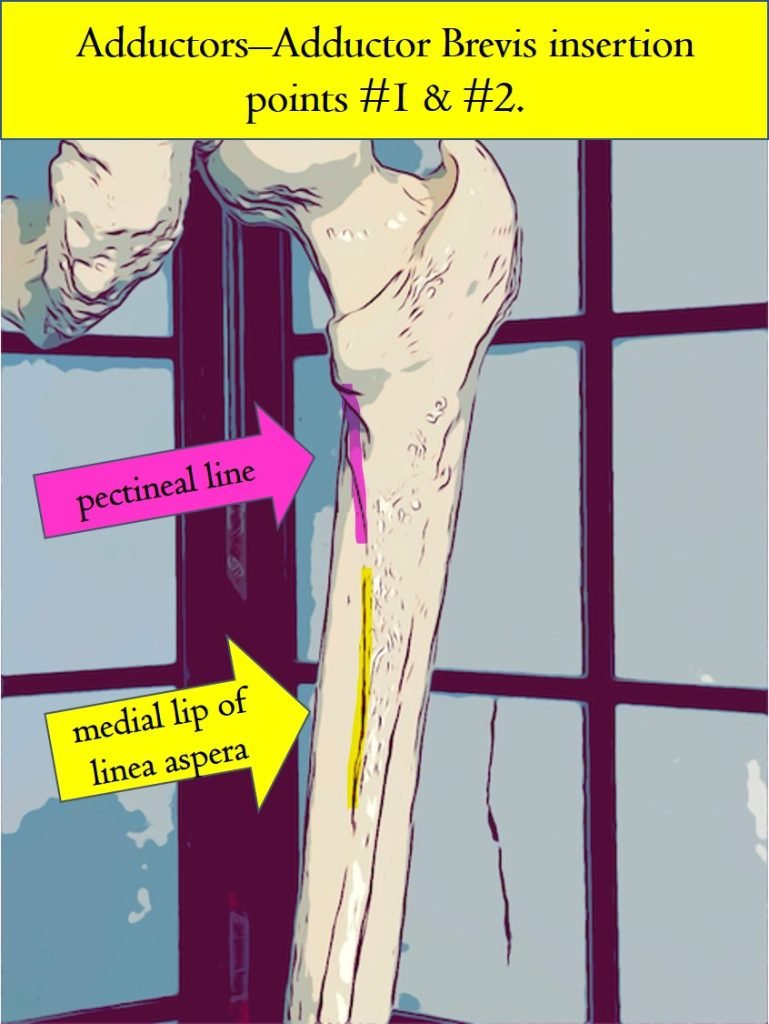
It inserts at (1) the pectineal line and (2) the top one-third of the medial lip of the linea aspera on the body of the femur.
Adductor Longus is the longest adductor muscle. Its main function is adduction of the femur, however, it also flexes, extends, and externally rotates the femur.
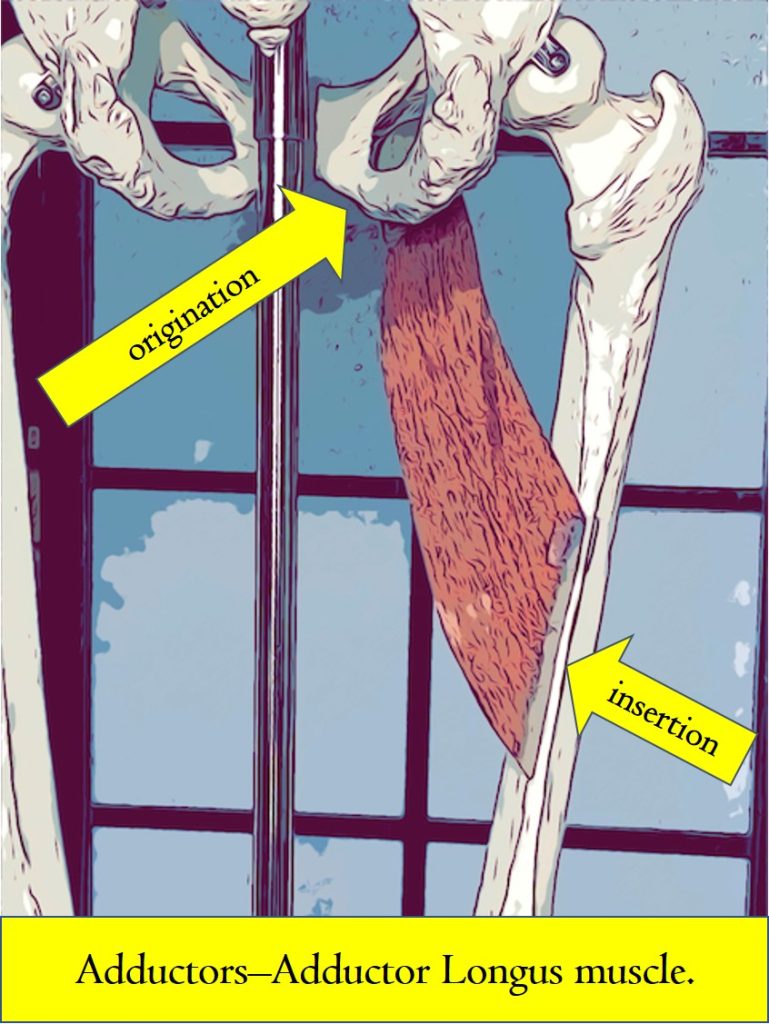
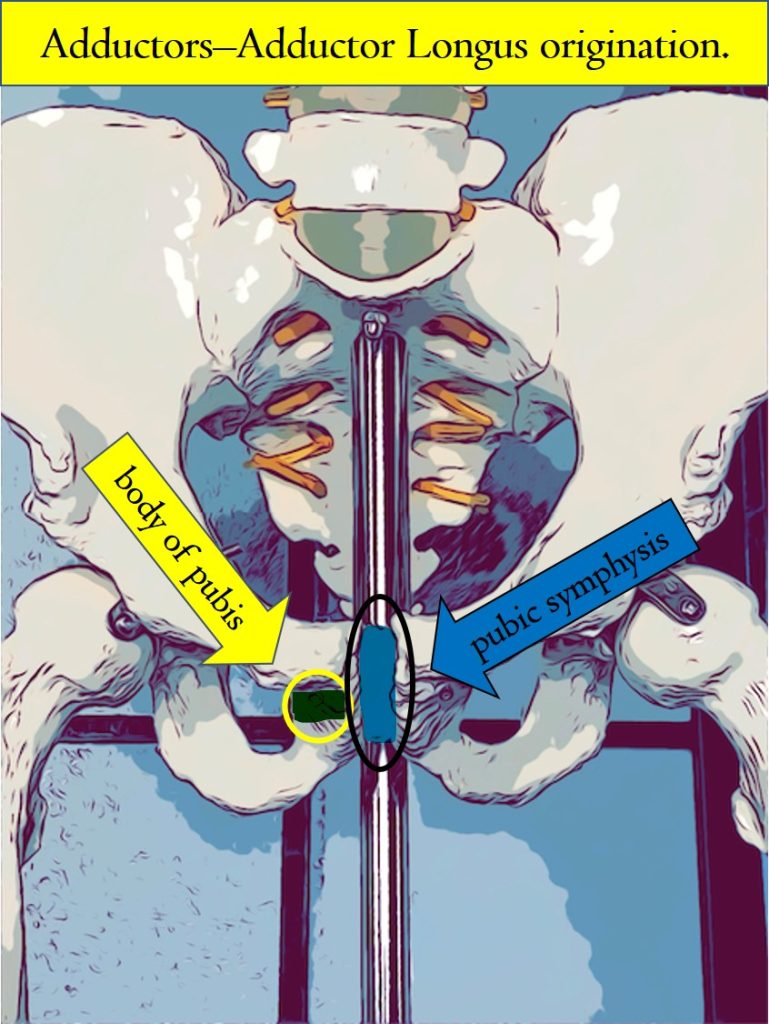
It originates at the surface of the body of the pubic bone, next to the pubic symphysis.
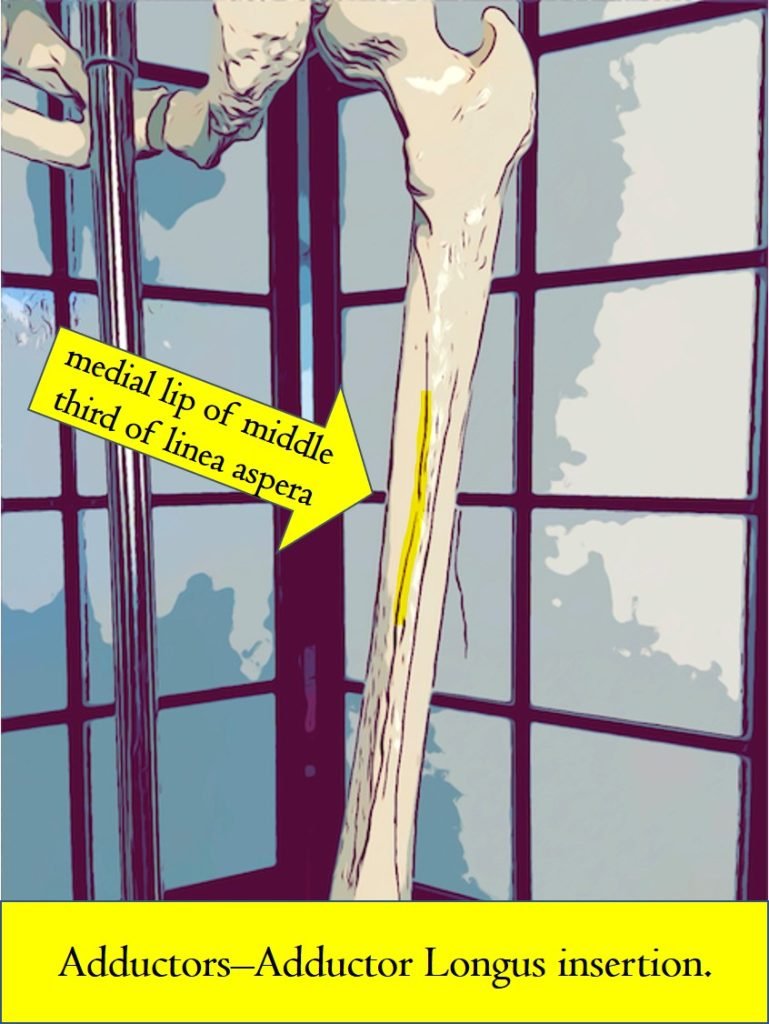
Its insertion point is at the medial lip of the middle third of the linea aspera.
Adductor Magnus is the largest adductor muscle. Its main function is adduction of the femur, however, it also flexes, extends, and rotates the femur.
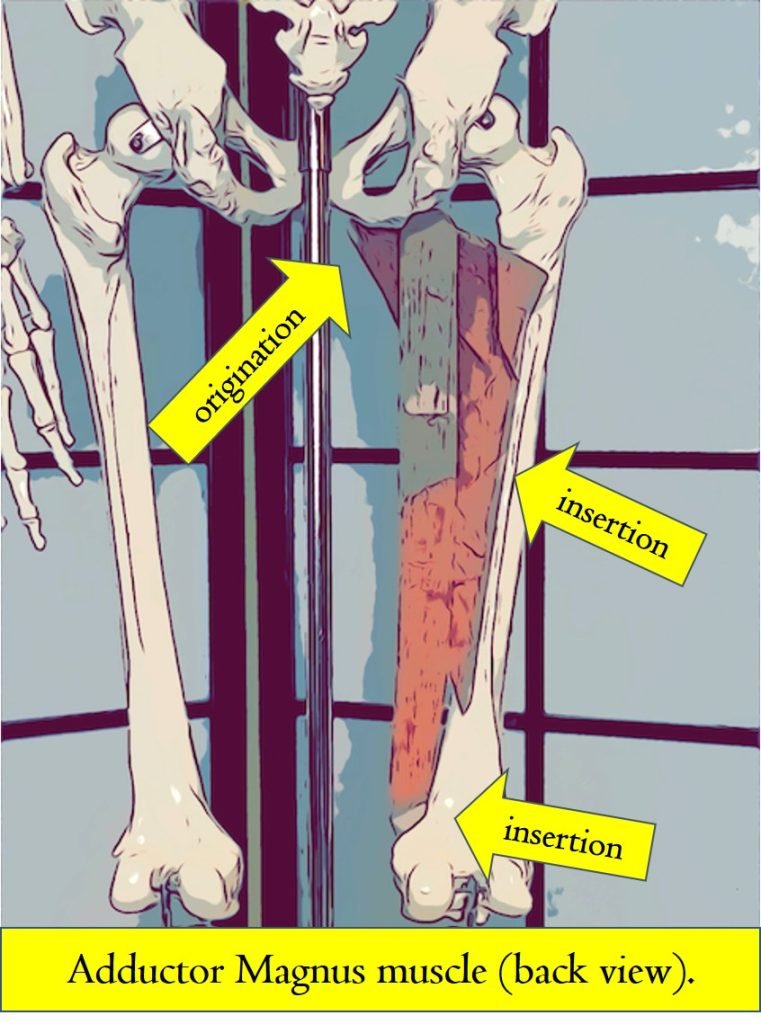
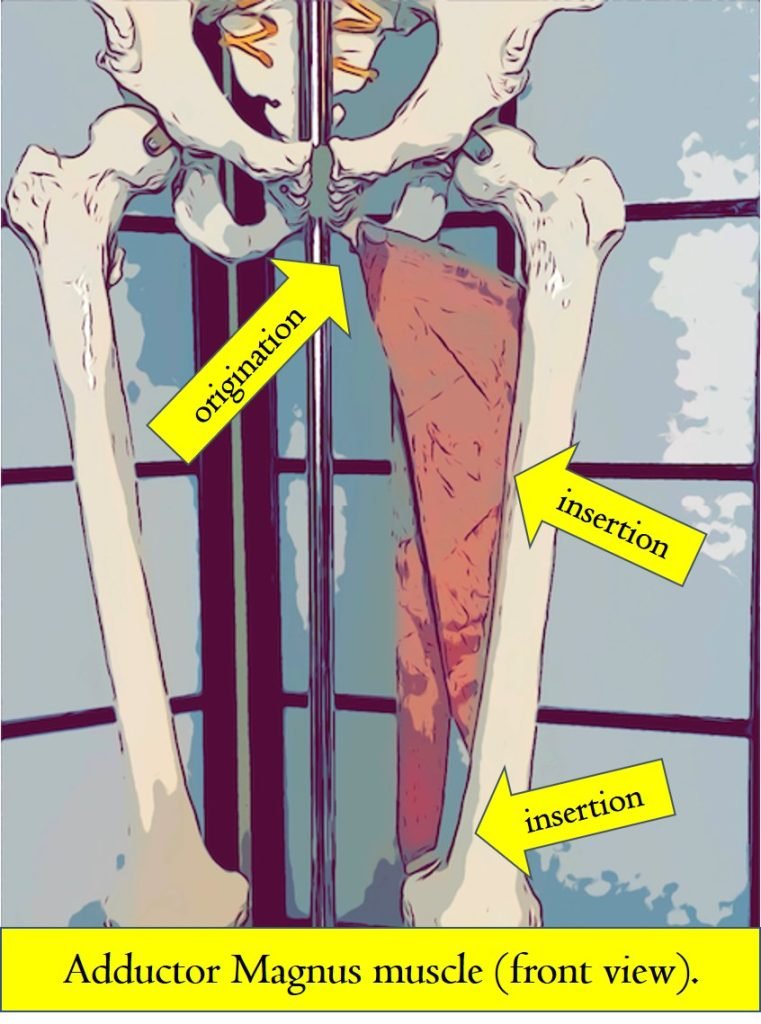
Just a note: this is a complicated muscle to draw in two dimensions, so I admit to errors in my depictions. The photos of the origination and insertion points should be used in conjunction with the muscle photos to remedy the two-dimensional limitations and to help you fill in your understanding of this muscle. Despite of the amateurish drawings, please remember that Magnus is one muscle.
Adductor Magnus is a pretty cool muscle, in my opinion. It originates in three places on the pelvic barrel – the pubic ramus, the ischial ramus, and the ischial tuberosity. So, although its origination overlaps with the other two Adductors, unlike Brevis and Longus, Magnus spans the curves of the two bones at the base of the pelvic barrel. (For a refresher on the bones of the pelvic barrel, take a look at Installment No. 13.)
Magnus’s origination means that it is involved in movement of the femur in front of, to the side of, and behind the body. Its origination also means that Magnus is described as having an “adductor part” and a “hamstring part.” These two parts have their own origination and insertion points and function. This does not mean that Adductor Magnus is two muscles or has two heads, rather, it means that anatomists have labelled two separate areas or parts of one muscle.
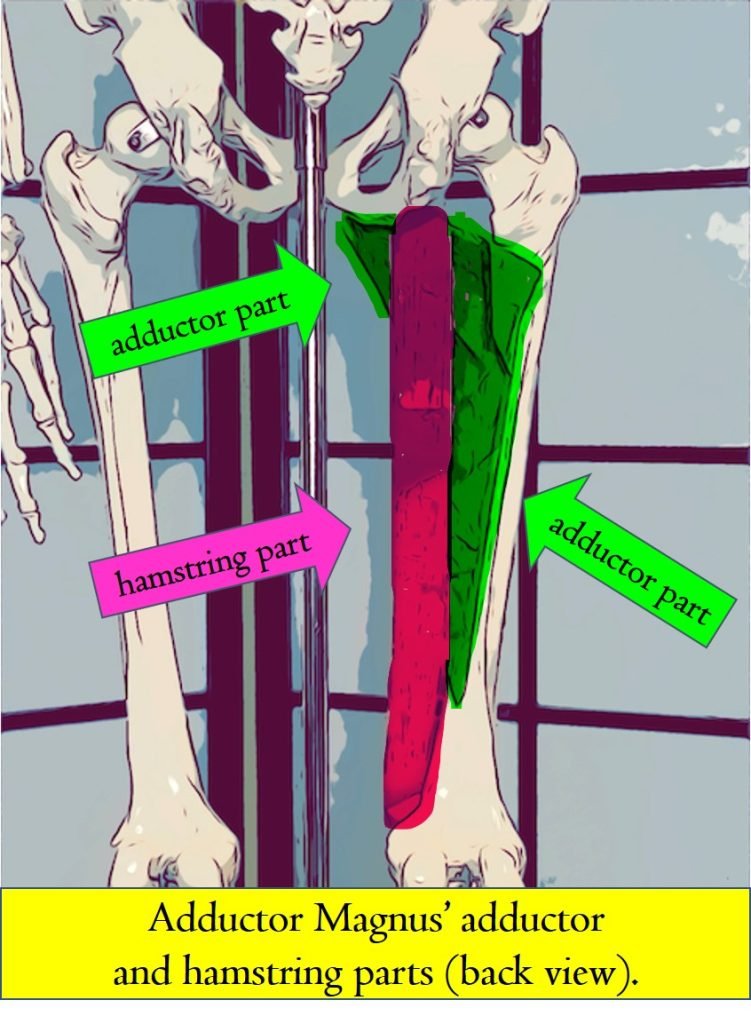
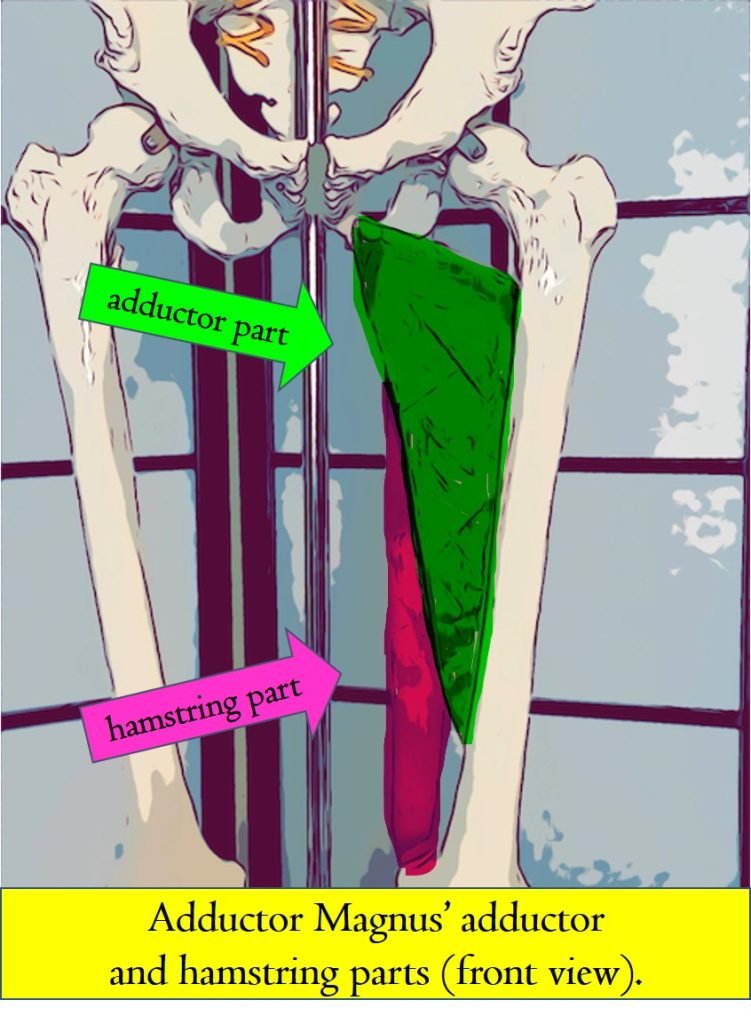
The adductor part adducts, flexes, and externally rotates the femur. It is further divided into two parts, a smaller part and a larger part. (Again, this is still one muscle.)
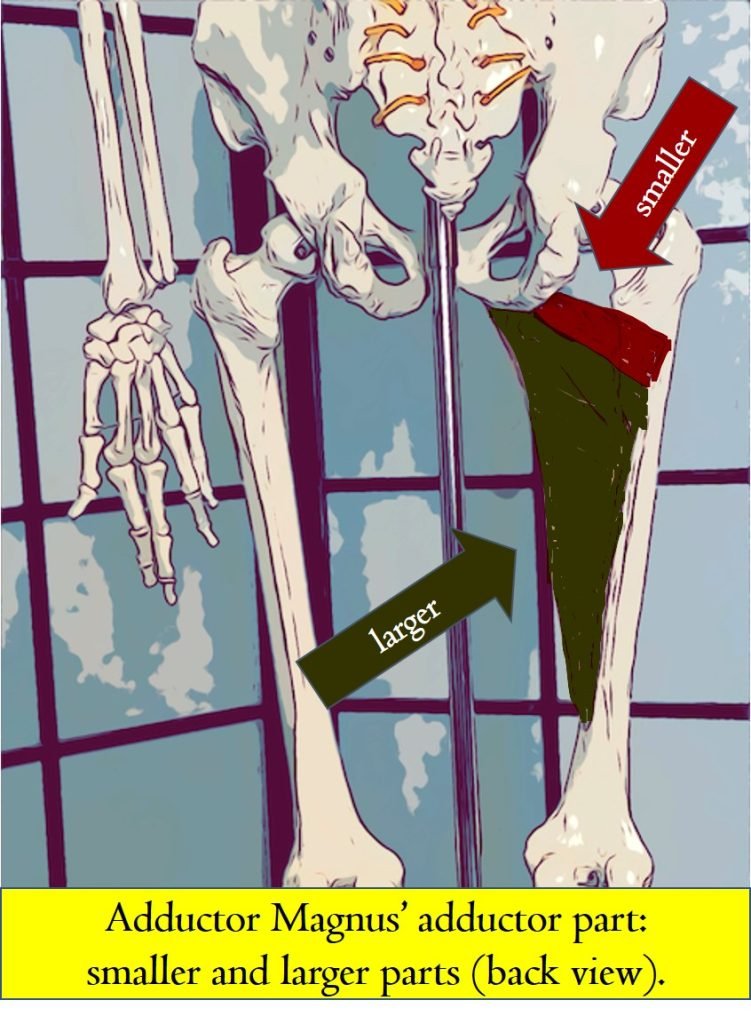
The smaller part originates at the pubic ramus and inserts on the medial side of the gluteal tuberosity. Its muscle fibers are essentially horizontal.
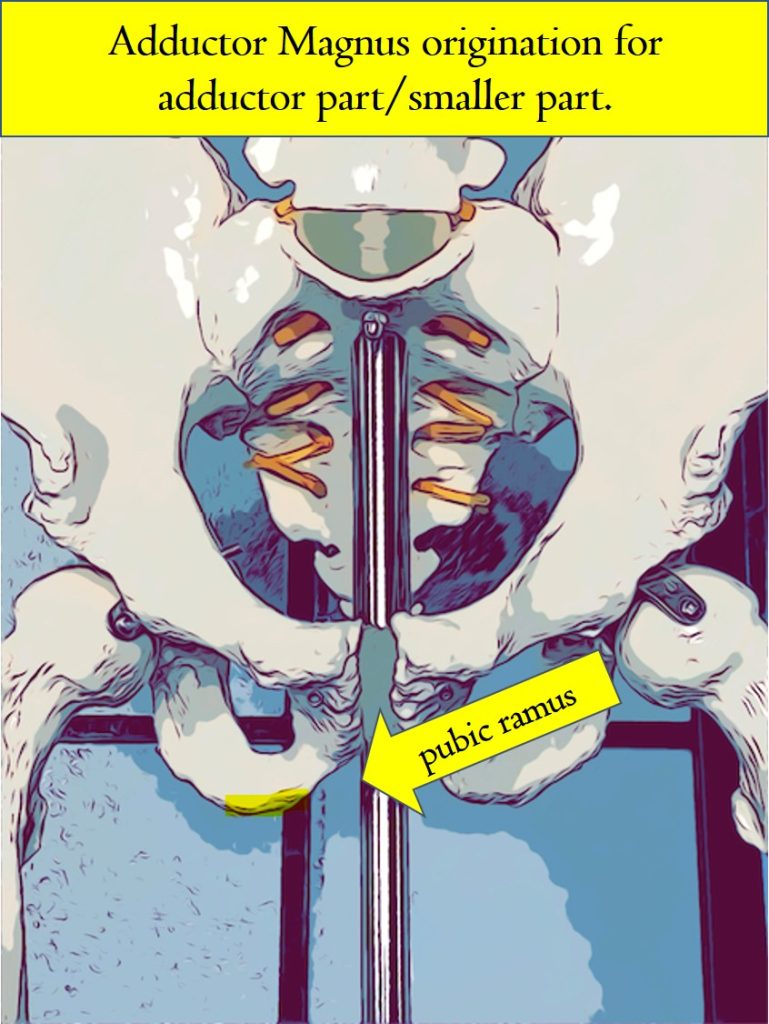
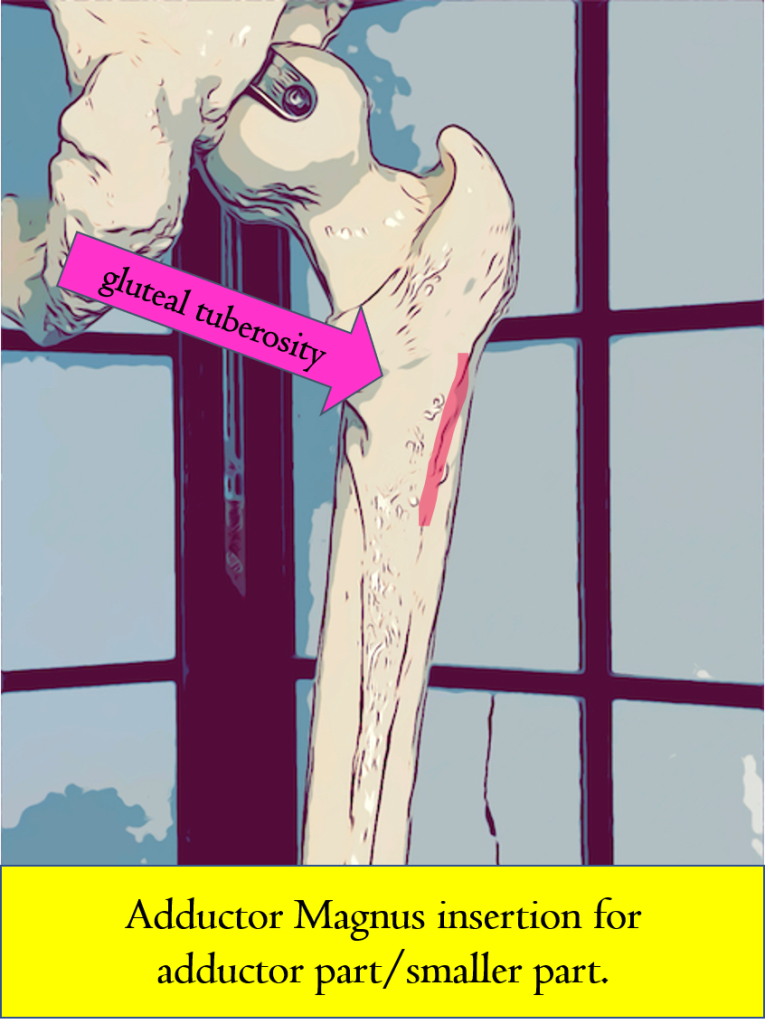
The larger part originates at the ischial ramus and inserts at (1) the medial lip of the linea aspera and (2) the medial supracondylar line of the femur. Its muscle fibers essentially extend on a diagonal to their insertion.
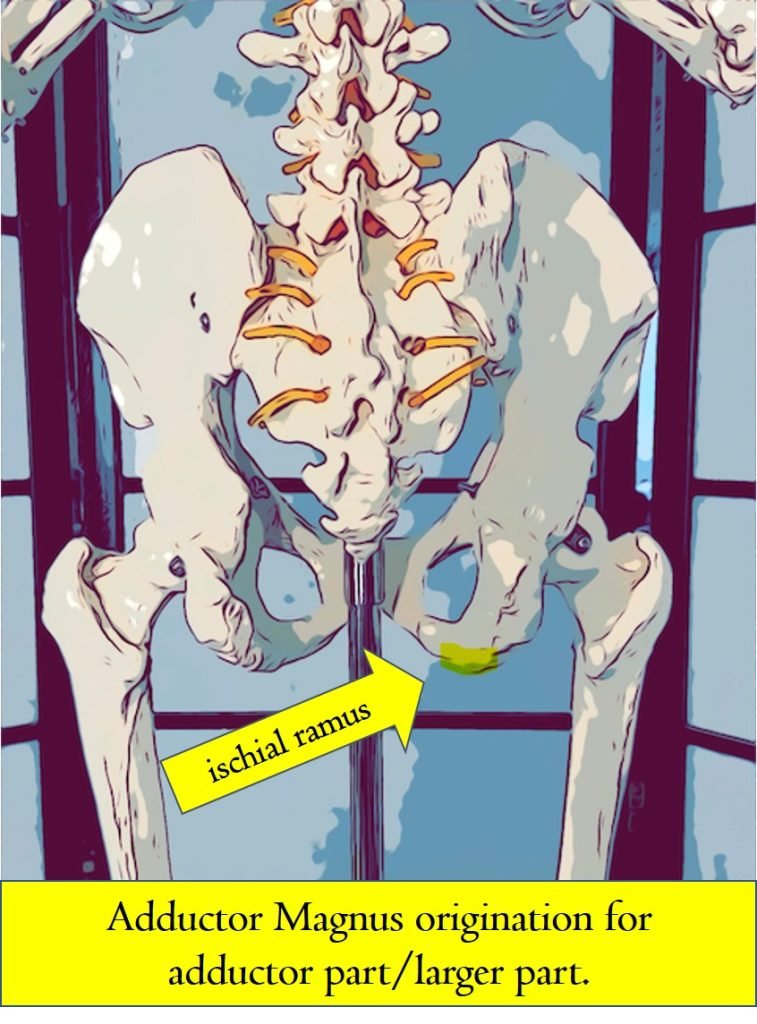
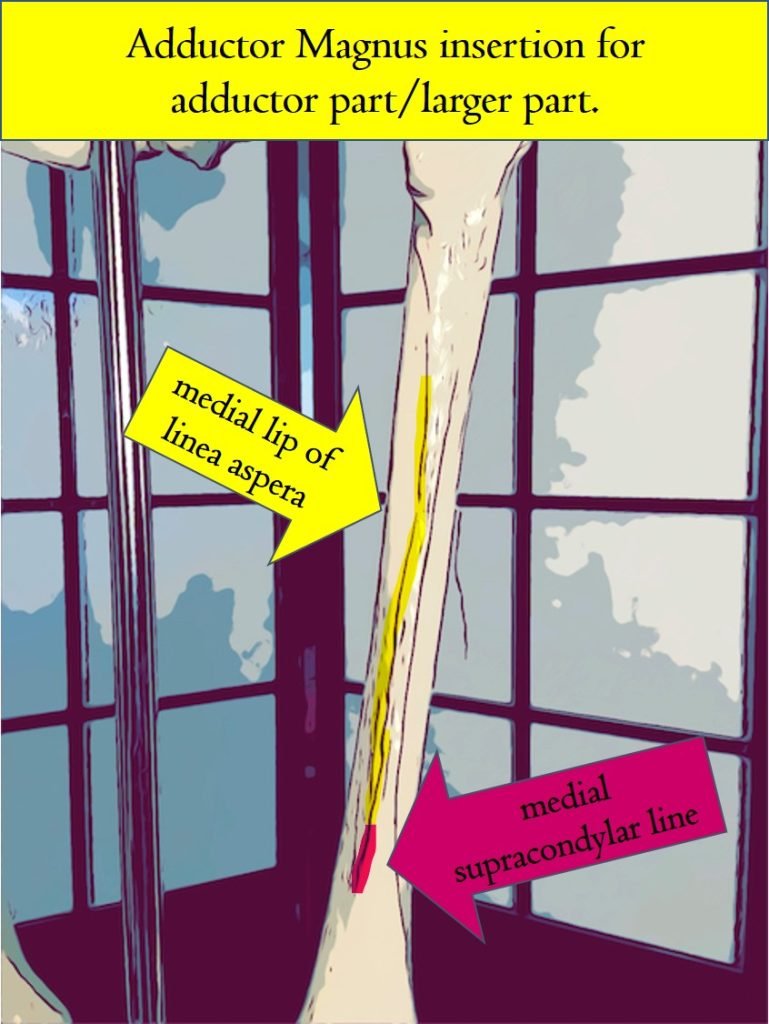
The hamstring part adducts, extends, and internally rotates the femur. It is sometimes called the fourth hamstring.
It originates at the side of the bottom of the ischial tuberosity. Its muscle fibers are almost vertical from its origination point to its insertion point at the adductor tubercle.
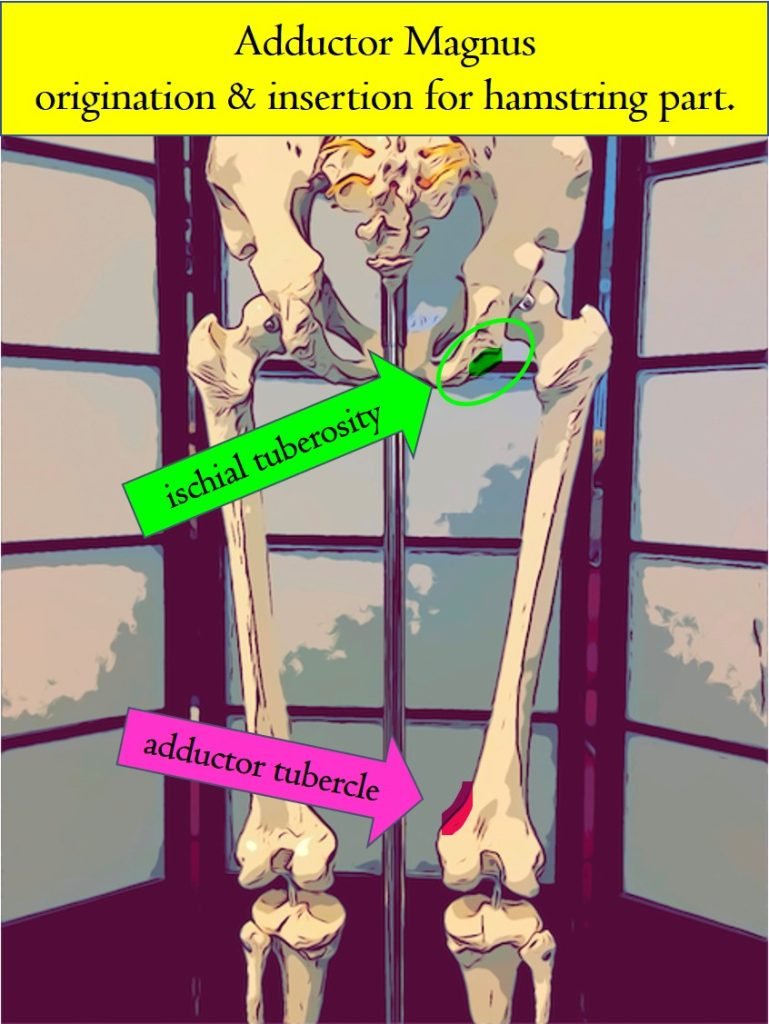
It is fairly easy to feel the effects of contraction of the Adductors. Sore muscles on the inside of the thigh and around the sitz bones can be an indication that we have worked the Adductors.
I am fascinated by the location of the Adductors’ origination bone at the bottom of the 360° pelvic barrel, but also by how close these bones are to our center of balance. All three Adductors insert directly on the femur, and they almost run the length of the bone. So, contraction of the Adductors at the pubic bone and ischium extends, flexes, and rotates the femur from distinct points on the femur itself. Once again, neither the origination nor the insertion points of these muscles are at the hip joint.
Understanding the Adductors gives us important information about our technique of movement of the legs. Close your eyes and visualize the origination points. Engage the Four Abdominals. Now, visualize the origination and insertion points, engage the right or left Adductors (the adductor part) and flex the femur, one leg at a time. Engage the right or left Adductors (the hamstring part) and extend the femur, one leg at a time.
***
Quads. The Quads are located at the front of the thigh and are a muscle group with four muscles: Vastus Medialis, Vastus Intermedius, Vastus Lateralis, and Rectus Femoris. Let’s look at them separately.
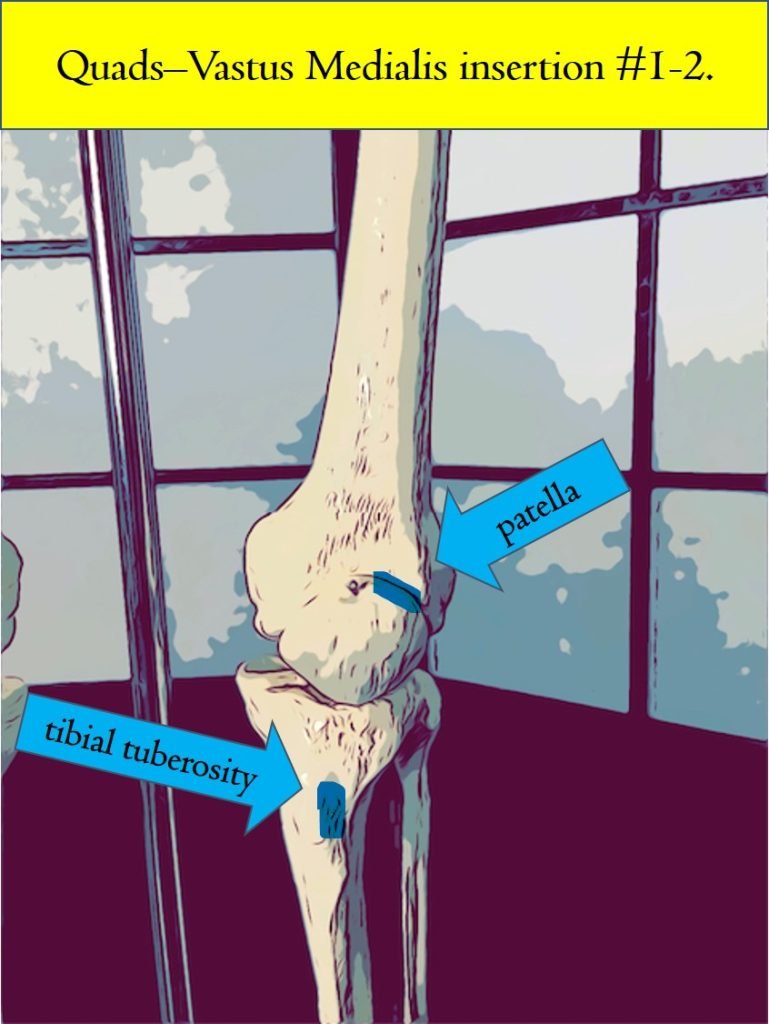
Vastus Medialis is located toward the imaginary mid-line (middle) of the body. It extends the lower leg by extending the flexed knee.
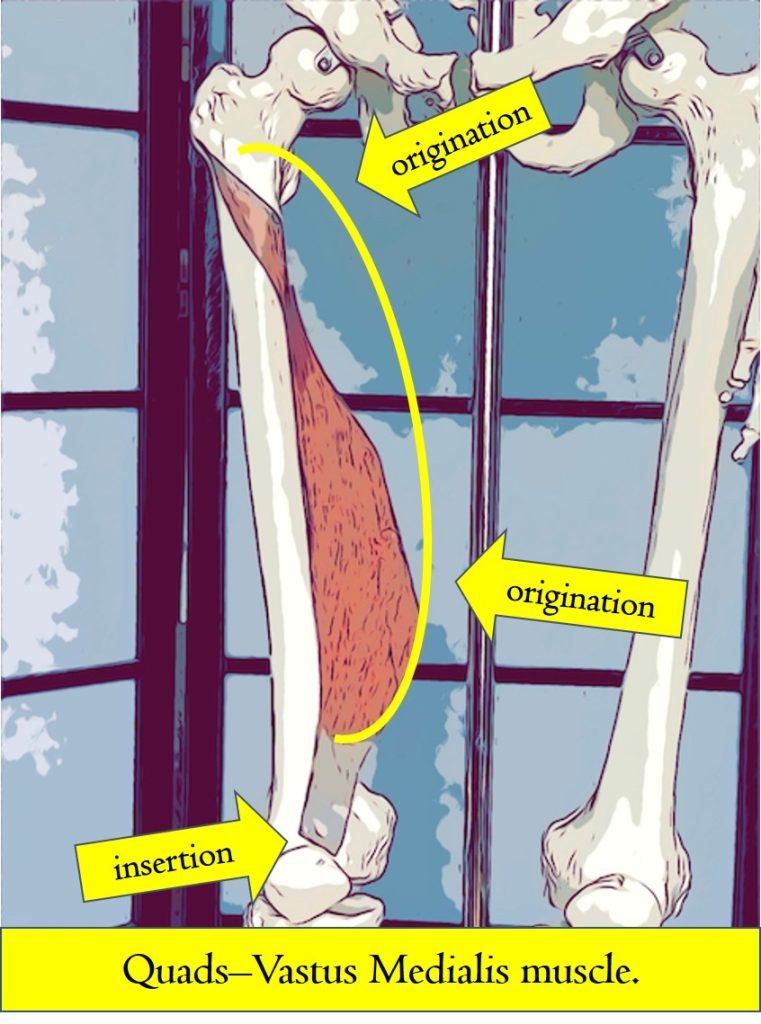
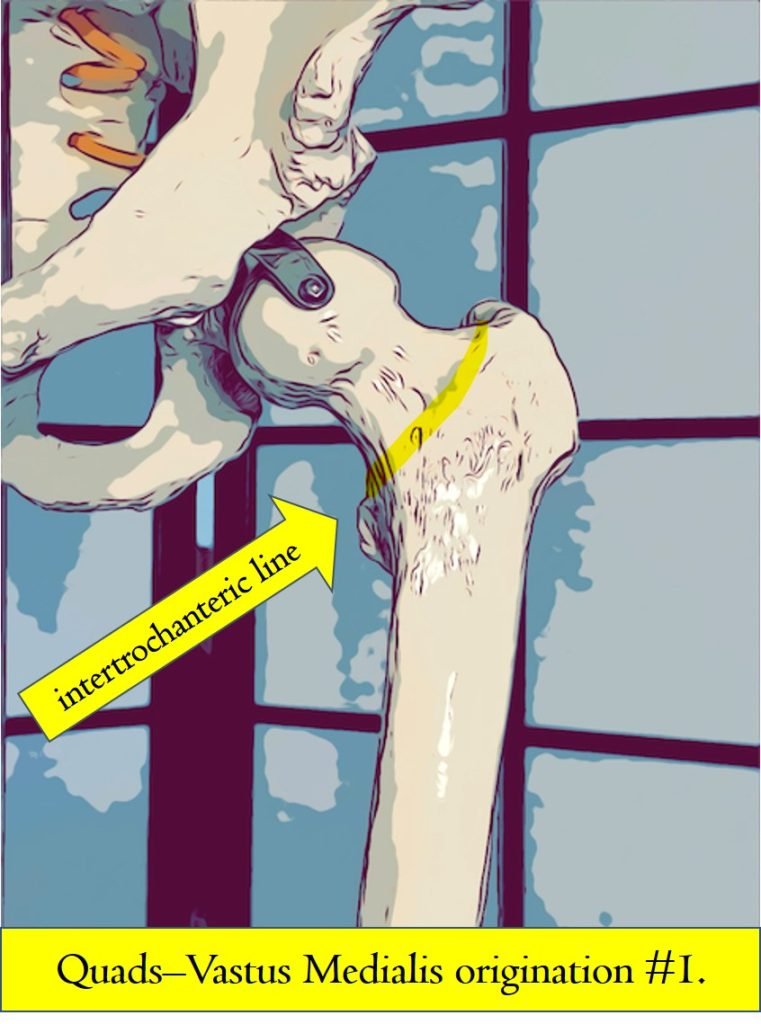
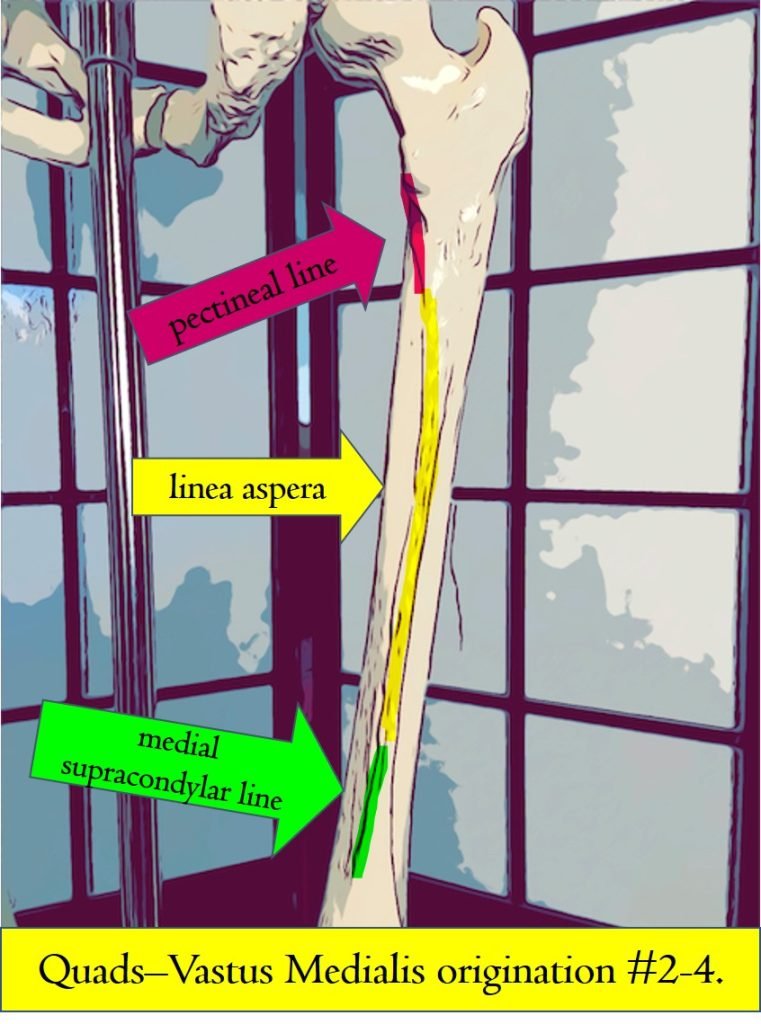
It has four points of origination: (1) the intertrochanteric line, (2) the pectineal line, (3) the linea aspera, and (4) the medial supracondylar line.
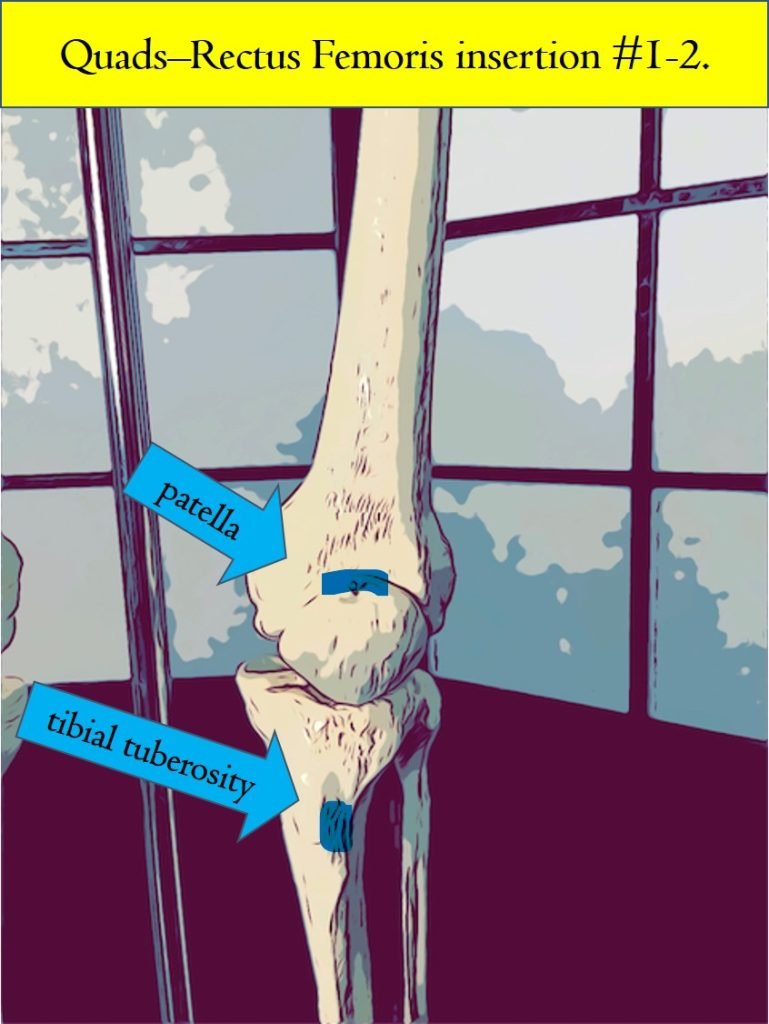
It merges into the quadriceps tendon with the other three Quad muscles, to insert at (1) the patella and (2) the tibial tuberosity (via the patellar ligament).
Vastus Intermedius is located between Medialis and Lateralis. It extends the lower leg by extending the flexed knee.
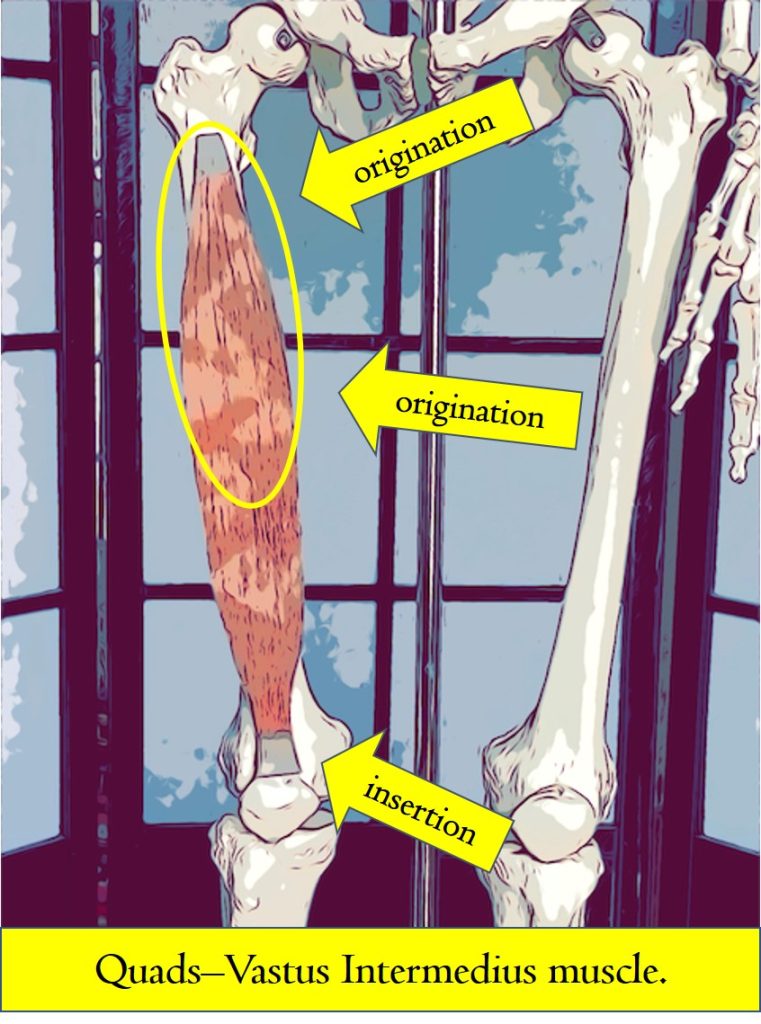
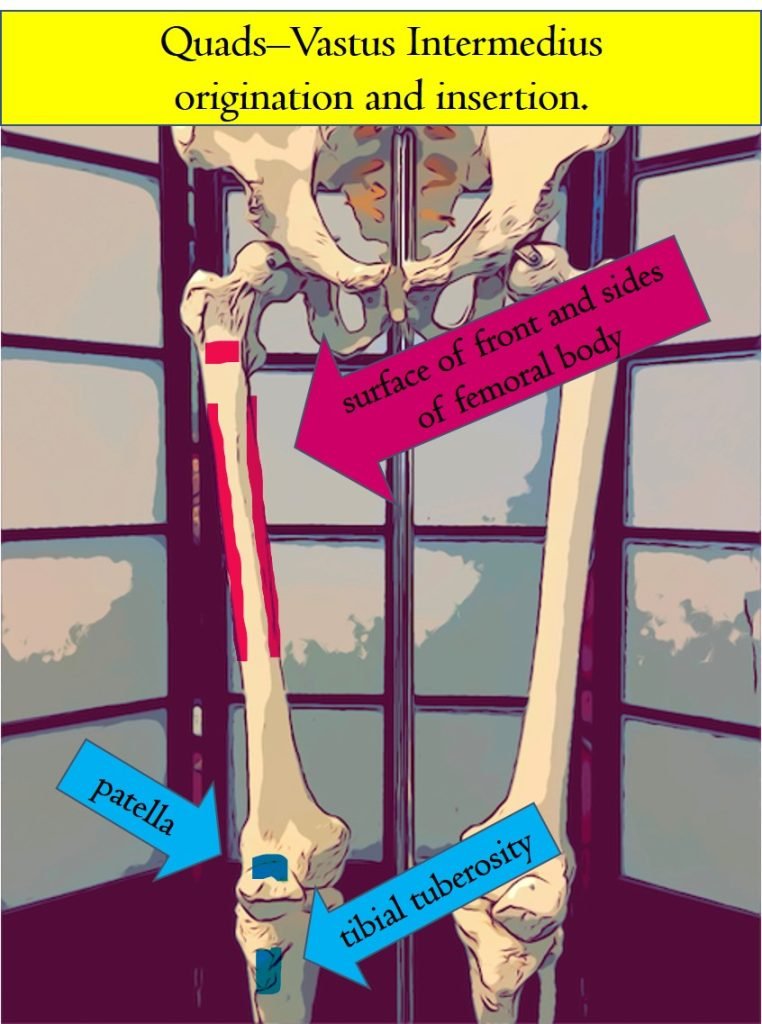
It originates at the upper two-thirds of the surface of the body of the femur, on its front and sides.
It merges into the quadriceps tendon with the other three Quad muscles, to insert at (1) the patella and (2) the tibial tuberosity (via patellar ligament).
Vastus Lateralis is located away (lateral or side) from the mid-line of the body. It extends the lower leg by extending the flexed knee.
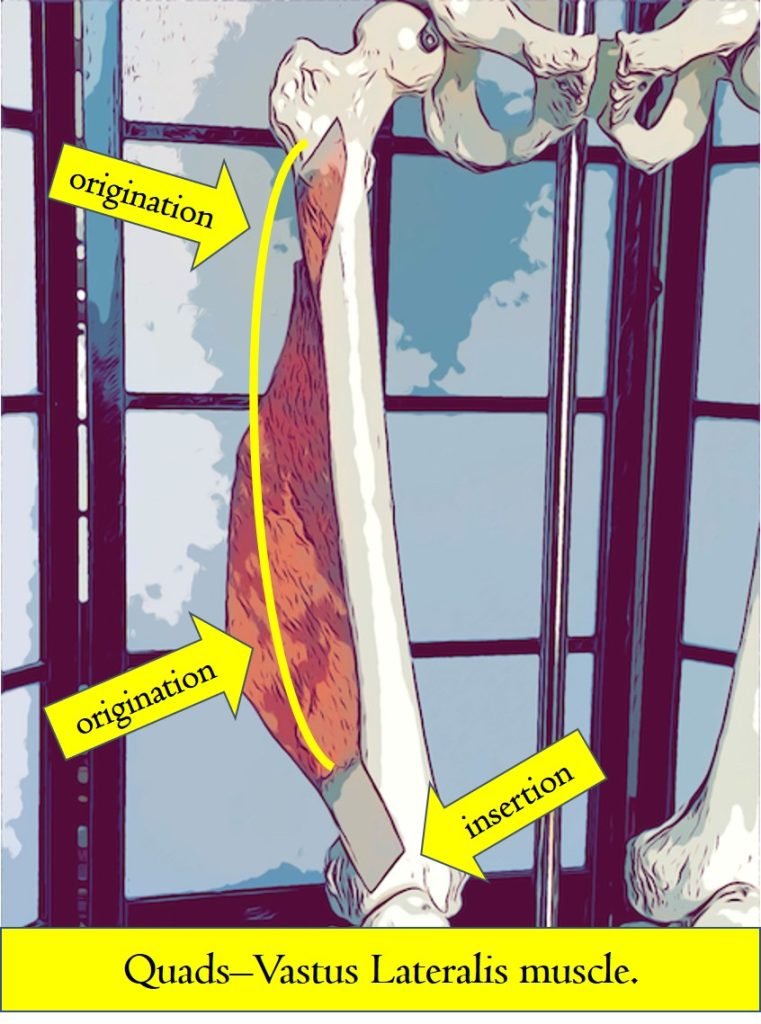
It has four origination points: (1) the intertrochanteric line, (2) the greater trochanter, (3) the gluteal tuberosity, and (4) the linea aspera.
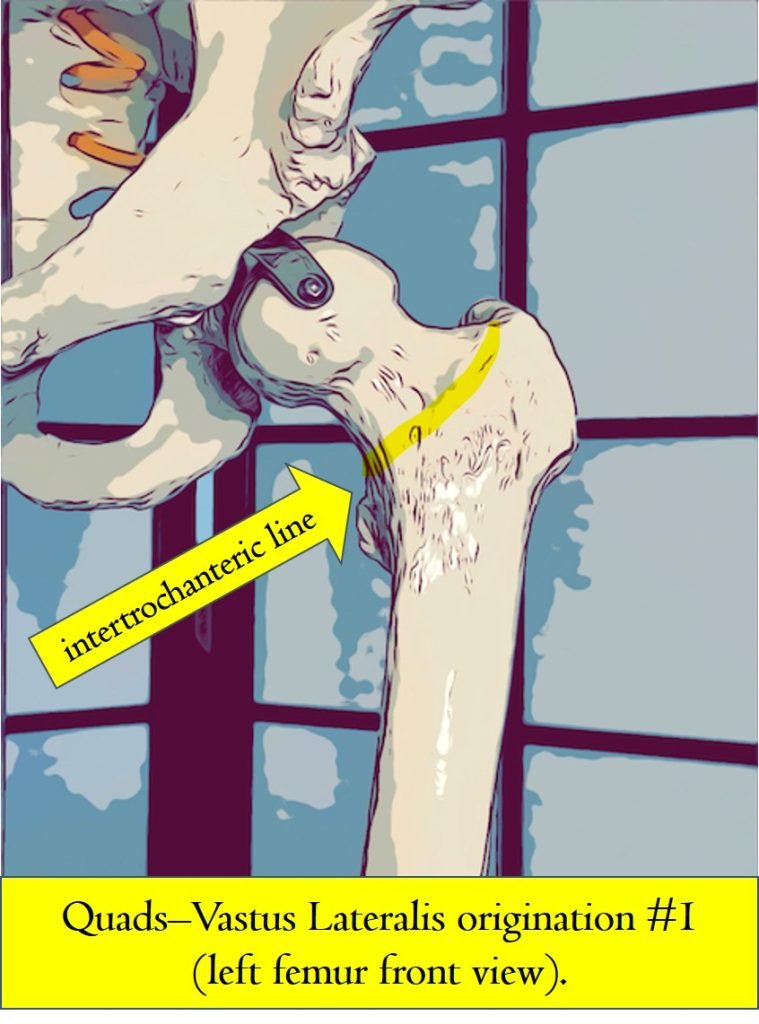
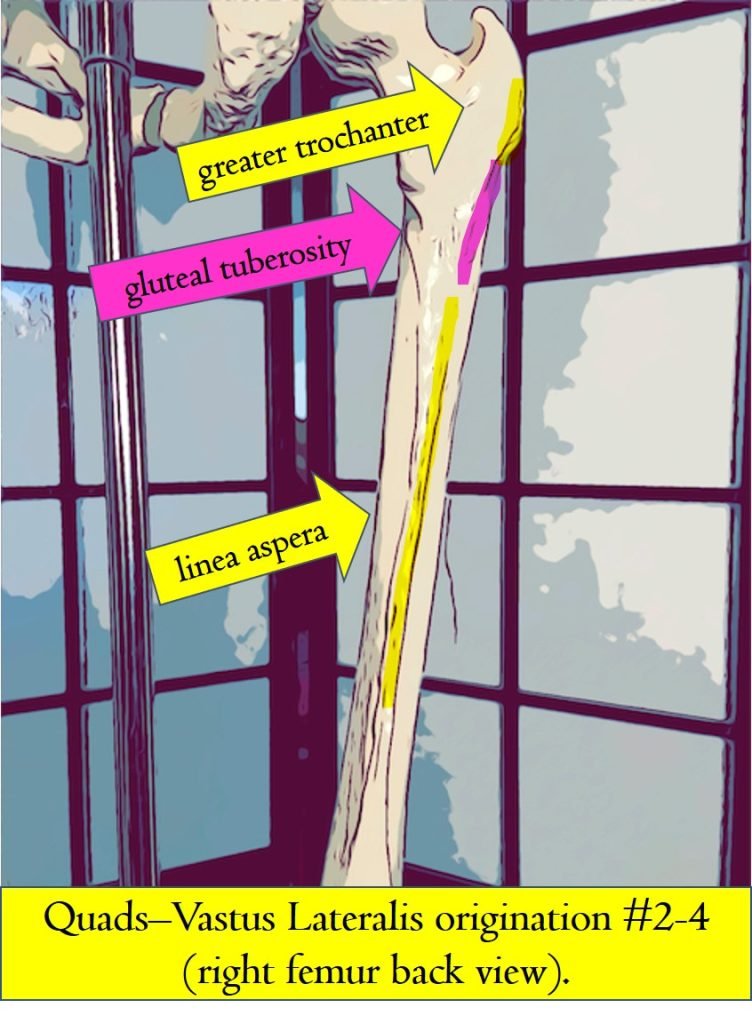
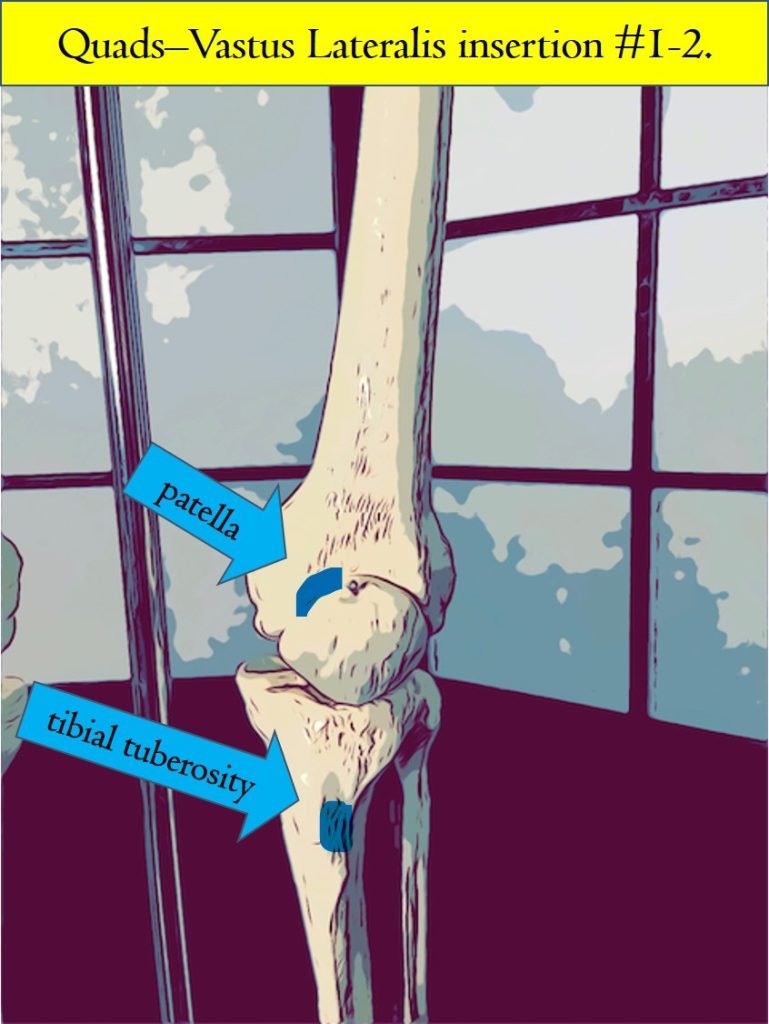
It merges into the quadriceps tendon with the other three Quad muscles, to insert at (1) the patella and (2) the tibial tuberosity (via patellar ligament).
Rectus Femoris is located in the middle of the thigh and it lies on top of Vastus Intermedius. It is the only muscle of the four that acts on both the hip and the knee joint. It flexes the femur and extends the lower leg by extending the flexed knee joint.
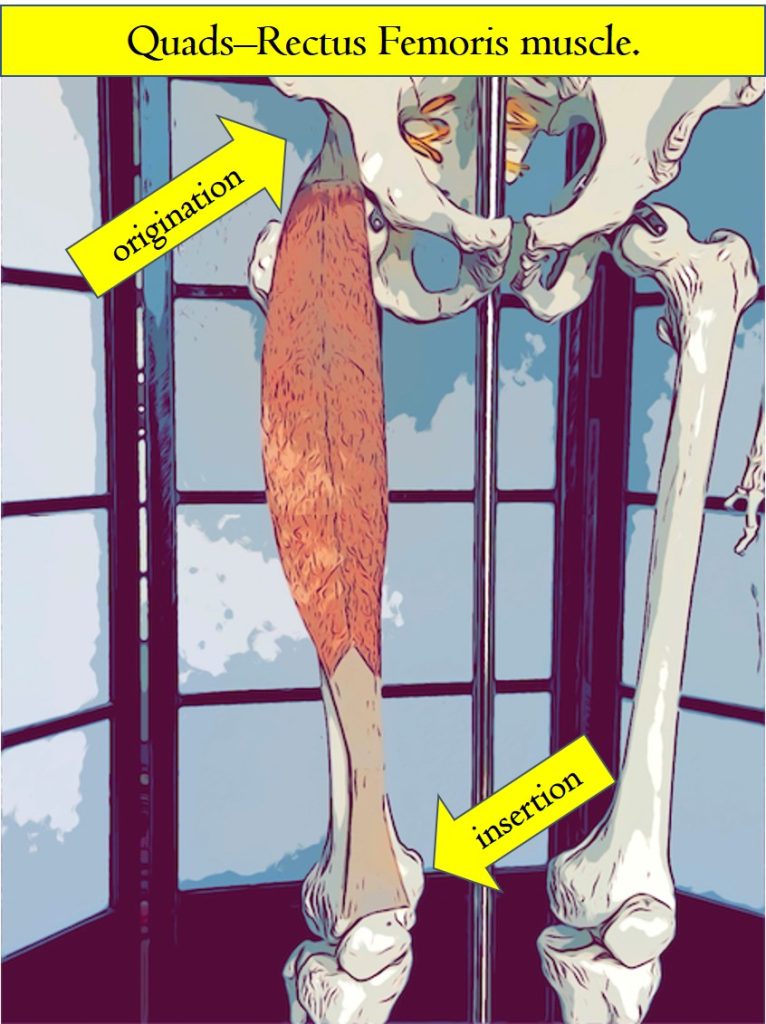
It has two heads that originate from two places on the ilium: (1) the direct head at the iliac spine on its front side and (2) the reflected head at the supraacetabular groove, which is a groove above the acetabulum (the socket of the hip joint).
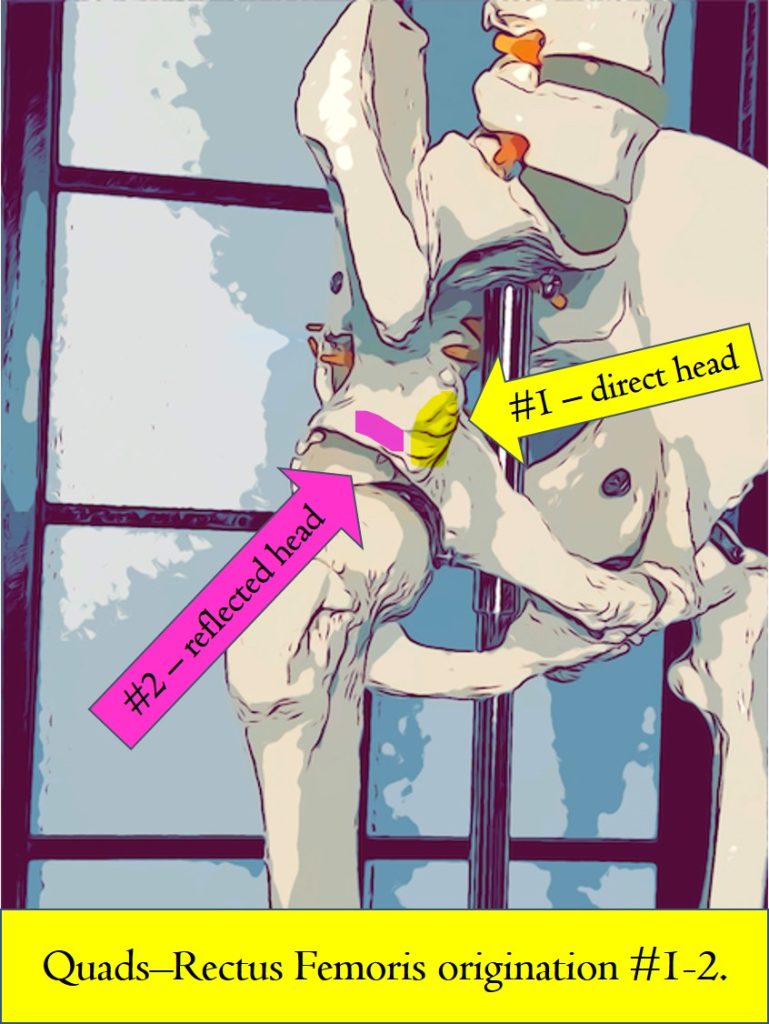
The two heads form a common muscle with fibers that run almost vertically to merge into the quadriceps tendon with the other three Quad muscles, to insert at (1) the base of the patella and (2) the tibial tuberosity (via the patellar ligament).
The photo below will give you an idea of what the quadriceps tendon/patellar ligament looks like.
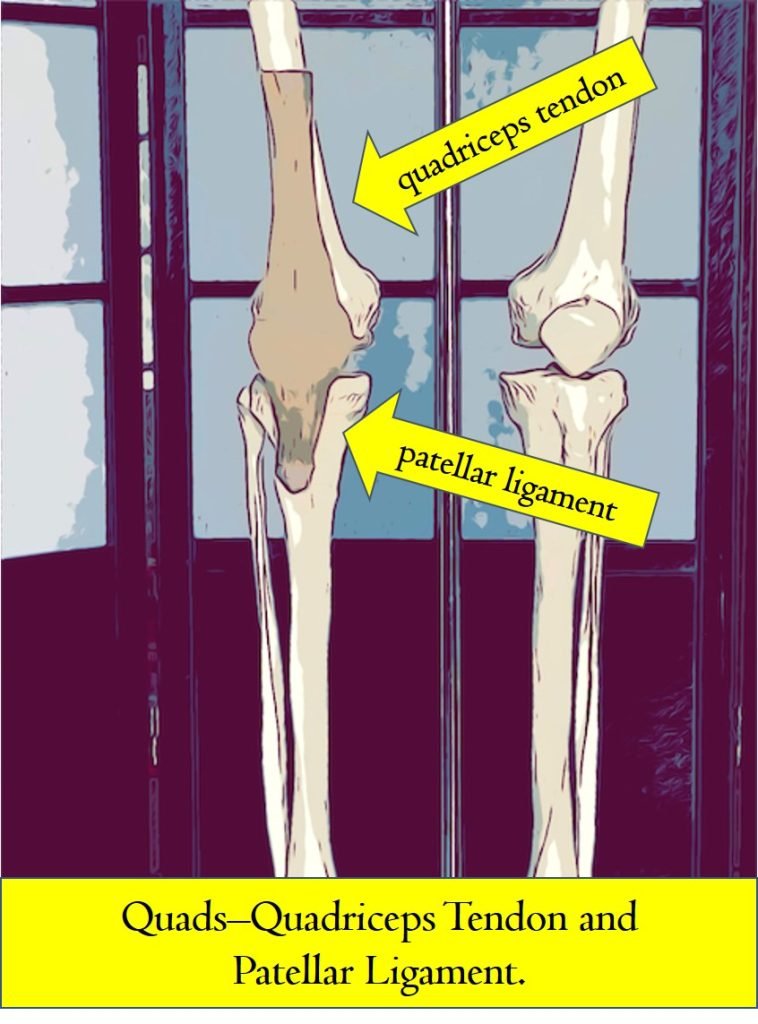
Rectus Femoris is the only muscle in the Quads that does not originate directly at the femur; it is anchored in two places at the ilium. Its contraction flexes the femur and extends the lower leg. The other three muscles are anchored directly either on the front or the back of the femur. Contraction of the other three extends the lower leg. It is also worth noting that, of the four Quads, Rectus Femoris is the only muscle with its origination on the pelvic barrel, close to our center of balance.
I’m not sure how easy it is to feel contraction of all four of the Quads. It may be easier to feel Rectus Femoris, since it is the most superficial and its contraction lifts the femur (flexion lifts the leg). The real question, in my mind, is whether we understand how to use these four muscles correctly.
Because we know where the Quads originate, we know that the movements of the femur and the lower leg are not the beginning of our movement, rather, they are the end result of contraction. The Rectus Femoris’ contraction simultaneously flexes the femur from points on the lower leg itself while it and the other three Quads’ contraction extends the lower leg from points on the lower leg itself. Insertion below the knee means that contraction moves the entire femur plus the lower leg.
Close your eyes and place your fingertips on Rectus Femoris’ origination. Engage the Four Abdominals. Now, visualize its origination and insertion points, engage Rectus Femoris, and flex the femur, one leg at a time. Keeping the femur flexed, visualize the origination and insertion points of the other three muscles, engage all four Quads of the right or left leg, and extend the lower leg, one leg at a time.
***
Geeky Glory +
To properly use the Five Leg Muscles, we have to know what each of them do and where they are. We know that they flex, extend, rotate, adduct, and abduct the femur, but these movements do not happen in isolation for a dancer. In fact, I would bet that you can think of many movements where flexion, extension, rotation, adduction, and abduction of the femur all happen together or within a split second of each other. This takes us back to the concept of simultaneously different muscle effort going on in the body when we dance. Leg movement happens because of the interplay between the Five Leg Muscles. As with any ensemble work, grasping the interplay is essential to coordinated, seamless movement. In this case, our ensemble of five muscles will dance the femur.
Leg movement happens because of the interplay between the Five Leg Muscles. As with any ensemble work, grasping the interplay is essential to coordinated, seamless movement.
Let’s take a closer look at the muscle network these muscles create all by themselves.
Flexion of the femur:
- The Psoas, the Rectus Femoris (Quads), Adductor Brevis, Adductor Longus, and the adductor part of Adductor Magnus flex the femur.
Extension of the femur:
- The Glutes Max, the Semimembranosus, Semitendinosus, and Biceps Femoris (long head) of the Hamstrings, and Adductor Magnus (hamstring part) extend the femur.
Rotation of the femur:
- Adductor Brevis, Adductor Longus, the adductor part of Adductor Magnus, the Psoas, the Glutes Max, and the Biceps Femoris of the Hamstrings (long head, when the femur is extended) externally rotate the femur.
There are a few movements that are created by contraction of only one of the muscles or muscle groups. Adduction and abduction of the femur are created by contraction of the Adductors and the Glutes Max, respectively. Flexion and extension of the lower leg are created by contraction of the Hamstrings and Quads, respectively. Even when one muscle or muscle group creates the movement, it is still part of our network. It is impossible to execute any of these movements in isolation.
Close your eyes and see the Five Leg Muscles. One by one, visualize their origination and insertion points. How is the femur moved by the muscles, individually or as a group? Where does movement begin, individually or as a group? Can you find and feel the simultaneous muscle effort? What does movement in the hip joint feel like when you dance the entire femur with the Five Leg Muscles?
With your eyes still closed, integrate the simultaneous muscle efforts that occur in a basic movement like demi-plié. Next, slowly move the femur to the front with tendu – what is the interplay between muscles? Low attitude and low arabesque use the leg muscles differently – how? What other simple movements can you try?
The answers to these questions will get you started on understanding and feeling the technique of dancing the femur.
Technique Fundamentals
In my second installment, “The Technique Gap,” I wrote about a class I took in New York taught by a respected dancer of an internationally-known modern dance company. The teacher gave a dancer in the class a correction about the extension of her leg to the side at 90 degrees. The dancer did not understand the teacher’s correction and he could not answer her questions about the difference between what she was doing and what he wanted her to do. He stumbled around for a response – he knew that her leg didn’t look right, but he could not explain how to do it.
You’ve seen the Five Leg Muscles. The technique of movement of the femur is complex. If we cannot understand how to move the femur, the only result is frustration, confusion, and bad habits that disrupt overall alignment. In a dance culture that seems to demand high extensions, there is a psychic toll as well.
The Five Leg Muscles are foundational muscles in Literal Technique. As such, I believe that there are four technique fundamentals for using these muscles to dance the femur that can help dancers re-learn and repair technique.
Our first technique fundamental is to know where movement begins. Movement is the end result of muscle contraction at its origination points. If you do not begin movement of the leg at the Five Leg Muscles’ origination, you are not tapping into the logic of the way the body and the muscle work. Take another look at the origination points of these muscles. With three exceptions in the Quads, their originations are all very close to our center of balance. This is important. Movement of the leg is intertwined with our vertebral center of balance.
Our second technique fundamental is to know where the insertion points are. Origination may be the beginning of movement, but the insertion point tells us from what point on the femur or the lower leg we are moving the leg. We must identify both points to properly use muscle to dance the femur.
Our third technique fundamental is to know how each muscle functions in the Five Leg Muscles network. The femur is surrounded by muscles that flex, extend, rotate, adduct, and abduct it, and they help each other with these functions. It is important to use all five muscles in their proper roles and to their capacity. They are an ensemble; every role is important. Guesswork about which muscle does what and how it does what is does will not improve your technique.
Our fourth technique fundamental is to know that the Five Leg Muscles are part of the muscle chain reaction that begins with the Four Abdominals. Stability at our center of balance (the lumbar vertebrae) begins with the Four Abdominals. The only way to properly balance the body and support alignment is not to use the Five Leg Muscles first. Moreover, the only way to make the Five Leg Muscles stronger is to use them correctly; you will not be able to do this if you use them first. So, the muscle chain reaction coincides with the reality of simultaneously different muscle effort in the fusion body: the Four Abdominals stabilize, balance, and/or move the torso, while the Five Leg Muscles dance the femur.
Muscle Habits versus Literal Muscle. In the New York class in the above example, what I saw was a dancer lifting and lengthening her leg to the side by using the Quads and nothing else. Obviously, in order to lift her leg to the side, she would, at a minimum, also have to use the Psoas. But her leg, in its larger context of the body, looked like it was being supported only by the Quad muscles; her Quads seemed to be doing all the work. Moreover, her femur was essentially parallel.
Literal Technique says that physical knowledge helps us reason it for ourselves: to properly lift (flex) the femur, you have to use the Rectus Femoris of the Quads, the Psoas, Adductor Brevis and Longus, and the adductor part of Adductor Magnus. The only Quad muscle involved in lifting the leg is the Rectus Femoris. If you are trying to lift the leg with all four Quads, you are attempting an impossibility – the other three Quads only lengthen the lower leg. Also, the Quads do not externally rotate the femur. If you want to externally rotate the femur to the side, you have to use the Psoas, Adductor Brevis and Longus, and the adductor part of Adductor Magnus.
As I looked at her leg, I knew that what she was doing made sense. The Rectus Femoris is the most easily identifiable muscle we have to mimic extension of the leg to the front or the side. So, it is true that it did not look like it would have looked if she had been using the correct muscles. She was, however, doing the best she could to mimic the movement of lengthening her leg to the side and holding it there.
She was also making the common mistake of relying so much on her Rectus Femoris that she was ignoring the Four Abdominals. Try lengthening your leg to the side at 90 degrees and holding it there, using the abdominals first. Then use the flexor leg muscles first and hold your leg there. If you isolate leg extension in your flexors, not only do you lose stability and strength at your center of balance, but the muscles are stressed and the femur loses its agility. The muscle and the femur become rigid because you are now holding onto both for dear life in order to keep the leg at 90 degrees.
What muscle habits do you have when you move your legs? How many times have you asked yourself, “How do I do that? What am I supposed to be doing?” What do you remember about your training?
Technique is a means to an artistic end. Imagery, repetition, trial and error, and mimicry can be useful training tools when we are technically inexperienced; they are extremely useful in rehearsal and performance. But it may be that, at a certain point in our professional lives, it is time for a different kind of technical training.
Fusion. Choosing to dance is not for the faint of heart. Learning to dance is hard work. Dancing is hard work. But it is not a mystery or a secret, and it should not be like running a gauntlet for our entire professional lives.
Technique is a means to an artistic end. Imagery, repetition, trial and error, and mimicry can be useful training tools when we are technically inexperienced; they are extremely useful in rehearsal and performance. But it may be that, at a certain point in our professional lives, it is time for a different kind of technical training.
It is not revolutionary to say that the body can be literally known and understood. I was frustrated with my own technique, so I developed Literal Technique to answer questions I had, and that I think other dancers have, about how to move the body. It is a dance technique that goes straight to the source of movement – the body – in all its majestic, magnificent, geeky glory. It dispenses with the vague-anatomy, body-parts thinking, the arms-and-legs thinking, of conventional training. Literal Technique redefines the dancing body so that we can stop working so hard to learn how to move a body that doesn’t exist, instead of learning how to move the fusion body we are in. Let the new work begin.
Next installment: Fusion
Installment No. 2: The Technique Gap
Installment No. 13: The Pelvis
Installment No. 15: The Femur
Photos credit: Jill Redfern
You can send comments and questions to Jill at info@thirdshiftmovementshop.com. Please subscribe to the Third Shift’s YouTube channel and follow the Third Shift on Facebook.