
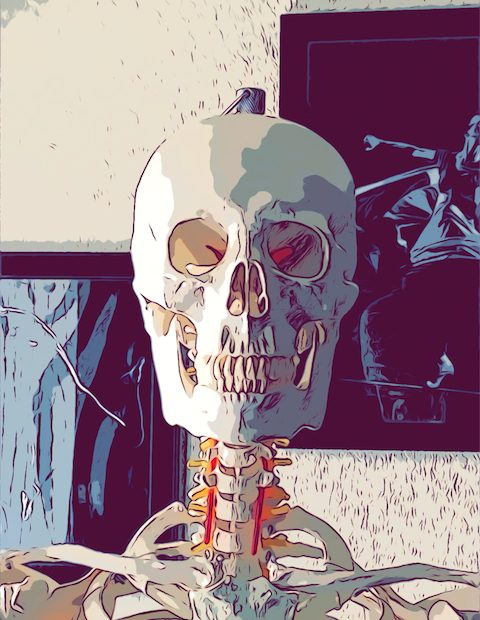
Welcome to the Third Shift Movement Shop, home of Literal Technique, where we work so we can move. And welcome to Installment No. 3 of The Central Geekdom of Dance Technique, “The Dancer and the Body Gap.”
In Installment No. 1, I said that studio training inevitably creates gaps in any dancer’s technique, and that the way technique is taught, in general, creates a gap between the dancer and the body. This installment explains what I mean by the dancer and the body gap. (Read Installment No. 2 for a discussion of the technique gap.)
As I was developing Literal Technique, I thought about how, most of the time, class revolves around repeating what the teacher did, plus trial, error, imagery, and repetition. Based on my own experiences in class, I identified what I think are the primary teaching tools that separate the dancer from the body: the use of imagery to achieve an end result; inaccurate or non-existent anatomy, which is usually intertwined with the use of imagery; and the separation of the body into arms and legs, which severs the body from its own logic. These do not generally happen in isolation, but as a combined method of teaching.
Imagery. When I say imagery, I mean figurative language that requires the use of imagination; when I say it is used to achieve an end result, I mean it aims to correct alignment. One example is describing a line of energy that extends out of the top of the head, to produce proper alignment of the skull or the spinal column. Another is the image that the leg in arabesque is part of a line that extends infinitely into space, to produce increased extension of the leg. There are important reasons to use imagery; there is no doubt that imagery can help dancers animate the moving body in useful ways.
From a technical standpoint, however, its usefulness is limited. Imagery requires us to use the mind to move the body, not the body to move the body. Superimposing onto movement states of being that are not human, imagined flows of energy, or emotion in order to learn technique, especially onto movement that has no inherent meaning, is a mental exercise, not a physical one.
In rehearsal or performance, imagery has a big part to play. However, I am not convinced that imagery creates any lasting correction of the alignment of the body. Because it is anatomically nebulous, it certainly does not create any concrete understanding of how to use the bones and muscles. Imagery addresses the symptom and not the origin of a technical problem. In my experience, using imagery in training is always a temporary fix. So, here is one layer of the dancer/body gap.
Inaccurate or Non-Existent Anatomy. Imagery may sometimes include anatomy, but not as a way to explain how to execute movement. One example is telling a dancer to open the arm pits. The vague anatomy – the arm pit – plus the image – open – is helpful to a certain extent. The problem is that it excludes everything going on around the arm pit: where are my collar bones and scapulae? What are my spine and pelvis doing? Where is my rib cage? And just what is an arm pit, anatomically, and what bone- or muscle-related instruction is “open”?
It is entirely possible to hazily open the arm pits without including the abdominal and back muscles to stabilize the spinal column and the pelvis. I now have an inexact body part – my arm pit – separated from the closest, most logical body part – the bones of my shoulder – separated from the rest of my body. My guess is that if I were correctly using the pecs, the abdominals, and the back muscles to stabilize the bones, the issue with my armpits, such as they are, would disappear. From a technical standpoint, here is the bigger question: how does inaccurate or non-existent anatomy help me execute the overall movement? So, here is another layer of the dancer/body gap.
In my view, unless dance as a form redefines the way it looks at the body, dancers will continue to work hard learning how to move a body that doesn’t exist, instead of learning how to move the body we are in.
Arms and Legs. My general observation is that dance technique as a whole has taken its cue from two places: anatomy, which splits the body into parts and planes, and ballet technique, which splits the body into arms and legs (and feet). Anatomy is about medicine; it dissects body parts and sections and organizes them from an outside, aerial view. How many modern dancers know about the various planes of the body? What’s that all about? Moreover, although ballet and modern dance may look very different in class or onstage, the farther modern has gotten from techniques like Graham and Cunningham, the more it has adopted many of ballet’s concepts about how to view and how to train the body.
In my observation, the separation of the dancing body into arms and legs predominates in dance training. (I would argue that, in ballet, this is the training method.) Class necessarily begins by slowly warming up the large muscles and makes its way into the legs and feet, increasing in speed and detail, while the arms remain still or move to counterbalance what is happening in the legs. Then, exercises in center and across the floor require dancers to take these concepts into locomotion. We warm up overgeneralized body parts. We move overgeneralized body parts. Training teaches us to view the body as separate parts and trains us how to use the body as separate parts. So, here is yet another layer of the dancer/body gap.
Conventional training teaches the mind to separate the body from the body, combining imagery (something outside the body and inside the mind), inaccurate or non-existent anatomy, and body part exercises into one big package that is not derived from anything concrete. Training becomes mostly a matter of being able to repeat the combination because no one is teaching how to execute the movement. Moreover, and most importantly, we are not taught how to move the body we are in, what I call a “fusion body.”
Separately or in combination, conventional teaching tools separate us from the body. In my view, unless dance as a form redefines the way it looks at the body, dancers will continue to work hard learning how to move a body that doesn’t exist, instead of learning how to move the body we are in. Literal Technique teaches technique by going straight to the source of movement – the body – in all its geeky glory. This is how the second goal of Literal Technique, addressing the gap between the dancer and the body, is approached – by teaching dancers the technique of moving a fusion body.
Next installment: Technique and Professional Dancers.
Photo credit: Jill Redfern
You can send comments and questions to Jill at info@thirdshiftmovementshop.com. Please subscribe to the Third Shift’s YouTube channel and follow the Third Shift on Facebook.