
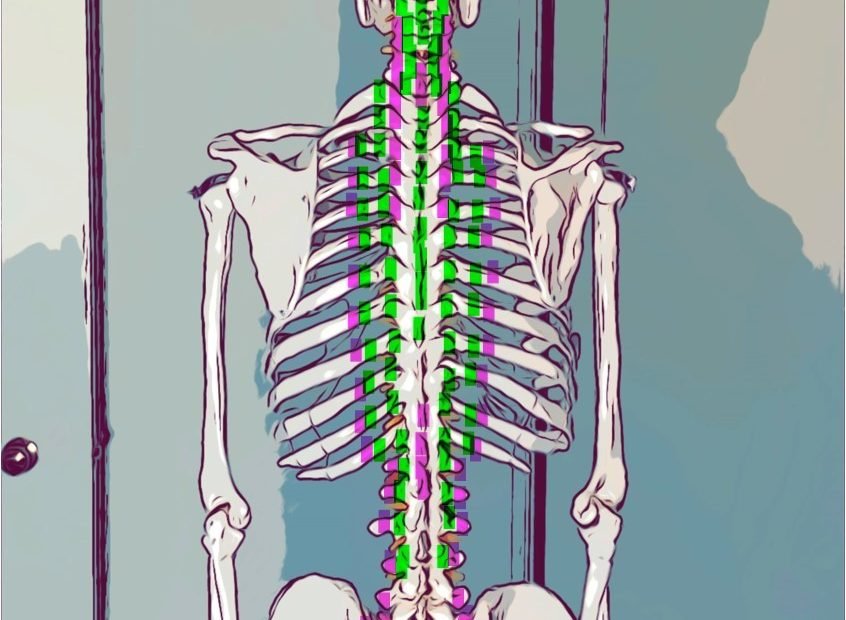
This tutorial is an introduction to the Erector Spinae, which is one of the seven muscles central to our alignment.
The Erector Spinae (pronounced, “spy-nee” or “spy-nay”) are the primary movers of the back. They are a pair of three vertical muscles on either side of the vertebrae that span the length of the spinal column, from the skull to the sacrum.
They help us stay upright without eliminating the anatomical curves of the 33 vertebrae.
They stabilize, laterally flex, extend, and rotate the vertebrae.
The Erector Spinae’s three vertical muscles are spinalis, longissimus, and iliocostalis; each of these muscles is made up of three groups. They originate or insert at the vertebrae, the skull, the rib cage barrel, and the pelvic barrel, which are the bones central to our alignment.
We use these muscles in all upright movements, all movements that flex the 33 vertebrae forward, all movements that flex the 33 vertebrae laterally, all movements that extend the 33 vertebrae into the space behind the body, and all movements that rotate the 33 vertebrae and the skull. (In movements that flex the 33 vertebrae forward, these muscles control and slow movement, but they do not cause forward flexion.)
Look for ways to actively use these muscles in your classes at every opportunity. Feel them support the anatomical curves of the 33 vertebrae when you are upright. Feel them lengthen your vertebrae into and out of lateral flexion, extension, and rotation.
If you are interested in a more granular view of the Erector Spinae muscles, my Substack newsletters about these muscles are linked below.
The Seven Muscles at the Center of Alignment: What Happens Where