
In this tutorial, we are going to do a very simple combination I call Extension Lullaby. It’s a lullaby because it’s in 3/4 time. This combination is a simple from a movement standpoint—there’s not a lot to remember. But, if you are not finding alignment at and moving from your vertebrae, you will have a hard time moving in and out of extension and neutral and maintaining a neutral pelvic barrel. If you do, slow the tempo down. Speed is not important—finding movement at the vertebrae is what we’re after.
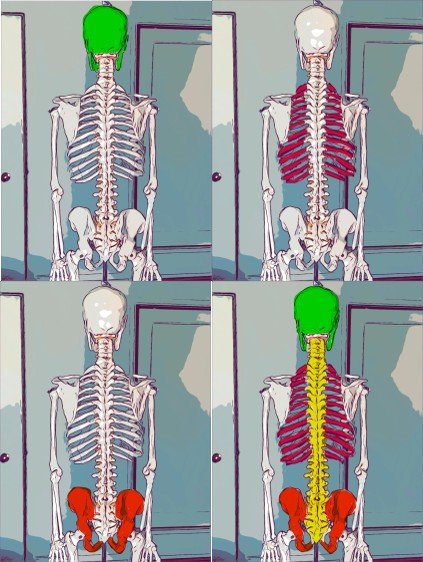
The key bone markers for this combination are:
- Extension happens in the thoracic and cervical vertebrae at and above the thoracolumbar joint
- Neutral atlanto-occipital joint
- Neutral lumbosacral joint
- Neutral lumbar vertebrae
- Neutral pelvic barrel
The muscle work for this combination is:
- the Erector Spinae are vertebrae extenders—they will simultaneously extend the cervical and thoracic vertebrae and stabilize the lumbar vertebrae and sacrum
- Transversus, both Obliques and the Lats stabilize the vertebrae during extension
- Rectus Ab is not an extender but it does lengthen and put on the brakes to control our speed and prevent hyperextension of the vertebrae past their anatomical range of movement
- the Pec Majors have no direct vertebral connection so they are not extenders (or flexors), but they still act to widen the sternum side of the upper body—no overzealous contraction!
This combination has 4 sets of two 3s and stays in rotated first position:
- Begin in your anatomical curves with both arms raised to the side, elbows bent, and palms down; prepare to move by contracting your seven muscles to support your vertebrae before you move
- Extend the vertebrae and lengthen both arms to the front and parallel to the floor, palms down 1 2 3
- Come back to your anatomical curves with both arms raised to the side, elbows bent, and palms down 1 2 3
Repeat three more times and finish
(Here’s a tip: the extension happens in the vertebrae not the skull – you should feel muscle working in the upper and middle back, not the neck. The skull becomes part of the vertebral column – it is neither flexed nor extended at its connection to C1.)