
This tutorial gives you a simple exercise to find and practice alignment of the arm bones.
Alignment of the arm bones is derived from two places simultaneously: the 33 vertebrae and the shoulder girdle. Tapping into both alignments helps the humeri have their full range of motion in the shoulder joint.
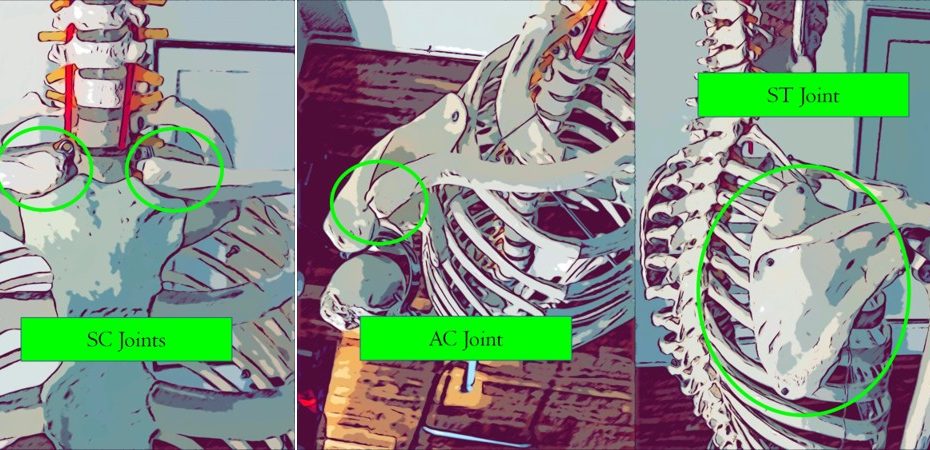
In Literal Technique, the arm bones are the shoulder bones and the shoulder girdle. The shoulder bones are the collar bones, the scapulae, and the humeri. The scapulae and the humeri form the shoulder joint. The bones in the shoulder girdle are the collar bones, the scapulae, the manubrium. The humeri are inherently included in the shoulder girdle because they tag along with the scapulae in the shoulder joints.
Because movement of the collar bones moves the scapulae, we will focus on the collar bones when we look for alignment of the shoulder girdle.
The shoulder girdle has three joints that connect its three bones. Movement of the three joints is not called flexion and extension, like the elbow or knee joints, for example. Instead, movement in all three joints is called elevation/depression, protraction/retraction, and rotation. All three types of movement involve all three joints.
Rotation happens automatically when we raise our arms overhead, for example. Rotation is not something we want to stop from happening.
We do want to avoid elevation/depression and protraction/retraction when we are looking for alignment and stability in the shoulder girdle. These movements prevent the humeri from having their full range of motion in the shoulder joint.
This tutorial uses a simple exercise to practice moving the humeri when the shoulder girdle joints are neutral. We then use the same simple exercise to compare what happens to movement of the humeri when the joints are elevated and when they are protracted.
To check our alignment, we first look to the vertebrae. Are they in their anatomical curves? Then we look to the collar bones because their movement moves the scapulae. Where are the collar bones? Where are the scapulae?