In this tutorial, we’re going to do a combination I call Fun with Small Flexion. There are degrees of flexion; small flexion is what I mean when we talk about flexion of the thoracic vertebrae.
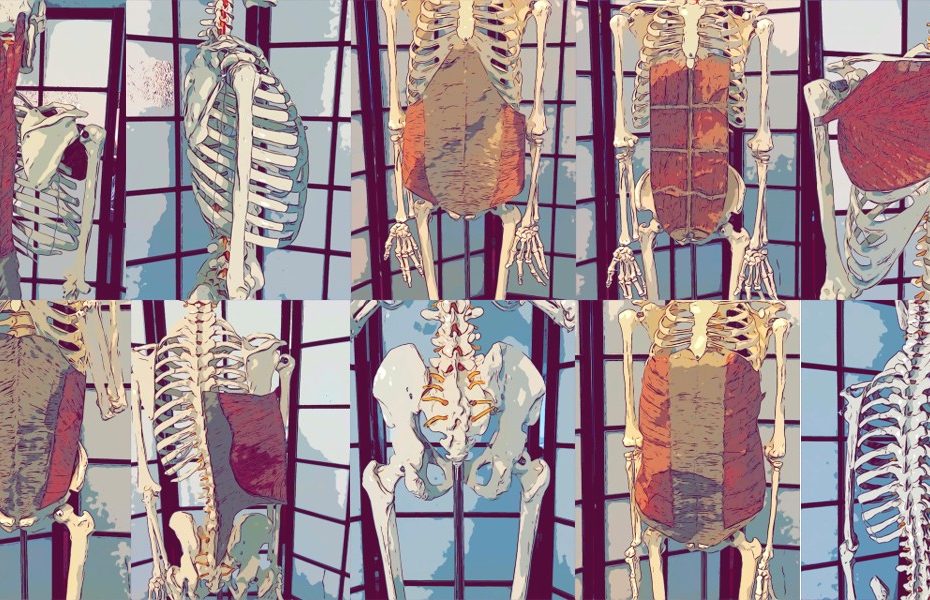
You already know about stabilizing the 33 vertebrae. You know about keeping the 2 joints neutral. And you know about using all 7 central muscles. What’s new in this combination is lateral (side) and forward flexion of the thoracic vertebrae.
At its most basic, flexion brings the two barrels closer together. In both lateral and forward flexion, we use the 7 muscles to simultaneously flex and stabilize the vertebrae. In both, we must be aware of the 2 joints.
Flexion brings the skull into the mix. The skull must remain neutral during lateral flexion (no flexion or extension), but it does flex forward during forward flexion – it is first to flex forward and last to lengthen back into neutral.
The Erector Spinae laterally flex the vertebrae to the right or left side; contraction of both the Internals and the Externals on the right or left side causes flexion of the thoracic vertebrae on the same side. The Lats assist with lateral flexion.
Rectus Ab is our primary forward flexor, but we also contract both sides of both Obliques to cause forward flexion. The Erector Spinae are not forward flexors but they do act to slow forward flexion so we don’t fall forward.
The Lats and the Pec Majors stabilize the rib cage barrel during lateral and forward flexion.
Transversus is not a flexor and does not assist with forward or lateral flexion. It is a stabilizer throughout. Don’t forget to use Transversus when you plié!
This combination is in four 8s and stays in rotated first position:
Small lateral flexion with neutral skull on 1 and 2
Plié on 3 and 4
Lengthen out of plié on 5 and 6
Lengthen out of small lateral flexion with neutral skull on 7 and 8
Repeat small lateral flexion to the other side (8 counts)
Small forward flexion with skull flexing first on 1 and 2
Plié on 3 and 4
Lengthen out of plié on 5 and 6
Lengthen out of small forward flexion with skull lengthening last on 7 and 8
Repeat small forward flexion (8 counts)
Focus on your 33 vertebrae. Flexion happens at the vertebrae. Finding alignment of the pelvic barrel in and out of plié while the thoracic vertebrae are flexing requires real awareness. Finding the neutrality of the 2 joints in flexion also requires real awareness. You will have a hard time maintaining a stable rib cage barrel or pelvic barrel while you are moving if you are not neutral in the two joints. The vertebrae are the key.