
In this tutorial, we’re going to do a combination I call the Temple Rotation Get Down to Get Up combination.
You already know about stabilizing the 33 vertebrae. You know about keeping the 2 joints neutral (the thoracolumbar joint and the lumbosacral joint). And you know about using all 7 central muscles. What’s new in this combination is rotation of the thoracic vertebrae.
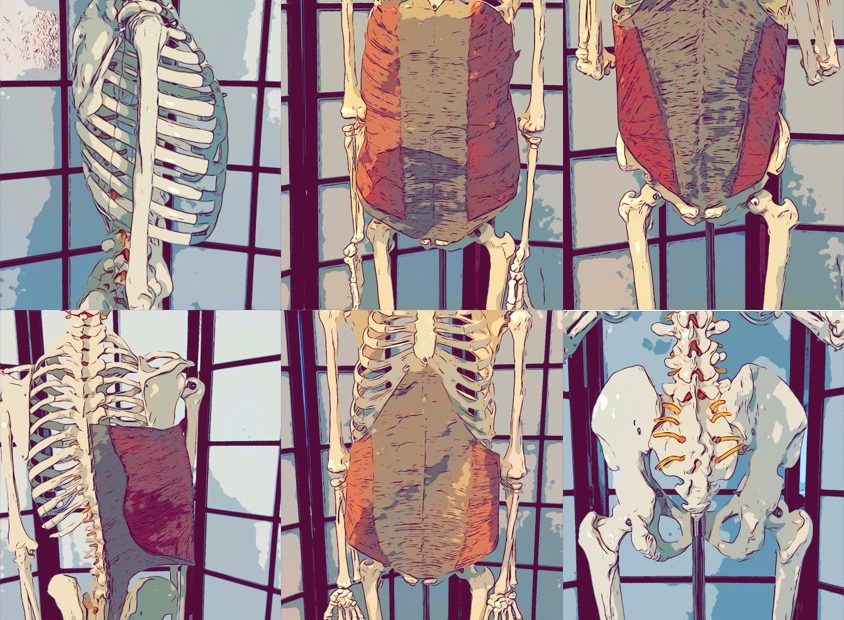
The External and Internal Obliques rotate the vertebrae with assistance from two other central muscles. Keep in mind that the Obliques are pairs of muscles – there is a right and a left muscle in both. Simultaneous contraction of the right (or left) side External Oblique and the opposite side Internal Oblique causes rotation of the thoracic vertebrae to the opposite side. The opposite side Transversus and Lat are also involved in this rotation – these muscles are also pairs of muscles with a right and left muscle.
The beauty of the body is that not only are these muscles causing rotation, but they are also still involved in stabilization if we use them to their capacity. They are stabilizing and moving the vertebrae at the same time. The Lats assist with rotation, but the Externals and the Lats are still interlocked and still stabilizing the rib cage barrel on the vertebrae. Transversus assists with rotation, but it is still stabilizing the pelvic barrel on the sacrum. And the two Obliques are still stabilizing the lumbar vertebrae and the sacrum.
This combination is in 8 counts and stays in rotated first position:
Hands to the temples on 1 – get the rib cage barrel down to get the hands up.
Rotation on 2.
Plié on 3 and 4.
Arm drops and swings up on 5 – get the rib cage barrel down to get the arm up.
Arm drops and swings up on 6 – get the rib cage barrel down to get the arm up.
Relevé on 7 – get the two joints down (neutral) to get up into relevé.
Lower on 8.
Focus on your 33 vertebrae. The “get down to get up” is really happening at the vertebrae. Finding alignment of the rib cage barrel at the thoracic vertebrae while they are rotating requires real awareness. Finding the neutrality of the 2 joints in rotation also requires real awareness. You will have a hard time maintaining a stable rib cage barrel or pelvic barrel while you are moving if you are not neutral in the two joints. The vertebrae are the key.