
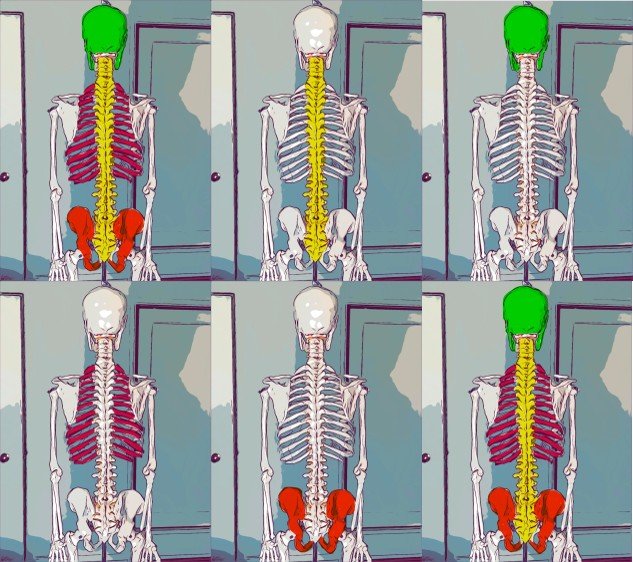
In this tutorial, we’re going to do a simple combination I call 33-2-7-1 in 4 that requires us to maintain alignment of the central bones by using the central muscles as stabilizers. This tutorial builds on the tutorials about finding alignment of the central bones at the vertebrae and the tutorials about the basics of using the seven central muscles.
This combination tests our ability to maintain 33 neutral vertebrae while we move forward and back onto one leg, moving both arms and the other leg. It is designed to make us use all seven central muscles to stabilize the bones in their alignment.
I’ve incorporated the imaginary grab bar into this combination. Once we start using the arms, it’s easy to destabilize the thoracic vertebrae (the rib cage barrel), which can destabilize the lumbar vertebrae and sacrum (the pelvic barrel). Remember, the purpose of the imaginary bar is to help us use the connection between the Lats and the External Obliques and the Pec Majors and the Externals:
– The muscle fibers of the Lats and the Externals interlock at ribs 9-12, which anchors the rib cage barrel – a neutral thoracolumbar joint means a stable rib cage barrel
– One of the places the Pec Majors originate is at the top of the aponeurosis of the Externals – the Pec Majors connect to the aponeurosis of the Externals at around ribs 5 or 6, which anchors the Pec Majors down into the pelvic barrel – a neutral lumbosacral joint means a stable pelvic barrel
In this combination, we:
Align all 33 vertebrae.
Keep the 2 joints (thoracolumbar and lumbosacral) neutral.
Use all 7 central muscles.
Step onto 1 leg (fully shift your weight).
Move in 4 counts of continuous movement.
Focus on your 33 vertebrae. This combination is not about the height of your legs or the shape of your feet. It’s about awareness of your 33 vertebrae in their anatomical curves and the neutrality of the 2 joints. It is designed to make you use all 7 central muscles to stabilize the bones in their alignment. Moving the arms down as the leg comes up helps you do this, but you won’t be able to successfully shift your weight onto 1 leg and immediately move your arms and the other leg unless your vertebrae are neutral and you’re using all 7 muscles. Move slowly in 4 counts so you can maintain a physical awareness of your 33 vertebrae. The vertebrae are the key.
Use this combination to help you find the sensation of 33 neutral vertebrae supported by 7 muscles. Our goal is to be able to quickly identify this feeling when we are dancing. Work for this feeling in your class at every opportunity.