
This tutorial is about the basics of using the Pectoralis Majors as vertebrae stabilizers in our dance technique. The Pec Majors are the last of the seven muscles central to our alignment. Although the Pec Majors are not attached to the vertebrae – they have no origination or insertion at the vertebrae – our use of the Pec Majors when we dance can either stabilize or destabilize the vertebrae.
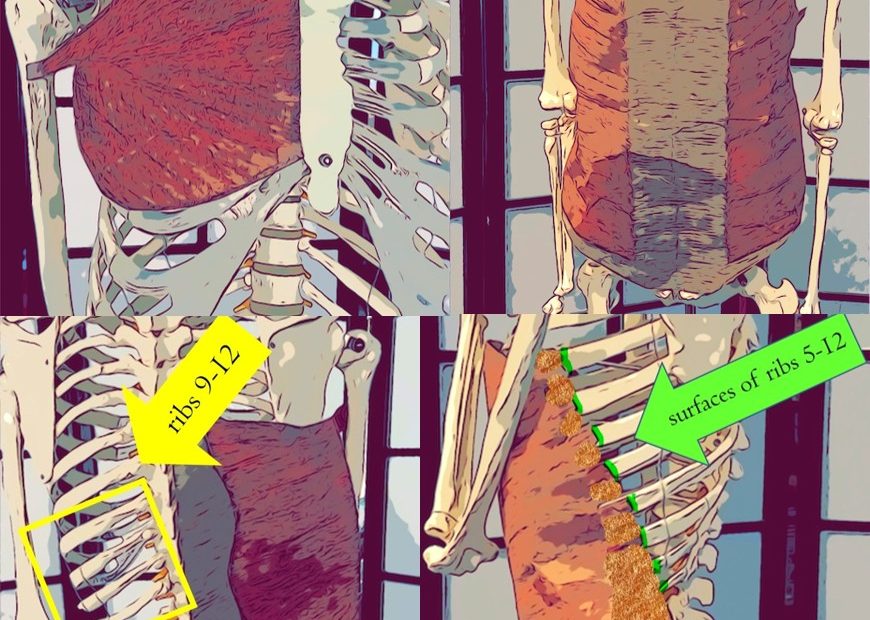
The Pec Majors stabilize the bones in what’s called the chest wall, which includes vital organs like the heart and the lungs. The bones in the chest wall are the rib cage barrel and the thoracic vertebrae. Just as the Lats and the Externals interlock to create huge stabilization for the rib cage barrel (and, thus, the thoracic vertebrae), the Pec Majors’ origination at the aponeurosis of the Externals means that the Externals are an anchor for the Pec Majors and contribute to stabilization.
There are two ways the Pec Majors can destabilize the vertebrae. One is during inhalation because the Pec Majors lift the rib cage barrel. Take a deep breath and feel what happens to the vertebrae. The other is overzealous contraction of the Pec Majors, which essentially collapses the rib cage barrel in on itself. This collapse takes the thoracic vertebrae out of their anatomical curve. Round your shoulders and feel what happens to the vertebrae.
So, the trick with the Pec Majors is finding a balanced contraction that stabilizes the vertebrae and allows the rib cage barrel to remain wide and open at the sternum and the collar bones.
Using the same exercise we did in the tutorial about the basics of using the Lats, we can now add the Pec Majors:
- Stand in parallel first position.
- Find the anatomical curves of your 33 vertebrae.
- Raise your arms up on a slight diagonal and keep your elbows slightly bent. Pretend that you are wrapping your hands around a bar that you are holding above your head.
- Be aware of and maintain the anatomical curves of your 33 vertebrae. Inhale.
- Exhale and contract the Pec Majors, Externals, and the Lats as you slowly bring the bar down until your hands are in line with your shoulders.
- Feel the rib cage barrel compress and move down, as you expel air by exhaling.
- Check your anatomical curves and correct your alignment of the rib cage barrel at the vertebrae if you need to.
- Stay in contraction and let your arms drop to your sides. This is what it feels like to use the Pec Majors, Externals, and the Lats to stabilize the vertebrae and the rib cage barrel.
- Notice the sensation at the lower ribs, just above the lumbar vertebrae.
- Notice the sensation at the lower ribs, just below the sternum.
- Notice the openness and width of the upper body that a balanced contraction allows.
Using the Pec Majors, Externals, and the Lats to stabilize the thoracic vertebrae and the rib cage barrel will help us maintain a neutral thoracolumbar joint, which will help us maintain our anatomical curves in the 33 vertebrae.