
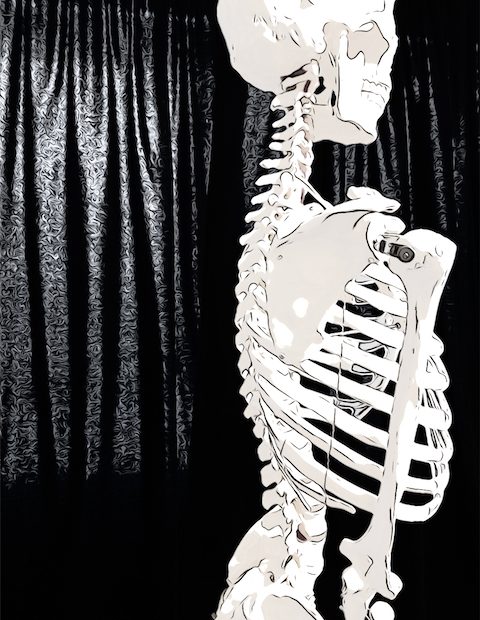
Welcome to the Third Shift Movement Shop, home of Literal Technique, where we work so we can move. And welcome to Installment No. 10 of The Central Geekdom of Dance Technique, “Movement of the Arm: The Humerus, The Collar Bone, The Scapula, & The Sternum.”
The bones we use for the movement of the arm add a layer of complexity to finding alignment and at rest. The skull and the rib cage barrel connect to the spinal column, but they do so in a fairly straightforward way – the skull sits on top and the rib cage barrel attaches to the thoracic vertebrae. Movement of the arm involves four bones that are connected to each other but are almost entirely independent of the larger skeleton, making their alignment and at rest more difficult to understand and accomplish. Grasping the movement of the arm will help us take our fifth step toward a fusion body.
What Happens Where
Movement of the arm happens at the shoulder bones, otherwise known as the humerus, the collar bone, and the scapula. The humerus and the scapula make the ball and socket shoulder joint. The collar bone and the scapula have a bone-to-bone connection. You cannot move the collar bone without moving the scapula, or vice versa, which means you are also moving the humerus.
Movement of the arm also happens at the shoulder girdle, otherwise known as the collar bones, the scapulae, and the manubrium bone of the sternum. The shoulder girdle inherently includes the shoulder bones because the humerus comes along as part of the shoulder joint formed with the scapula.
The shoulder joint connects the humerus to the shoulder girdle; the shoulder girdle connects the humerus to the larger skeleton.
To keep this relationship in the forefront of our understanding of arm movement, Literal Technique collectively refers to the shoulder bones and the shoulder girdle as the arm bones. When we move the arm, direct muscle effort from our group of 12 muscles comes from the Latissimus Dorsi, the Pectoralis Major, the Transversus Abdominis, the Rectus Abdominis, and the Internal and External Obliques. When we factor in the bone and muscle attachments, we see that the arm is connected to the rib cage barrel, the spinal column, the pelvis, and the femur, which requires muscle effort from the other six muscles. You can see that movement of the arm is not just about the humerus.
Geeky Glory
The anatomy of the arm bones is multi-faceted, so let’s take it in three steps.
First step: the shoulder bones are the humerus, the collar bone, the scapula:

The humerus is the largest and longest bone in your arm. It runs from the shoulder joint to the elbow. The head of the humerus fits into the socket in the scapula to form the glenohumeral joint, or the ball and socket shoulder joint. The ball is the head of the humerus; the socket, called the glenoid cavity, is part of the scapula.
The collar bone is a horizontal, S-shaped bone that has bone attachments to the top of the sternum and to the acromion bone of the scapula. It braces the shoulder by transferring weight from the arms to the axial skeleton.
The scapula (the shoulder blade), is a triangular, flat bone that lies on top of the rib cage, overlying ribs 2-6 or 2-7. Its only bone-to-bone attachment is with the collar bone. The side of the scapula closest to the spinal column is not directly attached to the spinal column or the rib cage; it is held in place by muscle, so it floats on top of the rib cage. This lets the humerus move with the scapula and gives the humerus a wide range of motion at the shoulder joint, wider than the femur has at the hip joint.
Second step: two of the shoulder bones are part of the shoulder girdle:

The shoulder girdle is made up of the manubrium bone of the sternum, the collar bones, and the scapulae. The collar bones’ attachment to the sternum and the scapulae attaches the shoulder bones to the rib cage barrel. This is the only bone attachment the shoulder bones have to the larger skeleton. The girdle functions as the anchor that attaches the arms to the axial skeleton.
Third step: there are three joints in the shoulder girdle that connect its three bones to each other:
The sternoclavicular joint (SC joint) connects the sternum and the collar bone.
The acromioclavicular joint (AC joint) connects the scapula and the collar bone.

The scapulothoracic joint (ST joint) connects the scapula and the rib cage, although it is not a formal joint, but an articulation.

Because of the bone connections, movement of the scapula moves the SC joint, the AC joint, or both. In other words, the SC, AC, and ST joints are interdependent. The humerus, as part of the shoulder joint, comes along for the ride.
Technique Fundamentals
Existing technique tends to do two things: separate alignment of the arm bones from the movement of the arm and separate the arm bones from each other. In many instances, the technique of moving the arm is replaced with solving the common problem of “keeping the shoulders down,” which attempts to correct the position of the scapulae in space, not in relation to anatomy.
Although we may be able to move the scapulae toward or away from each other, and up and down, the anatomy tells us that the scapulae do not move independently from the other arm bones. If the scapulae are misaligned, so are the collar bones and the humeri, so singling out the scapulae does us no good. Focusing on the scapulae also leaves out the rest of the shoulder girdle. Most importantly, though, it forces our focus away from the larger technique of movement of the arm, which is directly related to movement and alignment of the spinal column through the arm bones’ connection to the rib cage barrel.
Technique Building Blocks. Rather than separating the “arm” and the “shoulder” into two small, confined areas, Literal Technique says that the technique of moving the arm is found in the anatomy of the shoulder girdle. Here are the building blocks of our technique:
The joints that connect the bones of the shoulder girdle create a 360° reality in the body.

The collar bones’ attachment to both the sternum and the scapulae attaches the shoulder bones to the rib cage barrel. As an overall concept, if alignment of the rib cage barrel is found in the alignment of the spinal column, then, by extension, so is the alignment of the arm bones.

We have a precise way to find stabilization and alignment of the shoulder girdle because the 360° reality of the arm bones coincides with the 360° reality of the rib cage barrel like this:
- The shoulder girdle’s only attachment to the rib cage barrel is at the manubrium of the sternum. This bone articulates with ribs 1-2, which connects alignment and at rest to T1-T2.
- The scapulae overlie ribs 2-6 or 2-7 (rib 7 is at the bottom of the sternum), which connects alignment and at rest to ~T2-T7.
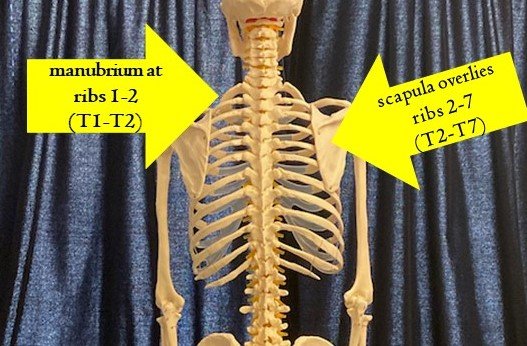
So, finding alignment of the arm bones is not as amorphous as “keeping the shoulders down” – when the smoke clears, the alignment of the arm bones happens in relation to the spinal column, specifically, T1-T7. Like the skull and the rib cage barrel, once again, our common denominator is the spinal column.
Two 360° Realities. Literal Technique identifies two 360° realities – two barrels – in the upper body. This is how the technique of moving the arm adds a layer of complexity to finding alignment and at rest. The movement of the arm bones is relatively independent from the larger skeleton, but their alignment is found in relation to the spinal column’s. The rib cage barrel’s movement and alignment, on the other hand, is completely dependent on the spinal column’s. The proximity and overlap of these two barrels will create real confusion about alignment unless you can feel both the connection and the difference between the two.
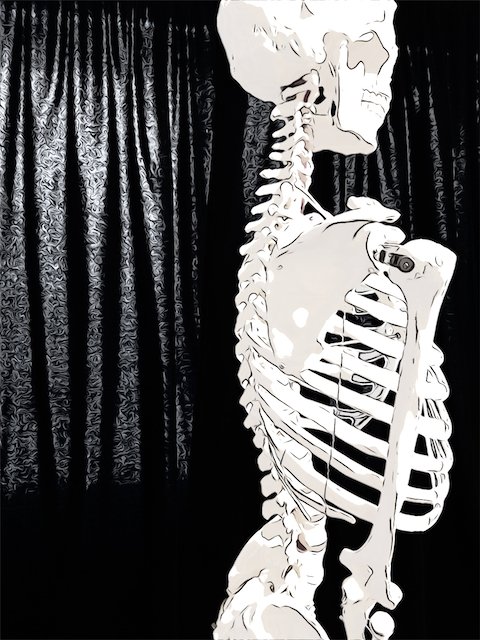
We will talk about the muscles in our group of 12 that move the arm, but this is our bone starting point. Finding the shared alignment of the arm bones and the rib cage barrel when we rotate, adduct, or abduct the humerus in the socket will open up freedom in the upper body. This is true whether we are moving the arms when we are standing, moving off upright, moving in and out of the floor, or supporting our weight on our hands.
From the standpoint of a fusion body, the relationship between the arm bones and the rib cage barrel provides a technique of arm movement that is connected to itself and the rest of the body – not a front and a back, but a three-dimensional body: bone connected to bone, connecting the arms to the spinal column and, ultimately, the pelvic barrel.
Play around with what happens to the arm bones and the rib cage barrel when you move an anatomically-curved spine as one structure with 33 vertebrae. How do you move the arms?
Next installment: The Latissimi Dorsi
Installment No. 6: The Spinal Column
Installment No. 8: The Rib Cage
Photos credit: Jill Redfern
You can send comments and questions to Jill at info@thirdshiftmovementshop.com. Please subscribe to the Third Shift’s YouTube channel and follow the Third Shift on Facebook.