
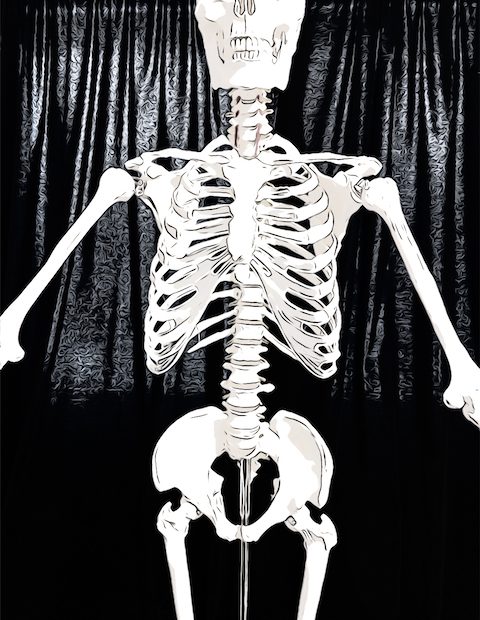
Welcome to the Third Shift Movement Shop, home of Literal Technique, where we work so we can move. And welcome to Installment No. 8 of The Central Geekdom of Dance Technique, “The Rib Cage.”
In Installment No. 7, we learned that it is impossible to separate the alignment of the skull from the alignment of the spinal column. In this installment, Literal Technique shows us a similar relationship between the rib cage and the spinal column. (Learn about the Spinal Column in Installment No. 6.) Mark this as our third step toward a fusion body.
What Happens Where
Movement of the rib cage barrel happens at the thoracic vertebrae. When we move the thoracic vertebrae, the rib cage barrel moves. When we rotate, flex, curve, or extend the thoracic vertebrae, we move the rib cage barrel.
Because its connection to the thoracic vertebrae is fixed, the rib cage barrel is stabilized or moved by the muscles that stabilize or move the spinal column. In our group of 12, direct muscle effort comes from the Erector Spinae, the Latissimus Dorsi, the Pectoralis Major, the Transversus Abdominis, the Rectus Abdominis, and the Internal and External Obliques.
As we move toward understanding a fusion body, when we factor in other bone and muscle attachments, the rib cage barrel is also connected to the collar bones, the scapulae, and the humeri (the shoulder bones); the pelvic barrel; and the femur.
Connection to the pelvic barrel and the femur means that the Psoas, the Glutei Maximi, the Hamstrings, the Adductors, and the Quadriceps Femoris can impact the neutrality of the rib cage barrel – the Psoas, because it connects the spinal column to the femur at the lumbar vertebrae, and the others, because they all connect to the femur and to the pelvic barrel, which connects to the spinal column at the sacrum.
The common denominator, then, is the spinal column.
Geeky Glory
The rib cage is made up of the 12 thoracic vertebrae, 12 pairs of ribs and their costal cartilages, and the sternum. (For information about the thoracic vertebrae, take a look at Installment No. 6, The Spinal Column.)
The ribs are connected to the thoracic vertebrae such that the first rib is at T1, the second rib at T2, etc., ending with the twelfth rib at T12.
The first seven pair of ribs attach directly to the sternum by their costal cartilage.
The eighth, ninth, and tenth pair of ribs and their costal cartilages connect to the sternum by connecting to the cartilage of the rib directly above them: the cartilage of rib 10 connects to the cartilage of rib 9; the cartilage of rib 9 connects to the cartilage of rib 8; and the cartilage of rib 8 connects to the cartilage of rib 7, which connects to the sternum.
The eleventh and twelfth pair of ribs are the floating ribs; they are connected to the vertebrae but not to the sternum.
The sternum is comprised of three bones:
Depending on how you count them, the manubrium has five or six sides. It is the widest and thickest of the three bones of the sternum. The manubrium articulates with the collar bones, the body of the sternum, and ribs 1-2. The bony notch you feel between the collar bones is the top of the manubrium and it’s called the suprasternal notch.
The body of the sternum is longer and narrower than the manubrium. It is located opposite thoracic vertebrae T5-T9, and articulates with ribs 3-7.
The xiphoid process is the tip of the sternum and is usually pointed. It is the smallest of the three bones and lies opposite T10.
Technique Fundamentals
Literal Technique refers to the rib cage as a “barrel”; rib cage barrel means the thoracic-vertebrae-rib-cage-sternum barrel.
Existing technique splits the rib cage into two halves – the rib cage in “front” and the rib cage in “back” – and it doesn’t talk about the back half very often. The rib cage, however, is a 360° structure – a barrel – not a front and back half of something. Thinking about the rib cage in front and back “parts” is another example of dance technique taking its cue from dissected, two-dimensional anatomy.
Literal Technique recognizes that the rib cage is a 360° structure – a thoracic-vertebrae-rib-cage-sternum barrel. It also recognizes that the rib cage and sternum move because the thoracic vertebrae move. . . . If the rib cage is doing something we don’t want it to do, we must look to the alignment of the spinal column.
Alignment of the rib cage barrel is typically thought of relative to space. For example, a correction to “drop the rib cage” makes no mention of the thoracic vertebrae – it focuses on the front half of the rib cage and its relation to space (up or down). A correction to “knit the rib cage together” also focuses on the front half of the rib cage in relation to some part of itself in space. You can see that these kinds of corrections leave out the spinal column entirely, as well as the three-dimensional nature of the body.
Literal Technique recognizes that the rib cage is a 360° structure – a thoracic-vertebrae-rib-cage-sternum barrel. It also recognizes that the rib cage and sternum move because the thoracic vertebrae move. The rib cage and sternum do not move – the thoracic vertebrae move and the rib cage and sternum come along for the ride.
So, our starting point for the neutrality of the rib cage is its connection to the thoracic vertebrae. From the standpoint of dance technique, the rib cage and sternum cannot be out of alignment. If the rib cage is doing something we don’t want it to do, we must look to the alignment of the spinal column. (In a lot of cases, the extension of the spinal column above and below T12 is the cause of rib cage barrel misalignment.) So, ultimately, in Literal Technique, any question about alignment of the rib cage barrel becomes one about stabilization and movement of the spinal column.
When you move, keep the 360° thoracic-vertebrae-rib-cage-sternum reality in mind. Learning to feel when the rib cage barrel is at rest is about learning to feel the vertebrae. Learning to move a fusion body means learning to move the rib cage barrel as part of the spinal column.
We will talk about the muscles that stabilize and move the rib cage barrel in the installments that follow, but this is our bone starting point. For now, play around with what happens to the rib cage barrel when you move an anatomically-curved spine as one structure with 33 vertebrae. Where does correction of your alignment happen? Add the skull – how does it feel to move the skull and the rib cage barrel, at the same time, from the vertebrae?
Next installment: The Erector Spinae.
Photo credit: Jill Redfern
You can send comments and questions to Jill at info@thirdshiftmovementshop.com. Please subscribe to the Third Shift’s YouTube channel and follow the Third Shift on Facebook.