
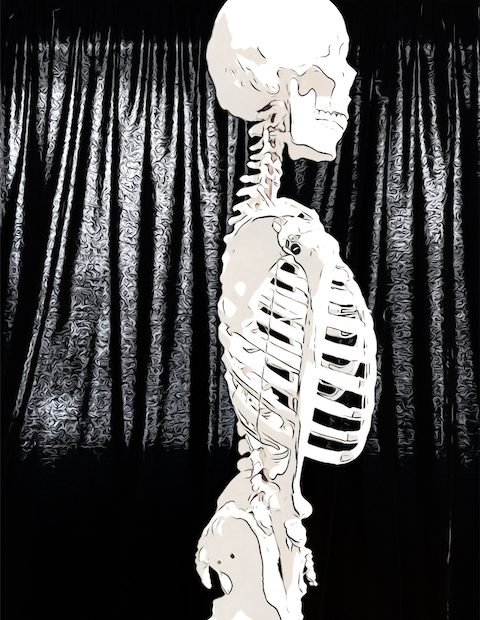
Welcome to the Third Shift Movement Shop, home of Literal Technique, where we work so we can move. And welcome to Installment No. 6 of The Central Geekdom of Dance Technique, “The Spinal Column.”
This installment marks our entrance into geeky world of the literal body, where I explain, one by one, the “what happens where” of the bones and the 12 muscles; show you what the bones and the 12 muscles look like, literally; and discuss the technique fundamentals that move us toward a fusion body. The installment for each bone and muscle will be broken into three sections – What Happens Where, Geeky Glory, and Technique Fundamentals – so that you can begin to understand and apply the concepts of Literal Technique. You can find a list of the bones and muscles at Literal Technique.
I’ve decided to start with the spinal column and work my way from there. Here we go!
What Happens Where
Movement of the spinal column happens at the vertebrae. When we flex, extend, or rotate the spine, we are flexing, extending, and rotating the vertebrae. It is possible to move some of the vertebrae and while we stabilize others, or move all of the vertebrae at once. Logically, this means that muscle effort along the length of the spinal column is not uniform.
The spinal column is one structure with 33 vertebrae, and the vertebrae are designed to move jointly but differently. This one structure is stabilized/moved with simultaneously different muscle effort from all of the 12 muscles – the Erector Spinae, the Latissimus Dorsi, the Pectoralis Major, the Transversus Abdominis, the Rectus Abdominis, the Internal and External Obliques, the Psoas, the Glutei Maximi, the Hamstrings, the Adductors, and the Quadriceps Femoris. All 12 muscles are involved because the movement of the spinal column impacts the skull, the shoulder bones, the rib cage barrel, the pelvic barrel, and the femur.
The ability to move the vertebrae jointly but differently requires acute awareness of muscle.
The Geeky Glory
Understanding the neutrality of the spinal column begins with knowing what it looks like. The established method of talking about the spinal column divides it into regions (cervical, thoracic, lumbar, sacral, and tailbone), with each region having a specific number of vertebrae; this is useful when we are learning the anatomy.
The vertebrae are conventionally referred to by a letter that corresponds to these regions (C for cervical, T for thoracic, L for lumbar, and S for sacral) and a number for their respective vertebra. The numbers start at one and ascend as we move away from the skull and toward the tailbone. For example, the first thoracic vertebra, which is connected to the first rib, is called T1 and the last thoracic vertebra, at the last rib (closest to the lumbar spine), is called T12.
We will start at the skull and work our way to the tailbone:
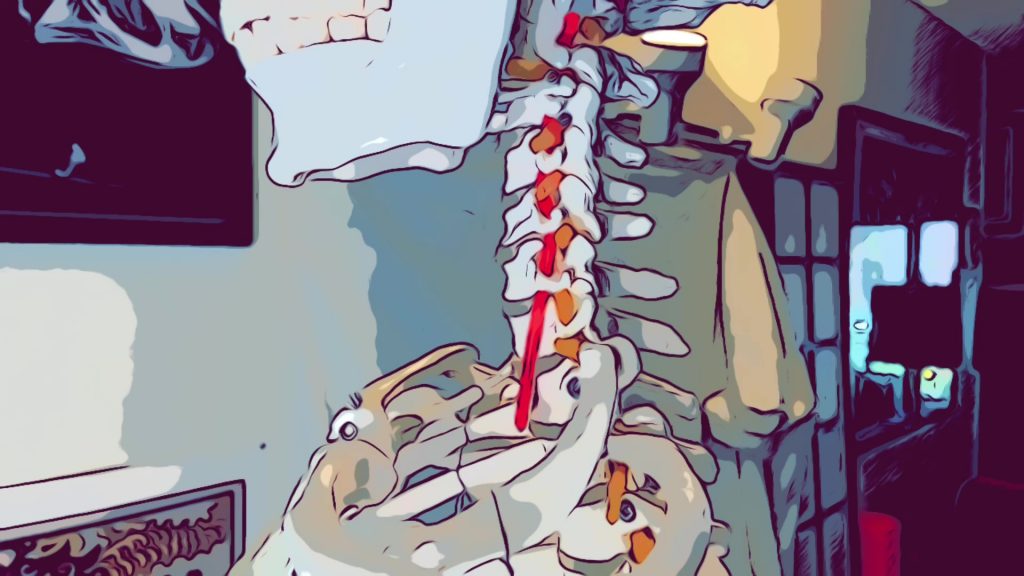
The cervical spine has seven vertebrae. It is inside the neck. The cervical spine has an anatomical curve of ~20-35° into the body (lordosis). The cervical vertebrae flex (~45°), extend (~70°), and rotate (~80°). The skull has a bone-to-bone connection to the spinal column at C1.
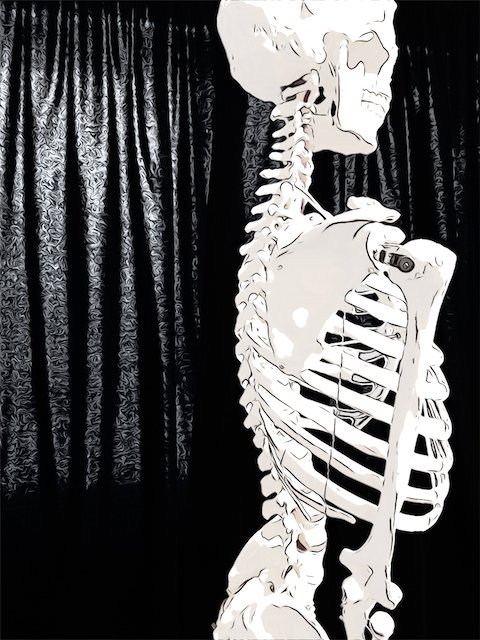
The thoracic spine has 12 vertebrae. It is inside the upper and middle back and spans the length of the rib cage. The thoracic spine’s anatomical curve creates a flexion of ~40° (kyphosis). These vertebrae flex (~35°, in addition to the anatomical flexion), extend (~25°), and rotate (~30°). For the thoracic vertebrae, extension, in many cases, amounts to less anatomical flexion. The rib cage barrel has a bone-to-bone connection to the thoracic vertebrae.
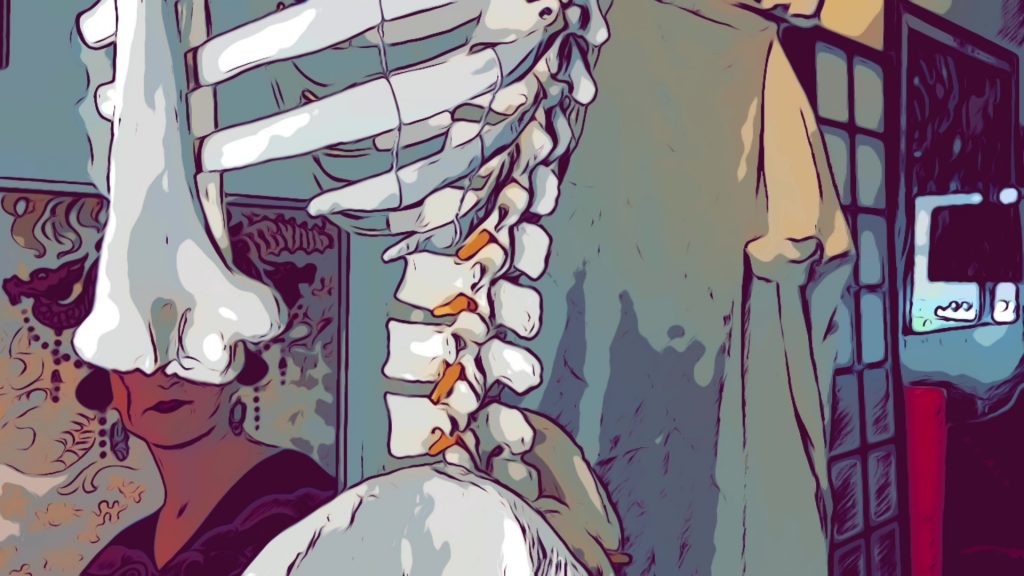
The lumbar spine has five vertebrae and it is inside the lower back. It has an anatomical curve of ~40-60° into the body (lordosis). The lumbar vertebrae flex, which reduces the amount of anatomical curve into the body (~60°); flex to the side (~25°); extend (~25°); and rotate (~10°).
The sacrum, made up of the five fused vertebrae just below the lumbar vertebrae, and the tailbone, made up of four fused vertebrae just below the sacrum, are also part of the spinal column. Both have a fused kyphosis. The pelvic barrel attaches to the spinal column at the sacrum.
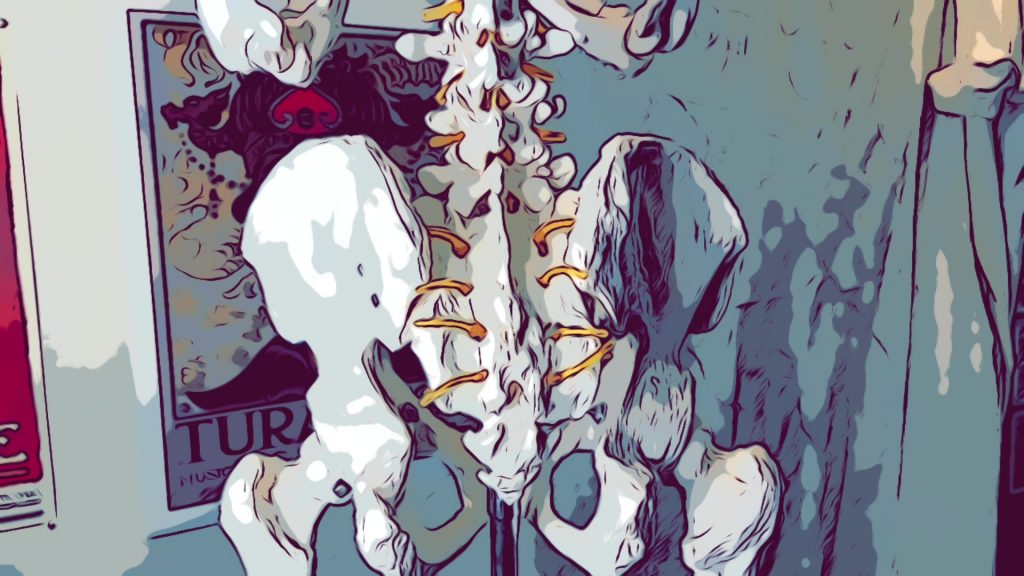
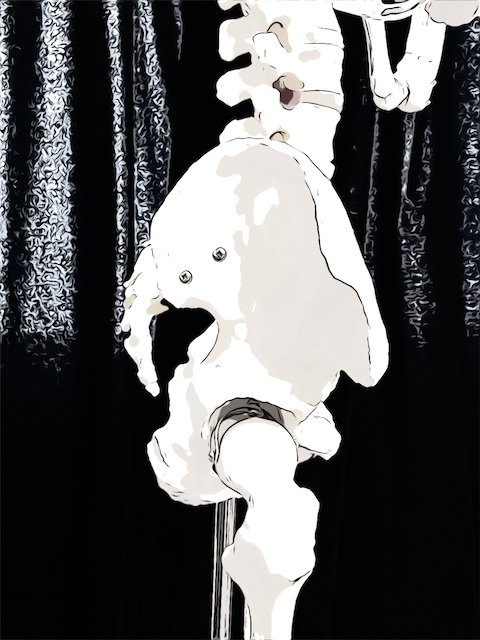
The meeting point of L5 and S1 forms the lumbosacral joint, which connects the lumbar spine to the sacrum; here, the anatomical curve of the vertebrae shifts from lordotic (lumbar) to kyphotic (sacrum). When the lumbar vertebrae flex, the sacrum and tailbone extend (curve under). When the lumbar vertebrae extend, the sacrum and tailbone flex (tilt up).
Including the sacrum and the tailbone, there are 33 vertebrae in the spinal column.
If, when we move, we separate the vertebrae into cervical, thoracic, lumbar, sacral, and tailbone in our minds, we eliminate the wholeness of the central support of the body . . . . The job of dance training is to help us learn how to find this wholeness; maintain the spinal column’s anatomical curves; and move the vertebrae in and out of at-rest.
Technique Fundamentals
Alignment of the spinal column has to be one of the more difficult aspects of dance training. We are generally taught to think of the spinal column in parts and to align it in parts (this division provides a good example of how of dance training takes its cue from two-dimensional, on-paper anatomy). Because the spine is not straight, using images of verticality muddies our understanding of how to align it. The image of the “S” curve is confusing, especially because there are multiple definitions of what it is.
You can see from the anatomy why someone decided to divide the spine into regions, but, from the standpoint of technique (and reality), the spine is one structure with 33 vertebrae that move jointly but differently. If, when we move, we separate the vertebrae into cervical, thoracic, lumbar, sacral, and tailbone in our minds, we eliminate the wholeness of the central support of the body. Because of the bone connections and the overlap of muscle, learning to move the wholeness of the spinal column will change the way we move the body and, thus, the body’s expression.
The job of dance training is to help us learn how to find this wholeness; maintain the spinal column’s anatomical curves; and move the vertebrae in and out of at-rest. So, in Literal Technique, I stop using an on-paper idea of the spinal column and make our starting point for an at-rest spine the actual spine: an anatomically-curved structure with 33 vertebrae that are designed to act jointly but differently. We will talk about the muscles we use to stabilize and move the spinal column (the vertebrae) in the installments that follow, but this is our bone starting point.
Really looking at and understanding the vertebrae makes it clear that the spinal column has an amazing capacity for movement. This is exciting for us as dancers. If you do not understand what the spinal column looks like and how the vertebrae move, however, it will be impossible to learn the technique of moving them with muscle. For now, your task is to take a good look at the spinal column, then play around with feeling and moving an anatomically-curved spinal column as one structure with 33 vertebrae.
Next installment: The Skull.
Photos credit: Jill Redfern
You can send comments and questions to Jill at info@thirdshiftmovementshop.com. Please subscribe to the Third Shift’s YouTube channel and follow the Third Shift on Facebook.